Readers questioning comforting cultural platitudes & easy answers, people processing sudden life upheavals or unexpected loss, writers and thinkers exploring personal agency versus fate, & anyone seeking comfort in the chaos.
I think it is safe to say we have all reached for it when the Earth crumbles under us, that familiar linguistic reflex meant to stitch up a wound before we have the time to look at it. Someone experiences a sudden upheaval, a figurative door slams shut in our face, or a foundational piece of our life fractures, and out slips the platitude: Everything happens for a reason.
It feels like safety. It brings the promise that somewhere, in some invisible ledger, the math will still work out in our favor.
However when you sit with that phrase long enough, it starts to curdle. It asks us to believe in a meticulous, heavy-handed architect scripting every heartbreak and roadblock just to teach us a personal lesson. Then it trades our actual resilience for a comforting myth, suggesting that pain is a mandatory prerequisite for worth. The truth is far less tidy, and infinitely more liberating.
The Weight of the Platitude:
I’m almost positive we have all heard it, and if we are being entirely honest, most of us have probably said it when we ran out of other things to offer. Someone experiences a sudden upheaval, a door slams shut in their face, or a foundational piece of their life fractures, and out slips the reflex: Everything happens for a reason.
I feel like this is typically used as a bandage; much like the words I am sorry when they come without any changed behavior. This is a linguistic reflex designed to soothe the raw edges of grief or confusion by promising that somewhere, in some invisible ledger, the math still works out. When you stop and stare at that phrase long enough, it starts to curdle.
This phrase implies an architect meticulously scripting every car crash, every late-night phone call, every cruel twist of geography, and every preventable tragedy just to teach a handful of mortals a personal growth lesson. To me that is not comforting, but is a cosmic exhaustion.
To live authentically, we have to look past the lazy platitude and separate the comforting myth of destiny from the gritty, mechanical reality of how the world actually spins.
Cause, Effect, & the Indifference of Physics:
At its most basic level, the universe operates on a relentless chain of cause and effect. To put it simply when we drop a glass it shatters because of gravity and molecular structure, not because the kitchen floor needed a lesson in impermanence.
When people conflate mechanical causality with a grand design, they are committing a fundamental category error. Things happen because:
tectonic plates shift
economies fluctuate
human beings are flawed & impulsive
probability is a chaotic game
The universe is largely indifferent to our comfort, our timelines, and our designs.
When a storm knocks out power to an entire region, it does not check whose birthday it is or who is desperately waiting on an important email. It just blows through. Pretending that every random variable in existence is secretly a targeted message meant exclusively for you requires a staggering amount of self-centered delusion.
Yet, we cling to it. Why? Because the alternative is facing the painful, unvarnished truth that the universe is largely chaotic and indifferent… is terrifying.
Most people would rather believe an invisible hand is steering the wheel, even if that hand is occasionally driving us off a cliff, than accept that nobody is driving at all.
The Trap of Retroactive Storytelling:
Human beings are narrative engines. We are wired to find patterns, to connect dots, and to draw straight lines through scattered plots. Yes, even when those lines are entirely imaginary.
This becomes painfully clear when we look at how people process our hardest chapters. When something devastating happens, we rarely see the reason in real time. We are too busy treading water, trying to keep our lungs clear of salt and panic.
Then years later, after we have found our footing again, our brains perform a neat little magic trick. We look backward, trace the wreckage, and say, I had to go through that exact hell so I could end up right here.
That is retroactive meaning-making. It is a survival mechanism, not a metaphysical truth.
We survive despite the things that break us, rarely because they were meant to move us along. If you take a jagged detour because a bridge collapsed, you might eventually discover a gorgeous hidden overlook you never would have seen otherwise. However, that does not mean the bridge collapsed so you could find the view. The bridge collapsed because of poor maintenance or bad weather. The view was just a patch of grass you happened to stumble onto while trying not to get lost.
Pretending every scar was a necessary blueprint strips away our actual resilience.
While it also suggests the pain was mandatory, rather than acknowledging that we simply clawed our way through a mess and refused to let it bury us.
Shifting the Burden from Fate to Agency:
If we strip away the illusion of cosmic scriptwriting, where does that leave us?
Does life become meaningless?
Not at all, in fact, letting go of the idea that “everything happens for a reason” is one of the most liberating shifts a person can make, because it moves the burden of meaning from the event to the response.
Things do not happen for a reason. They just happen. We still have the profound, terrifying power to give them a reason.
There is a vast chasm of difference between passive acceptance and active construction. Passive acceptance says, I guess this heartbreak or this roadblock was meant for me, so I will sit here and take it.
Active construction says, This situation is entirely devoid of inherent meaning, but I am alive, and I refuse to let random chaos have the final word on who I am.
When a plan falls apart, you are not being redirected by a benevolent cosmic GPS. You are just standing in an unexpected clearing. What you do next, how you pick up your gear, adjust your map, and decide to walk forward… is entirely up to you.
We spend so much time waiting for the universe to explain itself, waiting for the punchline or the lesson to reveal itself in the rearview mirror.
We never notice that the universe doesn’t owe us an explanation, and it certainly isn’t writing a redemption arc for our lives. We have to pick up the pen ourselves.
We are not characters in a predetermined story. We are the authors, writing in the margins of a wild, chaotic world, turning accidental noise into deliberate art.
Comfort in the Chaos:
When we finally strip away the illusion of cosmic scriptwriting, life doesn’t lose its depth. In fact it actually becomes entirely our own to do with and deal with how we feel best.
Letting go of the idea that a grand plan dictates every stumble frees us from waiting on an indifferent universe to explain its wreckage. Things do not happen for a reason; they simply happen through the raw mechanics of probability, human choice, and unpredictable weather.
When we are left standing in that unexpected clearing, we realize the burden of meaning was never meant to rest on fate. It rests on us. We have the profound power to give our experiences a purpose through the grit of our response, refusing to let random chaos have the final word.
When we stop looking backward for a hidden blueprint and start picking up the pen, writing our own deliberate art in the wild, unscripted margins of the world.
Hikers who enjoy educational trails, dog-friendly wandering, environmental oddity enthusiasts, & individuals who enjoy Ohio parks .
The Essence:
Read Time: ⏰ 12 to 15 minutes | Weight: 🌿 Medium| Mood: 🔎 Curious, Playful, & Reflective thought Slightly Irritated
Trail Notes:
The Trek- a roughly 2.7 mile trek over two & a half hours at Wolfe Run Regional Park on June 3rd 2026
Unique trail bonuses & park features found at Wolfe Run Regional Park
The nature preserve with-in the regional park
An affirmation by way of a sticker left in a port-a-John
Attention Deficit how neurodivergence effects me on trail
Controlled Hunting in Recreational Areas
Wolf Run Regional Park
Knox County, Ohio
I Came Looking for:
Luna and I got to the trailhead around 9:30 in the morning on June 3rd, 2026. I parked my car near the bouldering area at Wolf Run Regional Park just outside of Mount Vernon, Ohio. We managed to cover approximately 2.7 miles in about two and a half hours.
I know that calling this an efficient hiking pace would be an outright lie. I spent a lot of my time here goofing off with my dog.
Wolf Run Regional Park has ten miles of nature trails. Which includes a Storybook Trail, a Litter Trail, a children’s bouldering area, a Bark Park, and a separate but included state nature preserve. If all of this inside one park wasn’t enough there is also a pond with a viewing deck, picnic tables, and a natural-based play area.
Wolfe Run Regional Park offers a great deal of options for a park that, at least by map, didn’t initially look like it would be quite as interesting as it turned out to be.
First Impressions:
The first thing I noticed when I got out of the car was the children’s bouldering area.
Which for a rock & nature lover was not a bad first impression. Although, it’s not made of natural material it provides a unique and fun opportunity for children to interact with green areas.
The second thing I noticed was the gravel.
A lot of the gravel-type stones around the parking lot had a sparkle to them when the sunlight caught them just right, which prompted me to stop and look closer.
The third thing I noticed was the dog park.
Wolf Run has a Bark Park where dogs can get some off-leash time. Luna is reactive so we of course skipped this area, but I love it for the dogs who can enjoy it. There were also picnic tables, garbage cans, and a Porta John; this park is full of amenities.
Naturally, I left my mark in the Porta John, with a sticker that said:
A trans person peed here and you didn’t even notice.
It was made by Titty Graveyard and features a pretty cool snail against a trans flag background. After I used the restroom I stuck one in there. Sometimes a tiny bit of queer existence in an unexpected place is worthwhile, and it’s also true I peed and no one noticed.
You can find these stickers through Titty Graveyard’s Etsy shop. If you ask me even the Porta John is worthy of holding a little bit of transgender advocacy.
The Storybook Trail:
I understand ADA accessibility features and all, but what is the point of a bench literally at the entrance of a trailhead?
Not sitting near the entrance, or even a little farther down the trail. The bench was literally at the entrance.
I did realize this wasn’t just a regular trail entrance. This is where the Storybook Trail starts. As a self-published author and self-proclaimed nature enthusiast, something about a Storybook Trail just really made my day.
Wolf Run’s Storybook Trail gives visitors the opportunity to read a children’s story as they walk, with pages placed along the route. The book like the others along the story book trails in Ohio is a part of the Dolly Parton Imagination Library.
If you ask me nature and literature belong together. They provide plenty of reasons for kids and adults to look up from their screens and notice more about where they are.
Tiny Things:
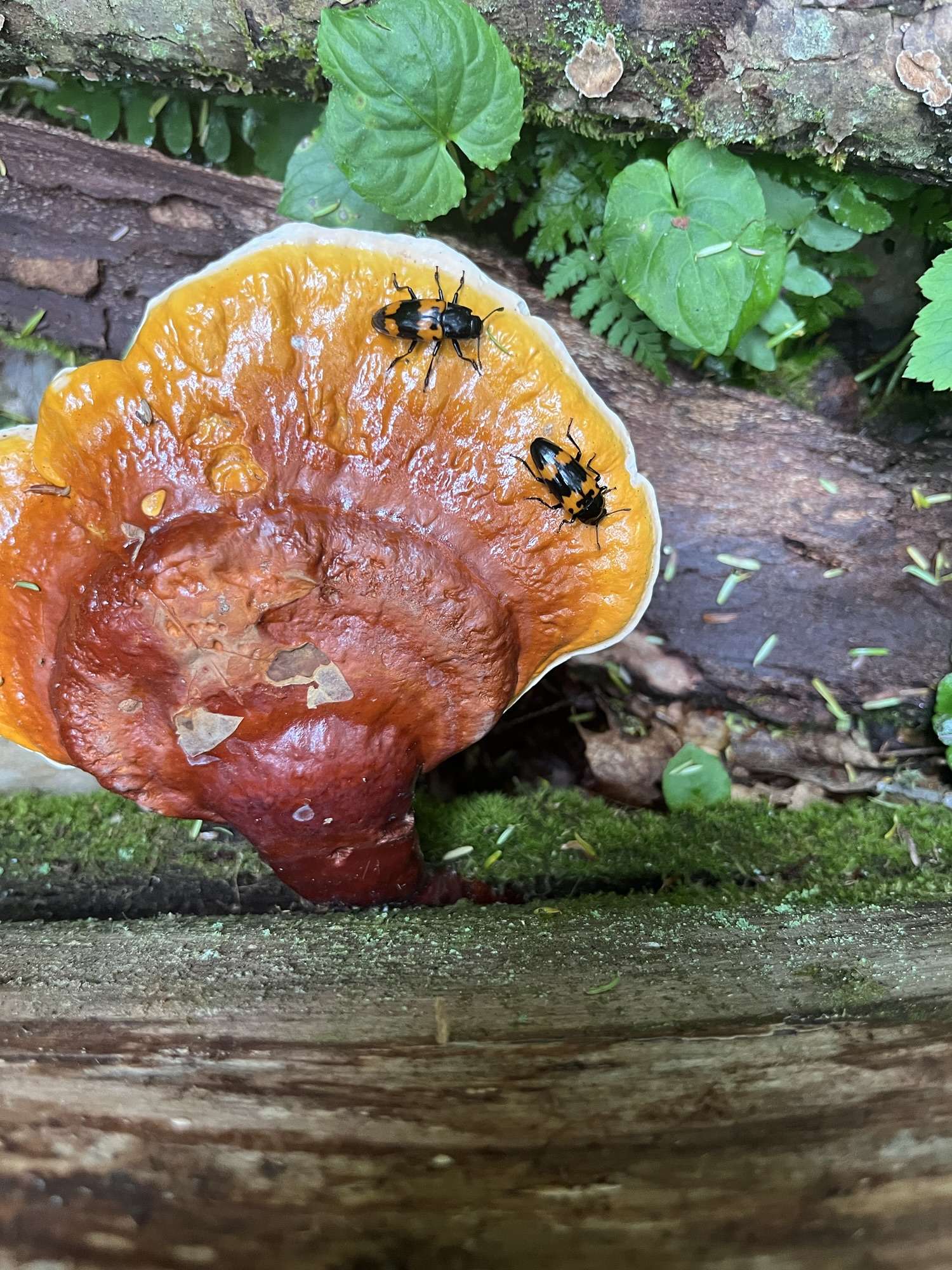
I had my first fungi sighting pretty quickly. While Luna, had her first attempt of the day at catching a chipmunk. She failed, thankfully.
I also stopped to look at the trail map and realized that the Storybook Trail and the Litter Trail both serve as entry points into the larger trail system.
This realization is how I came to make our plan for our this trek. We would finish walking down the Storybook Trail, cut over toward the Litter Trail, and the turn back around to see a little more.
I found a few heart-shaped rocks. I was also able to photograph the tiniest moss specimen I have ever seen.
Which got me thinking about ADHD. Attention deficit, correct? Apparently my brain missed that fucking memo.
On trails, I am constantly finding the tiniest little things:
Mushrooms
Fungi
Plants
Moss
Ferns
Insects
Fossils
I pay attention to the big things too, so don’t you worry.
I still notice waterfalls, cascading rivers, giant boulders, overlooks, and deer standing off trail deep in the forest. Somehow, still once I get on a trail, the tiny stuff starts screaming for my attention.
Maybe that’s one of the stranger things about neurodivergence. The way attention works in ordinary society isn’t necessarily the way attention works when you’re somewhere that actually interests you.
Out here, the things other people might walk right past become the entire point of my trek.
Fossils, Quartz & the Ground Beneath My Feet:
I also photographed a small fossil-bearing rock plate, and right next to it I found another heart-shaped rock for my collection.
I found a large boulder with quartz inclusions. That glitter I noticed in the gravel earlier suddenly seemed a little more interesting. I propped my phone up on a tree trunk across from it, ran back to it with Luna, jumped up on-top of it, and was able to get some photos of us sitting on it.
Wolf Run’s geology is part of what makes the park worth slowing down for. Granite rocks and a large granite boulder can be found throughout the park as remnants of glacial activity. This simply put means some of the rocks you encounter here originated much farther north and were transported by glacial ice.
The Litter Trail:
We finally reached the actual Litter Trail; I have to admit though, I had no idea what to expect.
However, I know I didn’t expect litter in cages. It also definitely wasn’t finding litter show up outside of those cages along the trail. I guess the caged litter is exactly what made it work.
The Litter Trail is an educational installation showing visitors how long different kinds of discarded materials can persist in the environment.
The first one we encountered was number 12:
Styrofoam. Apparently, I did the trail backwards, but who cares? I like to march to the beat of my own drum anyway. Styrofoam is a petroleum-derived plastic material.
The display explained how long it can persist in our environment and how its lightweight, breakable nature can create problems when animals mistake pieces of it for food.
The part I found especially interesting was the date attached to the piece of litter represented by the display: October 1, 2017.
Someone threw something away years ago and now, I’m standing in a nature park looking at it as an educational artifact.
Diapers, Cigarettes & the Weird Timeline of Trash
The next one that really caught my attention was diapers. The display explained that disposable diapers are made from a combination of materials that are difficult to recycle and can remain in the environment for an extremely long time depending on the conditions in which they are discarded.
Then there was the cigarette display. Cigarette filters aren’t simply little pieces of harmless cotton that disappear when they get wet. Conventional cigarette filters are primarily made from cellulose acetate, a plastic-like material, and they can persist in our environment for years.
Learning these facts made litter feel different. I learned decomposition isn’t the same thing as disappearance. A cigarette butt breaks apart but that doesn’t mean it has became harmless.
Plastic will fragment without becoming nonexistent. Foam can persist for generations.
The trail wasn’t simply telling us how long things take to disappear. It prompted me to think about what we mean when we say something is “gone.”
If You Bring It In, Bring It Back Out:
This is the part where my own conservation brain kicks in. Always bring your trash back out with you.
Whatever it might be always pack out what you pack in.
If you can safely pick up another pieces of litter while you’re there, even better. I know it sounds like something very small and trivial:
A few wrappers
Some bottles
A couple cigarette butts
A few plastic items
What difference do a few pieces make?
By themselves? Not much. Though it helps to know that environmental stewardship is built from individual actions repeated by a whole lot of people.
Our natural area do not need every visitor to become a professional trail-cleanup crew. They need people to stop treating the woods like their personal garbage cans.
If this sounds incredibly basic, it’s because it is. Yet, it is also apparently still necessary to say.
The Preserve Inside the Park & a Nature Playground:
While on our walk I realized there is a preserve inside this park. Knox Woods State Nature Preserve is located within the larger Wolf Run Regional Park area.
Ohio green areas like our geography occasionally feels like somebody kept adding layers until somebody else forced them to stop.
At the beginning of the nature trail, which was the end for me there is also a nature playscape. Although I don’t have children, I think nature playscapes are really cool.
This provides them the opportunity for sensory experiences, a place to climb and balance, and ways to interact directly with natural materials. Unlike most other plastic or metal play areas ones like these are actually apart of the environment around them.
Kids deserve places where nature isn’t just something they see through a car window.
Deer Management:
Then I reached a trailhead sign near the start of the Litter Trail and noticed a sign I absolutely was not thrilled about.
“To maintain the white-tailed deer population, a controlled bow hunt is currently underway in this park.”
The notice went on to tell visitors to expect deer stands and bow hunters in the park throughout the archery season.
My immediate reaction was: Oh, fuck off.
I have hunted deer before, and I understand that wildlife management is a real thing. I know that deer populations can become difficult to manage when natural predators are limited or their habitat has been heavily altered.
I get the reasoning, and I still fucking hate the idea of it happening in a recreational park. Before anybody jumps down my throat, I’m not saying deer should never be hunted. I’m saying there is something fundamentally different about walking through a public park knowing that another person could be sitting in a tree stand with a bow.
Especially when you’re there with a dog, a deer-colored dog at that. Luna was wearing a bright yellow leash and a bright blue reflective collar, and I had electric-blue shorts on. So nobody better shoot at me or my dog with a God damn arrow.
I remember feeling similarly about deer management at Oglebay Park in Wheeling, West Virginia. The part that bothered me wasn’t simply the fact that deer die.
Animals die; That’s nature. Wildlife management exists for reasons that can be legitimate, particularly in areas where human development has changed the balance between wildlife populations, habitat, and predators.
What bothered me was the idea that animals could come to associate a particular place with safety, only for humans to change the rules.
Maybe that’s sentimental, or anthropomorphizing. Either way I still don’t particularly like it one bit. Yes, I am aware that my opinion and wildlife management science aren’t necessarily the same thing.
They don’t have to be.
Speaking of Bambi:
Luna and I eventually reached a clearing where the shade broke into a field. The trail seemed to dissipate into open space. There was one tree standing in the middle of it all.
When my eyes finally adjusted to the bright light, there she was:
A very healthy-looking deer.
Luna didn’t even notice. What a big bad watchdog she is, huh? The dog who nearly gives herself whiplash trying to chase a chipmunk somehow didn’t notice an entire deer standing in a field.
Great job, Luna.
Bridges & Creekside Rock Hunting:
We crossed one wooden footbridge and a metal one as well before the inevitable happened…
Luna ended up in the creek while I was collecting rocks next to her. Honestly, this is how I expect the hike with us to go.
The first rock I found on the creek bed was of course, another heart-shaped rock. I’m beginning to suspect Wolf Run is manufacturing these heart shaped rocks I love so much. Then I found something considerably more interesting, a crinoid stem in a plate.
This is one of the many reasons I love looking at rocks while hiking.
You don’t even have to arrive with a geological hammer or a giant bucket. Though, if we are being honest I do sometimes have those things in tow. A lot of the time I get lucky and the landscape has already done the hard work.
The specimen is just sitting there, all you have to do is notice it.
The Bees:
Do bees not have the same undying hatred for DEET or OFF! spray like other fucking insects? OH MY GOD.
It’s not like I’m anaphylactic or anything. You’d think I’d carry an EpiPen. Why were the bees trying to swim in my ears?
I finally figured out where the damn bees were coming from. Which actually led to another interesting park feature.
We all know Ohio puts out bat boxes, birdhouses, and other structures designed to provide wildlife habitat. Apparently Ohio also puts out things called bee hotels or insect hotels.
These structures are designed to provide nesting and shelter opportunities for insects and other small organisms. I hadn’t been randomly attacked by the bee population. I had been frolicking around their neighborhood. My apologies to the residents.
The Pond:
Eventually, we reached the preserve pond. Which was part of the reason we trekked this far in the first place.
On the map the pond looked tiny. I saw it and remember thinking: Pond? More like: Puddle.
In person, it was much larger than I expected and, significantly browner. If we were not in Ohio the water looked as if an alligator could pop out and get us. Ohio must have decided to have a swamp episode.
The pond is one of the park’s established recreational and natural features, and there is a dock here as well.
Since it isn’t exactly the Everglades standing there looking at the dark water through the vegetation, my imagination was more than happy to fill in the blanks.
Don’t Throw Giant Rocks:
Then my solitude was rudely interrupted by middle-aged or older woman and a young girl who showed up. They of course couldn’t just enjoy the pond they had to cause chaos by throwing humongous rocks into the pond.
My immediate thought was:
Why?
Do they not know that living things inhabit that water.
Fish
Aquatic invertebrates
Amphibians
Plants
Microorganisms
All kinds of living things that don’t need a fucking boulder dropped on them because somebody wanted to hear a splash.
I know that sounds like a small thing, but it isn’t. This is exactly the problem with how some people think about public natural spaces.
A pond isn’t just scenery.
A creek isn’t just something pretty to photograph.
A forest isn’t just a backdrop.
There are organisms living in all of those places. You don’t have to be a biologist to understand that. Sometimes the respectful choice is simply to leave the habitat alone. After all you are exploring their home so treat it as such.
The Tiniest Spider:
While I was looking at a fern, I got pretty close to the tip because it looked like there was a spiderweb surrounding the entire thing.
That’s when I realized I had actually found the tiniest spider. Possibly the tiniest spider I have ever seen in my life. It was still working on making its web.
The same thing that happened with the moss. The thing most people might never see was right in front of me. I just had to slow down enough to notice it.
That’s probably one of my favorite things about hiking. It isn’t always necessarily about the big views, the mileage, or the destination.
Sometimes it’s realizing that an entire little world is happening six inches from your shoe and you almost walked straight past it.
The Reptiles I Didn’t Find:
You know what I don’t see on trails nearly as often as I would like?
Snakes
Lizards
Salamanders
Other reptiles
amphibians
This realization kind of made me sad. I know they’re out there. I just don’t encounter them nearly enough.
Wolf Run has plenty of varied habitat, including woodland, open areas, streams, and the pond, so there is plenty of reason to keep looking on another visit. The fact that you don’t see an animal doesn’t mean it isn’t there.
It might just mean that the animal is considerably better at hiding than you are at finding it. Which, honestly, is probably a good thing for the animal.
What Wolf Run Actually Became:
When I arrived at Wolf Run, I thought I was coming to investigate a Litter Trail. Instead, the trail became a weird little cross-section of almost everything I like about being outside.
The Litter Trail ended up being one of the more interesting parts of the visit because it forced me to think about time. A piece of trash doesn’t simply disappear because the person who threw it away stopped looking at it.
Meanwhile, the rocks underneath it are still there. The moss is still growing, the spider is still spinning, the deer is still eating, and the creek is still moving.
That’s the strange contrast of a place like Wolf Run. It shows you that nature operates on its own timeline.
Luna and I covered 2.7 miles in roughly two and a half hours. Though that’s a crazy slow hiking speed I don’t think we wasted the time.
I don’t race the trail; I look at it. Those are two totally different things. Wolf Run Regional Park turned out to be much more than the odd little Litter Trail I had been curious about. This is a place where education and recreation overlap in some genuinely interesting ways.
If you’re anything like me, you can spend an unreasonable amount of time staring at a rock because you think it might contain quartz.
The biggest thing I walked away with, though, wasn’t a rock. It was the reminder that attention changes a place.
If you walk to quickly, Wolf Run is just some more miles of trails wrapping through Ohio. If you slow down enough, it’s a fossil, moss, a spiderweb, a deer in a clearing, a heart-shaped rock, and a piece of Styrofoam that has been sitting around since 2017.
There is an entire ecosystem existing beneath, above, beside, and sometimes directly in front of your feet. That’s what I like about hiking most. You don’t necessarily need the trail to give you something spectacular.
Sometimes you just need to pay enough attention to realize it was already there.
Transgender people who live daily life faced with hypervigilance, rural queer folk, trauma survivors, queer individuals tuned into TikTok trends, Indie readers who prefer real over polished, activists, & people who use hiking as survival.
Transgender Survival & the American Landscape:
Some truths follow us the way we follow trails:
Step-by-step
Ridge to gorge and back
Breath to breath
I may hike because it steadies me, but I know that the world doesn’t always steady people like me. This poem sits in a space where identity meets danger, where movement becomes survival, and being transgender in America becomes a beautiful declaration and a life-ending risk.
There is a trend moving through TikTok right now that states “ I was born trans, I will die trans, but I do not want to die because I am trans”
I wrote this piece with that echo and the remnants of the feeling of my chest binder, although I took the last one off eight years ago.
This is my lived reality.
This poem to me is exactly what all of this feels like when carried through America especially rural America. It was born inside the part of me that never gets to rest or take a break. It is the hypervigilance of always looking over my shoulder. It may not be pretty, but it is honest and honesty is the only thing that’s ever kept me alive.
Here you’ll find the danger of being transgender and the United States of America, even after the caution tape has been ripped down. You will find that typically the threat always stays the same. Fear may follow us and danger may stay the same, but my resilience here will never back down.
Honestly, here you’ll find the part of me that knows visibility can be fatal, so I never actually rest. Located here is the transgender man that scans every room for the exit every time he enters, the man who hikes miles, gasping for breath just to be able to breathe again, as well as the man that knows danger hides behind every corner.
Are you ready to unpack that?
Die Trans
I was born trans I will die trans I do not want to die because I am trans.
Day by day As time passes Identifying myself feels like laying my life on the line
Step by step As I trek on these thoughts haunt me as if I’m projecting them onto the big screen
Can they tell? Do they know? I’m in danger At this pace it won’t end well, We can tell caution tape ripped down Is still just as yellow
The Bitterness in the End:
At the end, we see a transgender man moving on a trail that doesn’t always safely move around him or others like him. Yet every step reminds him that he is still here, he is still trekking, and still refusing to let fear silence him.
This poem shows you that lines that started a TikTok trend carry deeper weight when you actually move through life with them. This is the truth. I will always walk with: I was born trans and I will die trans, but I also refuse to live in fear because I am trans. I will always live on my own terms no matter how dangerous the world around me may seem. While the danger doesn’t disappear, neither does he.
I’m sorry if you were looking for a clean ending, and you didn’t find that here. However I won’t apologize for always having the same stubborn heartbeat that pushes me through this life. While this piece doesn’t solve anything it does prove that sometimes the truth is the only resolution there is to be had.
No matter what I will keep hiking, I will keep living and I will keep being and that’s the whole fucking point.
If you are a minority community-aligned person who is also an author, artist, creator, small business owner, etc and wish to connect with like-minded individuals look no further. Poeaxtry will gladly share your work, interview you, advertise your releases, and more.
To defeat this beast, we need to work together to grow together. Capitalism will not end without community action or community projects that offer opportunities to others.
Please feel free to submit this form or reach out via email for more information on how to get your showcase and other partnerships that are currently available.
Literature enthusiasts drawn to deeply personal stories about small town families facing extraordinary circumstances, individuals active in mutual aid or community-led disaster relief, readers interested in the intimate human stories that exist behind major disasters, & people looking for meaningful ways to support a family rebuild their lives after sudden loss.
A home filled with almost thirty years of love & family history swallowed by more than five feet of floodwater.
Two people who built their golden years in Crooksville, Ohio, & watched two generations of family grow here.
A Kentucky farmer, his lifetime of work, & the home that held the memories of his family.
The devastating uncertainty of a beloved dog that went missing during the flooding.
What remains after the water recedes? Find out how individuals can help so they can begin again.
When the Water Came Up:
Flood waters can turn a familiar place into something almost unrecognizable in a matter of hours if not minutes. Water is insanely dense if you didn’t know. When you consider the constant movement of flood waters you’ll find that ankle-deep water can sweep you off your feet, and knee-deep water can carry your car away you see the force it brings when it rises.
For these small town grandparents, the flooding did far more than damage their family home and fracture their security. When the water started rising they probably figured this would be a flood like the ones they typically get; they were unaware of the over 5 feet of water that would soon rob them of many things.
This was the same house they purchased for their golden years, the same community where they chose to spend the best years of their lives, and the same area where their family continues to put down roots. Their grandchildren were raised here and now their great-grandchildren stomp the same yards. Decades of their family history were held in this house.
This loss they are faced with is a part of a much larger story unfolding across the region as communities deal with flooded homes, evacuations, rescues, destruction, and the difficult days that follow natural disasters. Every flooded street holds people trying to figure out what comes next.
For this family, that realization is especially painful. They are facing the loss and destruction of the place that held just shy of thirty years of their lives, while also dealing with the heartbreaking loss of their beloved senior dog.
Let’s head back to the storm that caused the water to rise, when a familiar kind of flooding became something far more devastating.
The Derecho-
Where the Storm Went:
On August 11th, 2026, this system covered an enormous stretch of the country, starting in eastern Iowa before working its way across Illinois, Indiana, and Michigan before making its way into Ohio. After leaving Ohio the storm cell continued through Kentucky, Pennsylvania, West Virginia, Virginia, the Carolinas, and ended up reaching as far south as Georgia. Though the derecho classification applies only to the part of this system that went through Iowa, Indiana, and Ohio.
This wasn’t just your average end of summer thunderstorm. It was part of a massive line of storms which had already traveled hundreds of miles and would still travel hundreds more.
The National Weather Service’s Storm Prediction Center has preliminarily classified the storm system as a derecho. To be classified a derecho a storm must:
have a wind damage path of at least 240 miles
feature wind gusts of at least 58 mph along most of its length
include several concentrated clusters of 75 mph or greater gusts
The storms that ripped through Ohio were a long-lived, organized line of thunderstorms that produced widespread, destructive straight-line winds. These storms differ from tornados, which concentrate their strongest winds into a relatively narrow path. This is why a derecho can keep pushing forward for hundreds of miles, leaving damage spread across a much larger area.
This cell was not gentle along the way, producing wind gusts that reached 97 to 99 mph in parts of the Midwest. Ohio even recorded an 82-mph gust in Columbus. Trees came down, telephone poles snapped in half, and power lines tangled across roads and neighborhoods. At the height of the storm, more than 800,000 customers across the affected region were without electricity, including more than 200,000 in Ohio.
Wind wasn’t the only thing this storm brought with it that caused concern.
As the system pushed into Ohio, it unloaded the same kind of torrential rainfall it had already gifted Indiana and Iowa. Southeastern Ohio was already in a bad position with ground conditions saturated, waterways rising, and rainfall coming faster than the land or drainage systems could handle.
When the water started moving, Perry County, Ohio, was hit particularly hard. Flash flood emergencies were issued as water rapidly covered roads, entered properties, and almost submerged others.
State of Emergency:
Emergency crews began conducting water rescues as people became trapped in homes, businesses, and vehicles. The roads that people used to get around their communities were suddenly engulfed in rushing water, making an already dangerous situation even harder for rescuers to navigate.
Crooksville was one of the small Ohio villages caught in the thick of it. The area saw floodwater rise so rapidly that many people were forced to evacuate. A shelter that opened for people who could no longer safely in their homes. Nearby communities, including Roseville, were also dealing with the same rapidly changing conditions.
The flooding became serious enough that Governor Mike DeWine declared a state of emergency for Perry and Muskingum counties and deployed the Ohio National Guard to assist with searches, rescues, and evacuations.
This storm not only knocked out power, ripped down trees, and produced destructive winds, it also spawned tornadoes, and dumped enormous amounts of rain across its path.
One of the worst parts of this storm was what was rising from the ground or out of the creek beds, and would eventually rob families of their homes, vehicles, and pets.
Twenty-Six Years of Sunshine:
Roughly twenty-six years ago, the established couple came to Crooksville with the a small dream and lot of hope. Their goal was one many people share, after a lifetime of working the land: to spend their golden years loving the family that grew from their love.
They chose Crooksville, Ohio for the peace and quiet. They were able to see their grandchildren grow up on this land, and now great-grandchildren, giving the family even more reasons to stay connected to the place they had chosen all those years ago.
Their home became a cedar-chest that held all of it. A home where ordinary days became family memories; holidays, birthdays, cookouts, arguments, laughter, quiet mornings, and all the little moments that don’t seem important until they’re torn apart in front of you.
There were things in that house that wouldn’t mean much to a stranger walking through. Photographs holding children now grown and family no longer here, tucked away photo albums and saved mementos from far off places holding the memories as if they happened yesterday. The ordinary objects that quietly accumulate when a house becomes a home.
Twenty-six years is a long time to stay put, but that happens when you put down roots.
In that many years a house will become familiar to you in ways you don’t consciously notice anymore. You know which door sticks, where the floor creaks, what handle wiggles, and the way your family looked while filling the rooms over the years. You stop thinking about the walls as walls, as they become one of the main scenes in your life.
Beyond the house itself was the community they had spent almost three decades becoming part of. Where they came with a plan and a goal; they succeeded just to watch it all but wash away.
They did not just live in Crooksville for twenty-six years, they built their life, nurtured their roots, and watched those roots grow their family tree.
In a matter of hours, floodwater tore through everything they spent their life building.
Twenty-six years of building a life cannot be replaced simply by finding another house. A new roof can be put over someone’s head. Walls can be rebuilt. Furniture can be replaced. But the years that happened inside those walls, the history attached to the place, and the feeling of having finally put down roots somewhere permanent are not things you can simply buy back.
And that is what makes the aftermath of this flood about far more than property damage.
How You Help:
The family has an established go fund me set up and any funds raised will help them begin rebuilding their home. Renovations will include things like redoing the flooring and repairing the duct work that was destroyed by the historic flooding.
The couple doesn’t have home insurance and simply do not have the financial means to cover these major repairs on their own. These flood waters have devastated their family, and they do not know where to go from here.
Their grandchildren are asking for community support because their grandparents are the kind of people who have spent their whole lives helping others. They are caring, supportive neighbors who would give the shirt off their back to someone in need. So please if you are able to give, share, or keep them in your thoughts, it would mean so much to their family.
Any support will help them take the first steps toward rebuilding their home and their lives.
Individuals experiencing intense burnout, outdoor enthusiasts looking for psychological or physiological frameworks behind trail walking & rockhounding, people who find stillness suffocating, or anyone looking to build a high- energy self-care ritual.
The Fallacy of Forced Positivity: Why telling an overwhelmed or burnt-out individual to “think positive” fails on a physiological level, & why some of us need physical dislocation instead of a mindset shift.
The Trap of Stillness: Why for some of us sitting motionless during a mental spiral acts as an echo chamber for anxiety, making active kinetic movement (like hiking, kayaking, or rockhounding) a necessary release valve.
Sensory Grounding & Micro-Focus: How shrinking your perspective down to small, living details like wildflowers, fungi, and shifting sunlight forces your brain out of hypothetical anxiety & back into immediate reality.
Dual-Tiered Reset Systems: How to build a resilient, accessible routine that bridges high-energy physical dislocations with low-friction daily anchors like thunderstorms on the porch, rocking chairs, or comforting nostalgia.
The Science of Soft Fascination: Exploring Attentional Restoration Theory & the 5-4-3-2-1 sensory loop to explain why immersive nature & tactile rituals successfully down-regulate your nervous system.
Beyond Forced Optimism:
There is a specific kind of exhaustion that settles deep in my bones when life gets heavy, and only a few things seem to actually help me find my positivity. If the same can be said for you and standard advice completely collapses under the weight of it, then you might have found the place you were looking for.
We’ve all heard the platitudes about looking on the bright side, changing our mindsets, or simply choosing to thinkpositive. When your nervous system is actively redlining, and your brain’s dash-lights are all activated being told to force optimism isn’t just unhelpful, it is infuriating.
Positivity is a high-level cognitive function. When you are burnt out, grieving, overwhelmed, or trapped inside your own head, your brain is operating in survival mode. You cannot logic your way out of a physiological response, and you cannot talk a drowning mind into suddenly enjoying the water.
This disconnect happens because forced optimism asks you to alter your perception without altering your environment or your physical state of arousal. You don’t need a new mindset in those moments; you need a physical dislocation. You need a deliberate, uncompromising disruption of the cycle to force your nervous system to drop its guard and bring you safely back to Earth. Now we can examine how those cognitive shifts fail during deep burnout, explore how kinetic movement and micro-sensory focus physically ground a spiraling mind, and outline a full spectrum of personal rituals designed to bring you back to center.
The Mechanics Why Movement Trumps Stillness:
For a long time, mainstream wellness culture has sold the idea that resetting must look like quiet, motionless meditation. We are told to sit in a dark room, close our eyes, clear our minds, and breathe through the noise.
However, for many of us, sitting still when everything is crashing down isn’t a reset, it is a pressure cooker. When your mind is racing, forcing your physical body to remain motionless isolates you with the very thoughts tearing through your head.
The stillness gives the noise an echo chamber, making the mental burden feel exponentially worse because sitting still isn’t an option for everyone. Real relaxation and emotional processing often require active motion rather than passive stillness.
The physical act of moving (whether that means stepping onto a trail, paddling across open water during a kayaking day, or actively hunting through gravel beds for hidden geological treasures while rockhounding) gives the body’s restless, anxious energy a necessary output. When you are hiking, navigating uneven terrain, paddling against a current, or otherwise moving purposefully, your body is engaged in physical effort that acts as a kinetic release valve.
That movement consumes the stress hormones surging through your system and gives your mind the room it actually needs to untangle complex thoughts. You don’t think despite the movement; you think through the movement.
Micro-Focus as an Anchor – Grounding the Spiraling Mind:
While physical movement releases built-up kinetic tension in your body, steering your attention toward micro-details provides the mental focal point needed to stop a thought spiral. When the big picture of your life feels completely out of control, looking at the macro level will only paralyze you. The true reset happens when you force your perspective to shrink down to the micro-details directly in front of you.
Consider what actually happens when you step away from your phone, leave the walls trapping you to your routine behind, and walk into the woods or onto the water.
You aren’t staring at the entire landscape all at once. Your mind anchors on specific, isolated details. It’s the vibrant colors of native wildflowers cutting through the muted greens of a damp creek bank, wild forest mushrooms pushing their caps up through rotting logs and dead leaves, or the sharp geometry of the flora growing along an unmaintained path. Even the angle of afternoon sunlight breaking through a thick canopy, or the sharp bite of fresh air filling your lungs can help ground us. These moments are active sensory grounding.
Focusing intently on the texture of a stone, the outline of a fossil, the warmth of the sun, or the cold water splashing off a kayak paddle forces your brain out of hypothetical anxiety and back into immediate physical reality. These tiny, living details operate entirely independent of human stress, deadlines, or personal burdens. They exist simply because they exist. Observing them quietly reminds you that the world is vast, life continues to move forward, and your current state of being stuck is not permanent.
Mapping Your System – High-Energy Dislocations:
Understanding the value of kinetic movement and sensory focus allows you to build a practical, multi-tiered framework for your own life. A functional reset system cannot rely on a single action. If your only way to reset requires a three-hour drive or an all-day excursion, your system will fail you when you are too exhausted to leave the house.
A resilient reset strategy requires a spectrum of rituals ranging from high-effort physical dislocations down to quiet, low-friction sensory anchors you can reach within arm’s length.
High-energy physical dislocations are the non-negotiable actions for days when you must physically remove yourself from your daily environment to burn off compounding mental noise. This includes movement, like trekking, paddling across water, or rockhounding where every stone turned over requires your absolute visual attention.
A good ritual also includes dedicated self-care days where you intentionally care for your physical vessel through caring acts. I tend to enjoy things like facials, manicures, and pedicures. These work by way of forcing a tactile pause that treats your body with deliberate respect and rest.
Don’t forget to make a wish, you know they do come true.
On the other end of the spectrum are low-friction daily anchors, which serve as immediate, accessible micro-resets for days when you don’t have the energy for a trail but still need to pull yourself back to center.
These are moments like stepping outside with a hot mug of tea to sit on the porch during a heavy thunderstorm while the smell of rain and the rumble of thunder drown out internal chatter. They may also look like sitting back in a rocking chair with a joint or bowl to smoke while letting the rhythmic motion settle your physical frame.
I sometimes enjoy hanging in a hammock suspended between two trees, immersing myself in a good book, or blasting a comfort album like Mayday Parade’sA Lesson in Romantics from start to finish to let familiar melodies sweep out mental static.
The Biological Foundation – Soft Fascination & Sensory Regulation:
To fully appreciate why these high-energy and low-energy rituals are so effective, it helps to look at the underlying psychological and neurologicalmechanisms that govern how human beings process stress.
Our modern lives tend to demand almost constant directed attention from work, screens, driving, financial stress, and digital notifications. Over time, directed attention leads to cognitive fatigue, irritability, and mental burnout.
Natural environments and sensory rituals rely instead on soft fascination, such as watching rain fall during a thunderstorm, observing sunlight through leaves, or listening to a favorite record. Soft fascination holds your interest effortlessly without forced concentration, allowing the brain’s executive control centers to go offline, rest, and restore themselves naturally.
Simultaneously, when you actively pay attention to what you are seeing, hearing, feeling, and smelling, you activate the 5-4-3-2-1 sensory grounding loop.
This is a direct physical input signal to your amygdala that you are safe in the immediate present moment. Which then works at down-regulating your nervous system out of fight or flight and back into a state of recovery.
The Broader Lens:
We have dismantled the myth that mental exhaustion can be cured by simply changing your thoughts. True recovery requires physical dislocation, active kinetic movement, micro-sensory anchors, and an accessible spectrum of personal rituals.
Whether it is navigating a rugged trail, hunting for fossils, sitting on a porch during a downpour, or putting on an album that carried you through your youth, these practices are not hobbies or luxuries. They are essential maintenance required to remain human in a world that constantly demands your attention.
Where trail logs document the specific geography of individual journeys, and our poetry captures the quiet, emotional resonance of loss, memory, and healing, essays like this serve as the foundational philosophy behind it all. They bridge the gap between living through the noise and translating those experiences into written art.
Life is not going to stop being loud, heavy, or complicated. You cannot control the volume of the world around you, but you can build non-negotiable entryways back to your own sense of peace, protect them fiercely, and use them whenever you need to find your way back to Earth.
Hikers who like wandering rather than following a single prescribed route, mushroom & wildlife watchers, individuals interested in climbing, & anyone who enjoys parks that feel a little less tamed.
The Essence:
Read Time: ⏰13minutes | Weight: 🪶 lightweight | Mood: ✨ Grateful& Full of Wonder |
Trail Notes:
Just over 2 miles of wandering through Keller-Kirn Park with Luna
A cool breeze & bright sunshine made for a perfect transition into summer
Fungi everywhere, including striking blue-green wood stained by Chlorociboria
Deer, birds, mushrooms, a soggy little footbridge, & a cemetery that appeared unexpectedly along the way
An unplanned conversation with another park regular about wildlife, climbing, photography, & hiking
A reminder that sometimes the best hikes are the ones where you stop trying to make the trail into a route
Keller-Kirn Park Lancaster, Ohio
Fairfield County
A Monday Morning Without a Route:
There are some hikes that begin with a specific trailhead in mind, and that isn’t how we began the journey on June 1, 2026. We parked at Keller-Kirn Park at approximately 9:43 a.m.
After a night at work, Luna and I had a rare Monday morning available for trekking, so we decided to spend it at Keller-Kirn Park in Lancaster.
We were not there to complete one particular loop, chase a mileage goal, or check a specific AllTrails route off the list. Keller-Kirn is one of those places where the trails connect and overlap enough that following one predetermined route felt almost beside the point.
Instead, I opened up the free navigation in the app and decided we would simply explore.That turned out to be exactly the right choice. We wrapped up around 11:43, covering just over two miles.
We were also able to experience Ohio wildflowers, mushrooms, and birds.
Keller-Kirn Park:
Keller-Kirn is officially a 76-acre park, but what I liked about it was that it did not feel like someone had taken those acres and tried to make every square foot look like a carefully landscaped public garden. The trail had areas that were overgrown and rough around the edges. I liked that the most.
I have never understood the obsession with making every trail look like an unpaved sidewalk through the woods. I say “Give me the wild stuff. Give me the places where vegetation creeps back toward the trail and the forest gets to look like a forest.”
There is also farmland near parts of the landscape, too, which is hardly unusual for this part of Ohio. It is the mixture of woodland and open agricultural greenery that gives this park its distinct central-Ohio character. What more do we expect from Ohio than cultivated ground on one side, with woodlands and rocky outcrops on the other.
This was a good way to start our summer.
The Near Perfect Weather:
The morning air carried a cool breeze that made it feel like spring had not completely surrendered yet. Yet, at the same time, the sunshine was out. This combination made the morning feel less like the beginning of June and more like a final goodbye to spring.
It was cool enough to be comfortable while walking, but bright enough that everything around us seemed to stand out.
One of the things I enjoy most about hiking with no rigid itinerary is the ability to stop and look. When I am trying to complete a specific trail, there is always a little voice in the back of my head reminding me that I am supposed to keep moving.
When I am simply exploring, I can stop. And I stopped a lot.
A flower here or a mushroom there. The many textures of a tree.
Many mushrooms growing out of a fallen branches or a strange rock formation.
The hike became less about getting somewhere and more about noticing where I already was.
More Than One Outdoor Option:
One of the first things that stood out to me about Keller-Kirn Park was how many different outdoor activities have been worked into the same landscape.
There is hiking, obviously, but there is also the Flat Rocks Disc Golf Course, an 18-hole course that moves through a mixture of wooded and open terrain. The park is also home to the Flat Rocks climbing area, where climbing and bouldering have been developed along the sandstone cliffs.
I have never played disc golf before. Apparently, I keep encountering it whether I intend to or not.
It seems like Fairfield and Licking County parks have a particular fondness for putting disc golf courses into their green spaces. I cannot complain about it; I like seeing different forms of recreation sharing the same outdoor spaces.
Keller-Kirn Park is especially interesting because the recreational pieces are not completely separated from the natural landscape. The disc golf course moves through the hills and woods, while the climbing area sits among the sandstone formations.
This gives the park a slightly unusual personality. You can come here to hike, to throw discs, to climb, or just exist however you like to in nature.
I always chose the last option.
I Am a Fun Guy:
My mother used to tell me a mushroom joke when I was a kid. I would laugh my ass off at it. Though, as I got older, I realized how painfully unfunny the joke actually was.
Until I started photographing fungi, and the joke made its way back around.
A mushroom walks into a bar and tries to order a drink. The bartender keeps refusing him. Eventually the mushroom asks…
“What’s wrong with me I’m a fun guy.”
…
I know. It is terrible; it is also apparently appropriate now.
I found mushrooms in different shapes, sizes, colors, and stages of growth. Some were easy to spot from several feet away. Others required getting down closer to the ground and actually looking beneath the vegetation.
One of my favorite parts of photographing fungi is now remembering a hilariously stupid joke my mother used to tell me. The forest floor is full of things that look completely ordinary until you actually stop to examine them.
The Blue-Green Wood:
One of my more unique finds of the morning was a bunch of downed logs with this blue-green discoloration in their decaying wood. The culprit was likely Chlorociboria.
This is a genus of fungi known for producing a blue-green pigment called xylindein. Rather than simply thinking of it as a colorful mushroom, it is more accurate to think of Chlorociboria as part of the decomposition process happening inside dead wood.
The fungus colonizes decaying hardwood and produces the pigment that gives the wood that almost unnatural turquoise or blue-green appearance.
You can be walking through an ordinary Ohio forest, surrounded by brown leaves, gray and brown bark, green vegetation, and weathered wood, then suddenly there is this splash of bright blue-green hiding inside a piece of dead timber.
Chlorociboria’s pigment can penetrate the wood, producing what is sometimes called green-stained or spalted wood. The distinctive coloration has even been valued by woodworkers for decorative work.
Nature has a way of making decay beautiful.
The tree is dead, wood is breaking down, and yet somewhere in that process, another organism creates a color bright enough to make me stop walking.
That is the kind of thing I go hiking to find.
Rocks I Wasn’t Expecting:
The fungi were not the only thing pulling me off my original path. As Luna and I continued exploring, I started finding rocky outcrops and exposed sandstone formations.
Keller-Kirn Park also has a few rock wall areas with what looked to me like eyelets or anchors along the top.
I hadn’t seen this anywhere before but my initial inclination was to wonder if they were used for rappelling. As it turns out, I was right.
Flat Rocks is an established climbing area, and the Ohio Climbers Coalition notes that some of the taller walls have large eye bolts used for top-rope routes.
Climbing was formally recognized as a legal activity at Keller-KirnPark by Lancaster Parks and Recreation in 2021, after years of local climbing activity and development.
The cliffs here are sandstone, too, tying Keller-Kirn Park into the broader sandstone landscape that shows up throughout southeastern and central-southeastern Ohio.
I know I for one did not come to Keller-Kirn Park expecting a climbing area. That is just another reason why I prefer exploring over simply following a route.
Birds, Deer, & a Good Reason to Stop:
While we walked the trails here wildlife kept making appearances. Throughout the morning we saw many different types of animals.
There was a large blue bird that caught my attention, along with robins and a cardinal. We could hear the calls if different birds echo through the canopy intermixing with the rhythmic tapping of nearby woodpeckers who search the trees bark for food.
Then the deer came.
We crossed a small, soggy footbridge over what was a little more than a tiny trickle of a stream. I started to notice the movement farther up the hillside.
At first, I stopped because I thought there might be a person watching their off-leash dog. That unknown factor was enough reason to slow down and assess the situation rather than immediately walking toward whatever was happening.
The Conversation:
It turned out to be another person enjoying deer, and not and irresponsible pet owner who allows their off-leash dog.
Instead of being a strange encounter, (like the guy at Rockstull) it was one of those unexpectedly good conversations. Some people have an ability to turn a short hike into something we remember.
He told me about the pack of deer he visits here frequently to watch. We talked about his years hiking through this park and others I’ve frequently visited in the area.
We discussed nature photography. He told me about going out at night to photograph the full moon on rising park and about his time climbing the rock face there.
This was a good reminder that public outdoor spaces are shared spaces where you can meet some amazing new people. The same park exists differently for each person visiting; we all come for our own reasons.
Sometimes the best part is hearing what the place means to somebody else.
Reluctantly we eventually continued on, and a little farther down the trail, we found another deer by itself.
I noticed the deer here look remarkably healthy; as well as completely unbothered by our presence.
There is something satisfying about seeing deer. They are common enough that encountering one in an Ohio park is not exactly a once-in-a-lifetime wildlife event, but that does not make the encounter any less magical. Especially when they give you enough time to actually observe them.
Just a healthy animal standing in the landscape while a hiker and his dog tried not to disturb it.
The Cemetery:
Then, because apparently Keller-Kirn had not already thrown enough surprises at us, we found a cemetery.
I was genuinely elated as I did not know it was there.
Who doesn’t love a good surprise?
I don’t know about you but I’m a sucker for something spooky, especially an old cemetery. Even more so I love finding them while hiking.
There is something about coming across one unexpectedly that changes the entire feeling of the landscape. The trail stops being just a trail.
The woods stop being merely woods. Suddenly there is undeniable evidence that people were here before the park, before the trail, before the current landscape became something more recreational.
It is one of those moments that makes me want to stop and look around a little differently.
Who were the people here and how long ago did they live?
What did Keller-Kirn Park look like when the people buried here were alive? Did the surrounding land mean something different to them?
Sometimes finding something is enough to make you want to come back and learn more. Or at least it leaves you with something to ponder about.
When Tech Failed:
There was one problem with trying to document the whole thing digitally. My phone kept dying, and it was not even just one time, multiple times. When it finally decided to come back to life, it didn’t want to exactly cooperate.
That meant my trail-tracking data was not as accurate as I would have liked. Normally, I like being able to look back afterward to see how much distance I covered, and to accurately track it as well.
This time, the technology told me to figure it out myself. Honestly, there is something fitting about that.
I went into Keller-Kirn Park specifically not wanting tied to one particular route. Then my phone died and made sure I really wasn’t.
Little Things Matter Too:
By the time we finished, I had seen considerably more than I expected from a two-mile wandering hike. Even the little footbridge and muddy patches found a way to became part of the story.
Keller-Kirn Park still manages to provide some of the basic amenities that make a short exploratory hike easier. There are picnic tables, garbage cans, and portable restrooms, so this is not a completely primitive experience where you have to bring absolutely everything with you.
Not the Point:
We finished around 11:43 a.m., roughly two hours after we started; we trekked just over two miles.
I know that number does not sound particularly impressive. I for one do not think mileage tells the story of this hike.
If I had been trying to maximize distance, I would have walked right past half of what made Keller-Kirn Park interesting.
I would have missed the fungi. I would have overlooked the stained wood and its oddly blue hue, and no time would be wasted looking at the rocks. I might have tripped on the climbing anchors, even.
That is what I liked about this visit the most… the missing pressure to complete a perfect loop.
We do not always need to make every mile count. There is no requirement to turn the morning into some grand athletic accomplishment.
We just wandered and Keller-Kirn Park rewarded us with the kind of details you only notice if you actually look for them.
Closing the Loop:
By the time we left, I was already thinking about the things I had not seen; honestly that’s how I know a place was worth visiting.
Keller-Kirn Park is not the largest park I have explored, and it definitely is not the kind of destination where you need an entire weekend to experience it. It still manages to pack a surprising amount into a relatively compact landscape.
This is a park where the trail leads you next to open farmland, into the woodlands of Ohio. Where you’ll find sandstone climbing walls, disc golf, fungi, birds, deer, and old human history.
Keller-Kirn Park offers us the knowledge that there is a difference between hiking a trail and exploring a place.
The first one asks you to follow the path; while the second ones asks that you to pay attention. On this Monday morning, after a night at work Luna and I chose the second option. We went looking for a trail and found a little bit of everything. I think that makes for a better experience.
Date: May 25th 2026 | Time: Evening | Trail: Unmarked Nature Trail at Flint ridge
Distance: 1.5 miles | Time: 45 minutes
Leave No Trace
Rockhounding Tips
Flint Ridge Nature Preserve, Licking County, Ohio.
The Places We Return – Flint Ridge Nature Preserve:
There is a quiet comfort in returning to places close to home; where the trails are familiar, the commute is minimal, and the barrier to getting out in nature is low. On a late May evening, Luna and I returned to Flint Ridge Ancient Quarries and Nature Preserve.
We opted for an understated, lesser-known loop across the road. Though the trek was short at just 1.5 miles, it turned out to be an event-filled excursion. Between muddy trail washouts, vibrant amphibian calls, wet-weather fungi, and curious surface finds which included a heart-shaped piece of carved flint, the evening delivered a full dose of nature’s magic.
Even when an expiring phone battery and the sudden darkness of a late-spring canopy nearly threw us off track, the woods reminded us why even the simplest trips are worth taking.
The Value of Local Traditions:
I’m a firm believer that not every excursion needs to be a grand, multi-day expedition into uncharted territory. We all know that life can often bring days defined by low energy, limited free hours, or a simple lack of motivation to drive long distances.
It is in those moments, that the impulse to stay inside is strong, but the need for time in green space will always remain. Having a reliable, close-to-home trail system is a simple yet great fix for this issue.
For me revisiting familiar parks isn’t a compromise; it’s a practice in noticing the subtle changes over time.
When I’m not focused on navigating brand-new terrain or hitting strict mileage goals, my mind has room to settle. I begin to notice how a familiar trail responds to recent rainfall, or the way seasonal fungi cycle through the timber, or even the differences when twilight filters through the canopy in late spring versus early autumn.
It allows you to get me to get my shoes in the dirt while I breathe fresh air without the mental friction that can come with planning a more complicated trek.
The Unnamed Loop at Flint Ridge:
While the main side of Flint Ridge draws most of the area’s visitors, there is a quieter stretch across the road, marked subtly by a small sign behind a small wooden fence. It appears on mapping apps like AllTrails, but it lacks an official name on the signposts.
It tends to be far less populated, probably because of the obscurity. Offering the opposite of the other trail with its museum and informative features; you find a quiet haven where you are far more likely to hear wildlife than other hikers.
On May 25, 2026, Luna and I set out across that threshold around mid-evening. The air was pleasantly mild, carrying the distinct damp coolness only the late spring does. While it wasn’t actively raining during our walk, the sky had spent the preceding week pouring down over Licking County.
The trail was heavily washed out, turning low spots into temporary streams and filling the historic, moss-lined flint quarries along the path with deep puddles.
This standing water brought the woods to life. The forest echoed with a loud, layered chorus of spring peepers, bullfrogs, and other amphibians celebrating the high water table. Naturally, the dampness also brought out swarms of mosquitoes, but the trade-off was worth it: the humidity had triggered a vibrant flush of varied forest fungi, which I paused to document along the trail edge.
Reading the Ground & Uprooted Trees:
Walking through Flint Ridge is an exercise in looking down.
The soil along the trails at Flint Ridge are rich with geological history, heavily lined with scattered pieces of raw flint and small quartz clusters that glisten against the dark, wet earth.
While surface rocks are visible along the beaten path, one of the best micro-habitats for mineral hunting and photography is beneath the root balls of fallen trees.
When a heavy storm topples a tree, the lifting root plate pulls up years of undisturbed soil, creating a natural vertical cross-section of the ground.
Inspecting these uprooted root systems often reveals freshly exposed, unweathered specimens that have been buried for many years. The dirt clinging to the roots washes away in heavy rains, leaving clean mineral veins, embedded fossils, and sharp-edged flint nodules hanging in plain view. It offers a fascinating glimpse into the subsurface layers of the ridge without ever disturbing the ground yourself.
Small Finds along the Way:
Right about midway through our walk, we paused at a trailside concrete bench, a convenient spot to catch our breath and check our surroundings. Resting on the wood were a couple unexpected human traces: a small, squishy toy green rabbit, and, most surprisingly, a piece of flint clearly worked and carved into the shape of a heart.
Finding carved or worked stone in the wild always brings a moment of curiosity with it.
While ancient Indigenous peoples quarried high-grade flint across this very ridge for thousands of years to craft tools and weapons, modern visitors still feel that same connection to the stone, and sometimes that looks like leaving behind hand-worked tokens for others to stumble upon.
I collected the little squishy and the heart-carved flint, leaving the bench clean again as we pushed forward.
Respecting the Preserve:
Leave No Trace:
Flint Ridge is a protected State Ancient Monument / State Reserve. Collecting rocks, minerals, or artifacts here is strictly illegal. Preservation protects both natural habitats and historical sites.
To collect legally, visit nearby fee-based sites like Nether’s Farm.
When seeing such rich geological specimens lying along the trail, the temptation to fill one’s pockets can be strong. However, Flint Ridge is a protected State Nature Preserve and cultural site.
This means that state regulations strictly prohibit the collection or removal of any rocks, minerals, plants, or historical artifacts from the grounds.
This rule exists for two vital reasons:
Historical Preservation: Flint Ridge was one of the most important quarrying sites in pre-contact North America. The pits, debris fields, and stone scatters are part of an invaluable archaeological landscape that belongs to the public and future generations. Removing pieces breaks the context that archaeologists and historians use to understand how the site was utilized over millennia.
Environmental Conservation: Heavy collection strips the natural habitat, causes soil erosion, and degrades the trail corridors.
Though photographing quartz clusters, mossy nodules, and surface flint allows you to document the beauty of the site while leaving the landscape intact for the next hiker.
Looking to Collect legally? Visit Nether’s Farm:
For those rockhounds and collectors who specifically want to hunt and keep Ohio flint… I want you to know that you don’t have to break preserve rules.
Just down the road lies Nether’s Farm, a well-known private property situated on the same rich flint vein. For a small fee, the farm allows rockhounds, lapidary artists, and families to dig through field tailing piles and take home raw, high-grade Ohio flint by the pound. This provides a legal, ethical alternative where you can gather material for tumbling, slabbing, or knapping without disturbing protected state lands.
Lost at Dusk:
As Luna and I pressed further down the unnamed trail than we had on previous visits, we were eventually relieved to confirm that the path did indeed loop back toward the road rather than dead-ending deep in the timber. However, our timing hit a snag.
My phone battery died mid-hike, leaving us without a digital map or a quick way to check the time.
Around the same frame, dusk began to settle in. If you have spent time inside a dense forest near sundown, you know how deceiving the light can be. While the open sky above the tree line may still hold the soft orange glow of dusk, the forest floor beneath a heavy canopy drops closer and closer toward darkness much faster.
The shadows lengthened rapidly over the muddy, water-logged trail, making footing trickier and landmarks harder to distinguish. With Luna leading the way at a steady pace, we navigated the remaining bends in the loop with willpower and hope pushing us on, emerging safely back at the wooden fence and the roadside just as night started to set in.
Flint Ridge – A Local Staple:
Our 45-minute, 1.5-mile loop across from Flint Ridge served as a perfect reminder that outdoor adventures don’t need to be elaborate to be memorable. A short evening walk provided a rich mix of sights and sounds, from the chorus of amphibians in the flooded quarries to the damp fungi clinging to fallen timber, and the simple thrill of spotting raw quartz and worked flint along the path.
By respecting the regulations of state preserves and relying on nearby ethical alternatives like Nether’s Farm for collecting, we help ensure these sacred, historical landscapes remain preserved.
While we got caught in the fast-approaching forest gloom without a phone screen for a quick reality check, it only heightened the sense of quiet satisfaction that comes from stepping off the pavement, getting your shoes muddy, and connecting with the land right in your own backyard.
Conditions: High 60s, ideal late-spring weather with clear air
Chapel Cave aka 21 Horse Cave, Twin Falls, & Airplane Rock
Falling Turkeys & Puddling Butterflies
Unplanned Highs on the Trail:
Some days on the trail you step onto the dirt expecting a simple afternoon trek and leave with pockets full of stones, a heart full of inspiration, and a life-changing memory. Our 5.7-mile loop to Airplane Rock was supposed to be a straightforward May outing.
A chance to get out into the damp hemlock gorges and rocky heights the Ohio landscape offers. What it turned into was an unpredictable, electric blend of scrambling down what felt like rock faces, stumbling across rare natural phenomena, dodging falling wildlife, and celebrating one of my pal’s biggest personal milestones right in the middle of the woods.
Hocking State Forest:
Cyble spent a lot of the entire first leg of the trail determined to find a way down the hillside that more like the front of a cliff face. Watching her scout the drop line set the tone for the day: rough, focused, and leaning into the scramble.
After testing a few angles along the rocky edge, we finally spotted a safe path in the hillside that allowed us to climb down off the rim and drop into the throat of the gorge below.
This allowed us to see the cliff face and smaller caves from below instead of from above and off to the side alone. We also were able to access the bottom of one of the twin waterfalls here also.
Into the Waterfalls and Rock Shelters:
Down inside the gorge, the environment transforms entirely. We ducked inside a massive, ancient sandstone rock shelter. Here we found a place to hideaway from the heat.
Further down the trail we were able to walk underneath one of the twin falls. We had to mind our footing and climb up a few wet large boulders after climbing through the creek in order to do so. But the cool water awarded us with a much needed second chance to cool off.
The Accidental Rap Line:
Even in the most awe-inspiring outdoor spaces, the trail finds a way to keep you grounded in absurdity. While stepping back out from the damp rock faces, I felt a heavy thread catch across my nose and cheeks.
I turned to say “there’s a spiderweb on my face,” but my brain mashed the words together into a seamless flow, accidentally spitting out: “Spider face on my web.” It was so smooth and utterly unprompted that it instantly became the official trail motto for the day.
Chaos in the Canopy:
Just as we were recovering our breath from laughing at my sudden hip-hop debut, a massive noise broke out right over our heads. High up in the mature hardwoods above the rocks, a wild turkey lost its footing or got startled, and took a heavy, desperate plunge through the branches.
We shrieked as we waited it run off into the distance. I swore it absolutely had to be a buzzard or something, of course I was wrong,
How do wild turkeys end up in trees?
We usually see wild turkeys strutting through fields or along backroads, but did you know that actually roost up high? They make their beds in tree canopies every night to stay safe from ground predators like coyotes and foxes.
During the day, Turkeys use the upper branches to rest, feed, or even keep a lookout. Adult turkeys are heavy-bodied birds, taking off or losing balance on a weak branch causes a loud, chaotic avalanche of breaking twigs, heavy wing-flapping, and a steep downward plummet before they regain momentum and “fly” or run away.
That turkey crashed through the leaves, hit the ground near the trail with a thud, and sprinted full-tilt into the thick brush like a walking, feathered anxiety attack.
It scared the absolute daylights out of us, leaving us laughing in the sudden silence.
Trail Amenities & Their Arachnid Landlord:
Further down the loop, we came across an actual pit restroom on the trail. Finding functional plumbing or a maintained privy deep in the backcountry always feels like hitting a luxury jackpot when you’re miles out. The catch?
Guarding the doorway was an easily palm-sized spider (including the leg span) holding court over the frame. It was a classic “EEEEK” moment, but a restroom on the trail is still a massive win. Even if you have to negotiate entry with the eight-legged landlord.
Pockets Full of History: Flint, Fossils, & Shimmering Matrix:
For anyone like me, who keeps their eyes on the ground, this loop is an absolute geological minefield. I gathered heart-shaped stones to bring home and took photos of the larger specimens too heavy to pack out.
The Black Hand sandstone matrix here is stunning. You’ll find it riddled with tiny, silver-glittering flecks of mica that catch the light like buried treasure.
Beyond the raw geology, the history here runs deep. I picked up several pieces of what I assume was worked flint. These were sharp debitage left behind by ancient hands near small marine fossils pressed directly into the rock layers.
Butterfly Puddling:
Later along a damp and muddy stretch of trail, we came across a small cluster of bright yellow butterflies. These ones were doing something I hadn’t seen before in person, they gathered together on the wet soil. I had actually just learned about this phenomenon, which is called puddling, within the last few days.
What is Butterfly Puddling?
Male butterflies gather on damp soil, mud, or wet gravel to drink water rich in essential minerals, salts, and amino acids. The typical butterfly’s plant-nectar diet lacks sodium and vital nutrients, puddling allows them to extract these essential salts from the earth, which aids in reproduction and stamina.
Butterflies have always carried a deep personal meaning for me, especially yellow ones. Watching them quietly siphon minerals right at our feet felt like an intentional moment reminding us to take time for grounding. Life tends to hand us reasons to pause right when we need them.
A Milestone at the Top:
Just as we were soaking in the ridge, Cyble checked her phone and got the news she had been waiting on: she was accepted into the Ohio State University Architecture program. Celebrating a major life achievement surrounded by small snails, mossy stones, and towering cliffs made the entire 5-mile trek feel charged with hopeful energy.
Dangling Feet – Airplane Rock:
We ended the day sitting on the precipice of Airplane Rock, dangling our legs over the edge just like I had on the Conkle’s Hollow rim trail. The view opened out in every direction: layered Ohio forests, cliff faces, hidden caves, and winding creeks catching the late afternoon sun.
Though sitting on the edge here was much different than the flat edges of Conkle’s Hollow. The edges here slope downward towards the arms of airplane rock on either side. We took photos and explored the rock awhile while we got used to being up there near the ledge.
This is by far one of Hocking State Forests best views to experience in my opinion.
Why We Walk the Ridge:
Nearly 6 miles and almost 4 hours later, we walked off the trail completely spent. Hiking isn’t just about putting miles under your boots; it’s about making space for the unexpected.
Between the chaos of falling turkeys, ancient worked flint, shimmering rock matrixes, and a life-changing acceptance letter, this trail reminded us why we keep coming back to the dirt. You step into the woods looking for a quiet walk, and you come out carrying stories and pockets full of stone, that stay with you for good.
What the Hike:
Cliff Safety Reminder: Hocking Hills’ sandstone cliffs are stunning but unforgiving. During our visit, an elderly hiker lost her life after a fall at Cantwell Cliffs. Give cliff edges with markers plenty of space and remember: no photo is worth the risk. Do not attempt to approach edges where erosion is present.
Water Volume Advisories: True to mid-summer patterns, the waterfall flows at Cedar Falls and Upper/Lower Falls have decreased to their steady summer trickle. Deep gorge trails remain comfortably cool, maintaining temperatures between 70–75°F even when above-ground heat indexes spike.
Tar Hollow Forest Closure: Hikers looking to avoid crowds in the nearby state forests should note that portions of the Orange Boundary Trail and the White connector trails at Tar Hollow State Forest are temporarily closed between Poe’s Run Road and Park Road 39. This is due to active timber management though The Boundary Trail Rest Area remains accessible.
Readers who enjoy media analysis beyond surface-level themes, individual aligned with environmental advocacy, nature lovers, and anyone who has ever wondered whether ambition and stewardship can coexist.
The Essence:
Reading Time: 🕰️ 10 to 14 minutes | Weight: 🥊 Heavy | Mood: 🌹 Reflective, Thought-provoking, & Hopeful with bittersweet undertones
The Vault:
Environmental stewardship
Creativity vs. consumption
Corporate greed
Hope & Human potential
Personal reflection & Media analysis
“I know it may seem small and insignificant, but it’s not about what it is, it’s about what it can become. That’s not a seed, any more than you’re just a boy.”
– The Once-ler
Read If You Enjoy:
Reflective essays
Nature in writing
Symbolism in media
Children’s stories with adult themes
I’m The Lorax, I Speak for the Trees:
I finally watched The Lorax for the first time, the other night and somewhere between the Truffula Trees and the songs, I realized I had spent years avoiding a beautiful story that I align with immensely because of my own views and standpoint in relation to Dr. Seuss.
For a moment, I even caught myself wondering what it would be like to be the Once-ler. I don’t agree with what he became; I understand where he started.
A man who dreamed of building something. He saw possibility where everyone else saw nothing. As a person who spends countless hours writing, creating, and trying to grow something meaningful, that part feels familiar.
Almost immediately I came to see that No… I’m definitely more like The Lorax. I can’t seem to stop caring about the living things like the trees who cannot speak on their own behalf.
I feel that’s what this story has always been about.
People.
Is there a Little Once-ler Inside Each of Us:
I think one of the biggest reasons The Lorax has survived generations is because the Once-ler isn’t introduced as a monster.
He’s curious and inventive. He’s even ambitious and charming dare I say. None of these things are flaws. In reality they are some of humanity’s greatest strengths.
Think about it everything ever invented and the companies that started them didn’t just form out of a vacuum.
The shows you watch, the books you read, and even the content you consume on social media from your favorite creator all began somewhere small.
“Don’t get bigger than your britches.”
– Many Appalachian Mothers
Every movement, act of advocacy, small breath of change, and dream begins with someone imagining what they could grow from it.
As creatives, that’s our job. We are called to imagine futures that don’t yet exist. The tragedy isn’t even that the Once-ler dreamed too big.
Somewhere along the way, his dream stopped including the forest that made any of it possible. The Once-ler’s goal became the growth of his company instead of the byproduct.
That shift was so subtle; it was almost terrifying. This isn’t your everyday average villain.
There’s The Lorax:
The Lorax has always been painted as the environmental conscience of the story. I don’t think that’s all he represents. Is he not the voice asking the questions no one wants to hear or answer?
Who’s paying the price?
What are we losing?
Is this actually worth it?
I don’t think the Lorax hates innovation. He just doesn’t want us to forget what matters. It seems as if he doesn’t want those without a voice to suffer because they can’t speak up.
Trees
Flowers
Waterways
Fungi
Native Mammals, Amphibians, Fish, and other wildlife
As someone who spends a lot of my time hiking through forests and encouraging others to experience these places respectfully, I can’t help but laugh at the line…
“I speak for the trees.”
– The Lorax
It’s funny and also strangely accurate. Trees don’t have lobbyists, and streams don’t get a vote. Wildflowers don’t get to argue for their survival.
When’s the last time you asked a bear to share a plot of land?
Did you take the bee’s honey without permission? I bet you didn’t even thank him…
Someone has to care enough to speak anyway.
Someone Like You:
If you ask me the most important lines ever written in children’s literature as of yet…
“Unless someone like you cares a whole awful lot, nothing is going to get better. It’s not.”
– The Lorax
Most children, I’d assume, think it means to start planting trees. Watching it as an adult for the first time, I think it’s about refusing apathy. Let’s face it, nothing will improve if everyone assumes someone else will fix for them.
There are relationships that never heal because nobody wants to have difficult conversations. We all know other conversations never happen because people assume someone else will speak up.
Art disappears when nobody thinks it’s worth preserving.
The best part is that this sentence never promises success or failure. It just reminds us that caring is where change begins.
Without someone caring nothing can happen.
Not a Seed:
The quote that hit me harder than anything else in the film:
“I know it may seem small and insignificant, but it’s not about what it is, it’s about what it can become. That’s not a seed, any more than you’re just a boy.”
– The Once-Ler
That isn’t really about Ted or the seed. It’s about their potential. All the forests in the world had to begin as something tiny.
Just like every movement starts with one person and every poem started as a blank page. All our friendships began with two strangers and everyone’s life begins with possibilities no one else can see.
The world spends so much time measuring people by what they are today. Yet The Lorax reminds us to consider what they can still become.
The Question the Movie Leaves:
I don’t think The Lorax asks us to choose between The Lorax and the Once-ler; I think it asks us to recognize both inside ourselves.
The creator and the protector. The dreamer and the conscience.
The challenge isn’t avoiding ambition; it is refusing to sacrifice everything meaningful in pursuit of it. Success without stewardship eventually destroys the very thing that made success possible.
Looking Around the World Today:
Watching the movie in 2026 feels different than I think it would if i were younger. The author understood something timeless. Human beings have always wrestled with the same question.
How much are we willing to trade for convenience, wealth, and growth Sometimes we answer wisely; though looking around it sometimes seems like most times we don’t. Every generation inherits that question and they all answer it differently.
Maybe That’s Why I Keep Coming Back to Nature:
Every trail I hike exists because somebody cares. At one point someone stood up and protected the land. Later on others maintained the path. People advocated for the green-spaces long before I ever arrived.
The waterfalls, wildflowers, old-growth trees, salamanders hiding beneath logs, and quiet stretches of forest are not here by accident. They are all reminders that caring leaves evidence that remains long after we’re gone.
Timeless Children’s Media:
I do not see The Lorax as a story about trees; It is closer to a story about responsibility and balancing ambition with stewardship.
The Lorax reminds us that growth means very little if we destroy everything that allows us to grow. And maybe we’re all a little bit of the Once-ler.
I know I can be; I dream big.
I wish for my words to reach people.
The difference is that every time I lace up my hiking boots, stop to admire a wildflower, or encourage someone to leave a place better than they found it, I help the Lorax speak just a little louder.
The forests do not need people who can build. They need people to remember why they matter.
TLDR:
The Lorax isn’t just a story about environmentalism. It’s about the tension between ambition and responsibility.
The Once-ler reminds us that dreams can become destructive when growth matters more than stewardship. While The Lorax reminds us that caring is never insignificant.
Whether it’s protecting a forest, nurturing a relationship, creating art, or standing up for a cause, meaningful change begins with someone deciding that indifference isn’t an option.
After all…
“Unless someone like you cares a whole awful lot, nothing is going to get better. It’s not.”
The Less Touristy Side of Hocking Hills the Forest
Yes we ran into an Off-leash dog… Again
The Nervous Feelings
Our trek – 2 miles, May 18th 2026, mid 80’s
Leave no trace.
Rockstall, Hocking State Forest, Ohio.
The Trails:
I’ve hiked many trails here some became memorable because of sweeping overlooks or towering waterfalls. While others stay with me because of the small details that I quietly collected along the way. Rockstall Nature Preserve offered both.
What I expected was a peaceful afternoon exploring one of the region’s lesser-known trails with Luna. I found a landscape layered with moss, fungi, flowing water, and reminders that every hike is shaped not only by the place itself, but also by the people and wildlife that happen to cross your path.
What are you waiting for? Folllw Luna and I on our late spring trek through Rockstall Natural Sanctuary. The forest rewarded us with quiet beauty and a few unexpected lessons about awareness, preparation, and trusting your instincts.
I’m a fun guy.
The Timing:
I’ve been meaning to explore this area ever since moving from Eastern Ohio to Central Ohio more than three years ago. We all know how life happens though.
Between my work schedule and everything else life throws at me, Rockstall in Hocking Hills just kept getting pushed further down my list. Sometimes I just flat out forgot to consider it… if I’m being honest.
However after getting my shift at work covered and also using a little bit of my PTO, the ability to visit finally aligned on May 18th. We parked around 1:38 p.m., with the temperature sitting around 85 degrees, Luna and I headed out to see what we’d been missing.
The Nature Preserve:
This preserve is located in Logan, Ohio inside of Hocking State Forest, and also is known as Rockstall Natural Sanctuary. This 1.1 – 1.5mile secluded loop is owned by Camp Akita, who generously open their beautiful private park to the public.
This preserve is open 9am to 5 pm daily. The parking lot is very small holding maybe seven vehicles maximum and there are no amenities. Make sure to download or print your maps as most carriers do not have signal here.
Do note that to access the basin, hikers descend a long wooden staircase containing close to 104 steps. Most hikers recommend that you follow the trail fork to the right to trek counter-clockwise. Some even opt to head straight down the stairs to the basin if they want to avoid walking along the high rim walls.
Though dogs are permitted here unlike at most nature preserves camping, fires, and wading are prohibited.
The Fungi:
It didn’t take long for Hocking State Forest to start rewarding Luna and I. We were able to spot shelf mushrooms that clung to the sides of fallen trees while clusters of cap mushrooms that seemed to just appear across the trail. It felt as though everywhere I looked I was rewarded with another variety of spore or fungi waiting to be found.
Yellow cup-shaped fungi, darker brown cap mushrooms, pale shelve-like fungi in patches, moss, and spiderwebs stretched between branches, all turned an ordinary walk into one of those hikes where you’re constantly stopping… to look a little closer.
Or if you’re like me stopping to get the webs off your face.
The Sounds:
The sound of water followed us for much of the trek. Several small streams spilled through the ravine, each one adding another layer to the quiet atmosphere.
Frogs called from the wetter sections of the trail, occasionally revealing themselves before disappearing back into the water and its undergrowth.
The Off-leash Dog:
As fate would have it not long into our hike, the peaceful rhythm we had built was interrupted when an off-leash dog charged toward Luna. Thankfully, nothing to serious happened.
Luna is reactive around unfamiliar dogs, so I always try to keep situations like that from escalating. The owner struck up a conversation and asked if I wanted the dogs to meet. I politely declined and continued on.
Of course the dog wasn’t the problem. Owners are responsible for keeping their dogs under control, especially on shared trails where not every dog is comfortable with unexpected encounters, and Ohio laws require owners to leash their dogs unless in special areas.
The Waterfall:
When we reached the waterfall, where water flowed over a broad rock face before disappearing downstream my nerves had eased again. This was easily one of the highlights of the hike.
Nearby, I noticed what appeared to be a campsite with a tent set up among the trees and artwork hanging from their branches. The same man was there, carrying and occasionally playing a bongo-style hand drum. It was certainly one of the more unusual sights I’ve come across on an Ohio trail.
After spending a little time enjoying the falls, I decided to head back toward the trailhead.
The Nervous Feelings:
As we continued hiking, I expected that to be the end of the interaction. Instead, we kept crossing paths with this same man. By our fourth encounter, it had become impossible not to notice the pattern.
Each time his dog was still off leash, he was still playing his bongo drum, and each meeting made me a little more aware of my surroundings.
What stood out was that although his campsite remained near the waterfall still setup, I somehow continued running into him several more times throughout the return hike. I even used different trails that cross and reconnect, so seeing someone again isn’t unusual.
Though seeing the same person over and over after they appeared to have settled into camp felt a little different.
The Parking Lot:
Back at the parking area, I wanted to load Luna into the car, but he continued talking. After he placed his own dog inside his vehicle he remained between me and my driver’s door while trying to carry on the conversation. I eventually asked if he could give me enough room so I could get Luna into the car. Once she was secured, I started the car and prepared to leave.
During that final conversation after he allowed me to put my dog into the car he mentioned using hard drugs. He kept himself behind my car pacing back and forth almost blocking my exit and he brought up a few places I’d recently been researching to hike.
While this may have been nothing more than coincidence combined with repeatedly running into him throughout the afternoon, it left me feeling uneasy. I didn’t argue or linger. I simply waited for my chance to jump in and drive away.
The Impression:
Despite that uncomfortable ending, the trail itself left a much stronger impression than one awkward encounter. The waterfall, frogs, mushrooms, moss-covered forest, and quiet beauty were exactly what I’d hoped to find after wanting to visit for so many years.
Sometimes the biggest reminder from a hike isn’t just to appreciate nature. It’s to stay aware of your surroundings, trust your instincts, and remember that sharing public spaces means preparing for unexpected encounters with people as much as wildlife.
The Reminder:
I continue seeking out places that sit just beyond the busiest trail systems. The waterfall, countless fungi, singing frogs, and cool ravine created exactly the kind of afternoon I’d hoped for after putting this hike off for years.
The trails do not exist separately from the people who visit them.
Most hikers I have encountered are friendly, respectful, and simply happy to share the trail. Occasionally, though, an interaction leaves you paying closer attention to your surroundings. That doesn’t mean every stranger is a threat, but it does mean to keep listening when your instincts tell you to stay alert.
That ended up being the lesson I carried home.
Appreciate the beauty around you, respect the wildlife and fellow hikers, keep your dog under control, and never ignore your intuition. Sometimes what surrounds you isn’t just the sandstone cliffs, waterfalls, and forests. It’s every decision, encounter, and observation that shapes the story you take home with you.
TLDR:
This secluded Hocking State Forest trail delivered peaceful streams, abundant fungi, frogs, moss-covered ravines, and a beautiful waterfall that made the hike memorable.
An encounter with an off-leash dog and repeated interactions with another visitor served as reminders that trail awareness extends beyond watching for wildlife.
While the preserve’s natural beauty far outweighed one uncomfortable experience, it reinforced the importance of trusting your instincts and staying aware of your surroundings.
If you’re looking for a quieter alternative to Hocking Hills’ most popular destinations, Rockstall Natural Sanctuary is a rewarding stop. Just download your trail map before arriving, bring plenty of water, and enjoy one of Ohio’s hidden natural treasures.
Black Hand Gorge – The main paved multi-use trail, along with three key parking areas, remains closed for extensive structural repairs. Only the Marie Hickey Trail (2-mile loop) and the Canal Locks Trail (0.4-mile trail) are open to the public this summer.
Cranberry Bog Nature Preserve – If you are planning to visit this unique bog located on Buckeye Lake, remember that it requires an advanced access permit to step onto the boardwalk due to its fragile ecosystem. Processing takes up to two weeks via the ODNR Cranberry Bog Portal.