Author: poeaxtry_

  • Echoes in the Limestone: Falls of Ohio State Park

    Echoes in the Limestone: Falls of Ohio State Park


    Best for:

    Readers interested in Indiana Preservations, hikers planning a trip to Southern Indiana, geology enthusiasts, & individuals who enjoy nature journals.

    The Essence:

    Read Time: 🕰️ 8-10 minutes | Mood: 🍃 grounded & inspired | Weight: 🪶 light & free |


    Trail Notes:

    • Date & Time: June 17th 2026 at 4-5PM
    • Location: Falls of Ohio State Park Indiana
    • The State Park & the Confusing Name
    • Mammoth Fossils & the Nature Center
    • Preservation & Geography
    • Bridges & Dams
    Two oddly shaped brown and tan mushrooms grow out of the side of a fallen tree at Falls of Ohio State Park.

    Falls of Ohio State Park

    Clarksville, Indiana

    Fossils & No Falls:

    There are no waterfalls at this park, and it is not located in Ohio. That doesn’t make it any less appealing it just makes the name make way less sense. You will find an abundance of fossils here, as well as a dam that resembles multiple waterfalls, and a large train bridge.

    The natural world often preserves its most ancient chapters in unexpected places, where the relentless flow of water carves away the modern veneer to reveal a prehistoric past. Along the borders of the Ohio River, ancient seabeds lie exposed to the open air, offering a rare portal into a forgotten geological epoch. Stepping into these landscapes changes the entire rhythm of an afternoon, shifting attention from the routine pace of daily life to the deep, silent timescale of fossils and ancient stone.

    Two birds sit on a rock near the water at Falls of Ohio State Park in Indiana.

    Woodland Paths & Sports-Mode Mishaps:

    The afternoon started with a familiar battle of wills: trying to coax a seven-year-old out of the car. After some heavy convincing, he finally declared that his shoes were in “sports mode,” bolted out the door, and promptly took a tumble within the first five steps.

    Once the initial wipeout was out of the way, however, there was no turning back. Getting him to slow down or chill while we tried to take photos became the new challenge.

    POV: looking down on trail at a Caucasian man’s tattooed leg, wearing green croc junipers and grey shorts.

    The Trail:

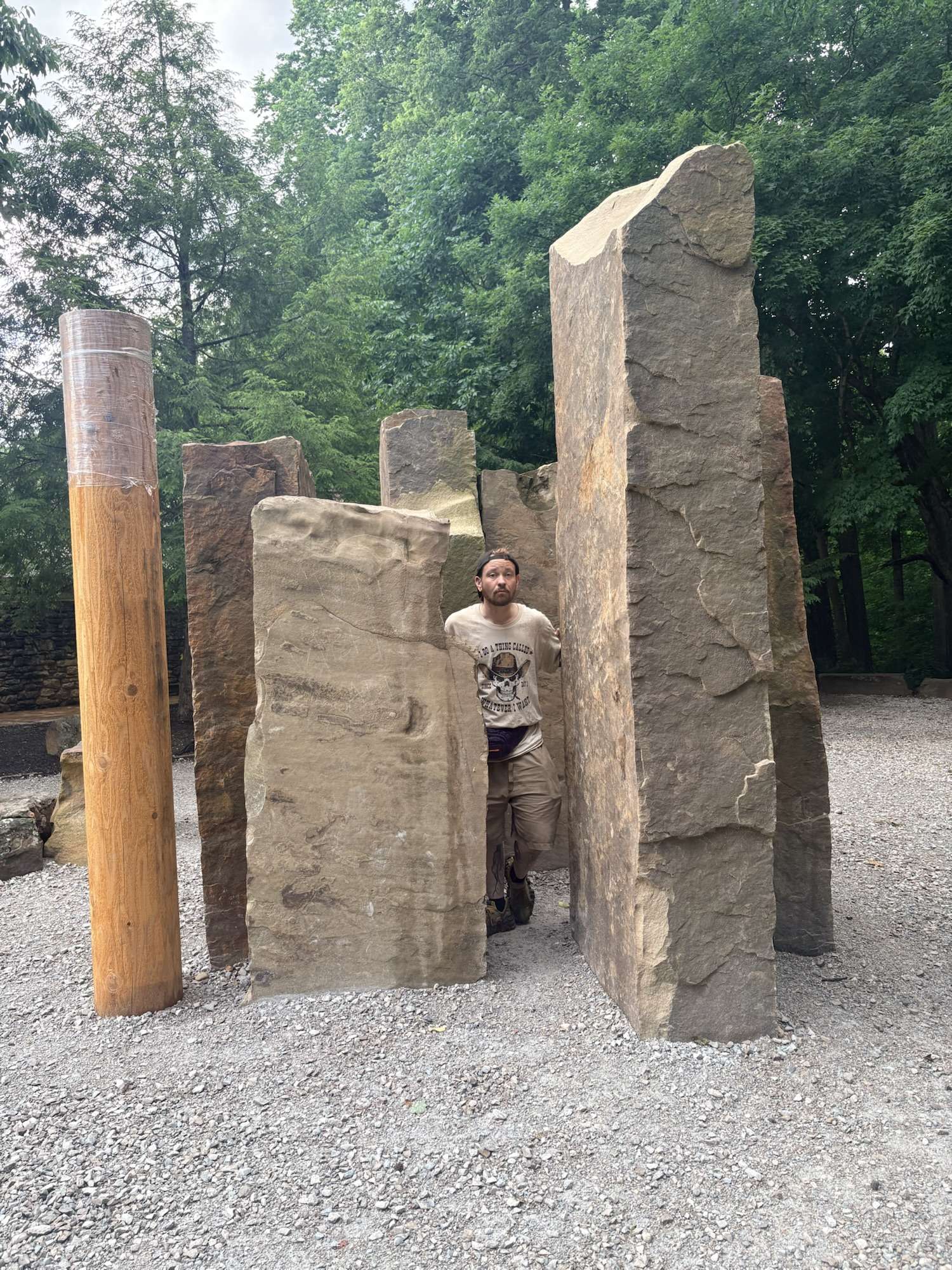
    Right off the trailhead, we spotted wild mushrooms tucked near the path, alongside a surprisingly interesting outdoor classroom area.

    The trail quickly opened up into a landscape teeming with history. There are fossils scattered everywhere along the path, and stepping inside the interpretive center even revealed a woolly mammoth fossil exhibit.

    The atmosphere of the trail had its own distinct local flavor, complete with a few local dogs on the walk and the unmistakable scent of weed drifting through the air.

    By the time the clock hit five o’clock, we had cleared the few available trails here. To enter and leave the area that I would struggle to call a beach we had to scramble over massive piles of drift logs.

    While walking along the beach we explored the exposed rock formations and looked into the small cave-like openings. This felt almost like stepping onto another planet, every inch of the stone under our feet were made of massive fossil plates.

    The kid who threw a fit just to get out of the car ended up having the absolute time of his life, demanding to know where else we could explore next. That’s just how kids are, keeping the adventure alive right to the end.

    POV: from above showing dry dirt shore of the Ohio river at Falls of Ohio State park. Included in photo are some of the logs that had to be scrambled over.

    The Ancient Architecture:

    The Falls of the Ohio State Park is a unique geological and ecological sanctuary situated along the Ohio River in Clarksville, Indiana. Unlike typical waterfalls driven by vertical drops, the “falls” are actually a 2.5 mile series of rapids and cascading limestone ledges where the river drops about 26 feet over a relatively short distance.

    This dramatic descent historically created the only major navigational hazard for early riverboat travelers, requiring flatboats and steamboats to navigate carefully or portage around the turbulent stretch. Today, the park serves as a protected National Wildlife Conservation Area and state park. The goal here is preserving one of the largest exposed Devonian fossil beds in the world.

    When river levels drop during the late summer and autumn months, vast acres of limestone emerge from the water, allowing visitors to walk directly across an ancient seafloor that spans hundreds of millions of years of Earth’s history.

    Small cave like indentation in the rocks lining the beach area full of fossil impressions.

    Coral Reefs & Devonian Seas:

    The reason fossils are so overwhelmingly abundant here comes down to ancient geography. Approximately 390 million years ago, during the Devonian Period, the region that is now the American Midwest sat near the equator, completely submerged beneath a shallow, warm tropical inland sea.

    This prehistoric ocean swarmed with marine life comparable to modern coral reefs. As ancient corals, brachiopods, bryozoans, crinoids, and stromatoporoids lived, died, and accumulated on the seafloor, their calcium carbonate skeletal structures were compressed and lithified into dense layers of limestone over millions of years.

    Because the Ohio River continually scours away the overlying mud and sediment, these massive fossil plates are exposed in stunning preservation. Walking across the limestone shelves reveals intricate patterns of horn corals, honeycomb corals, and crinoid stems frozen directly into the bedrock. It is a living museum where stepping stones are literal fragments of an ancient tropical reef.

    A mix of loose fossils found on the beach at Falls of Ohio state park held in the palm of a hand with a water bottle and large rocks in the background.

    Industrial Horizons – Dams & Massive Rail Bridges:

    While looking down reveals millions of years of natural history, looking up and across the landscape frames the heavy footprint of human engineering. Dominating the immediate view from the park are two monumental structures: the McAlpine Locks and Dam system and the sprawling, industrial spans of nearby railway bridges crossing the Ohio River.

    The dam regulates the powerful river currents, drastically altering the natural water levels that once defined the wild, roaring rapids of the historic falls. Parallel to the water management structures, the massive steel lattice of the historic railroad bridges stretches across the horizon. These industrial iron giants frame the ancient riverbanks, creating a striking visual contrast between the heavy infrastructure of the 19th and 20th centuries and the 390-year-old fossil plates resting quietly beneath their shadows.

    Photo shows large dry rock formations full of fossils, the Ohio river, the dam, and the train bridges all located at Falls of Ohio State Park in Indiana.

    Feeling Small:

    One of the main things that keeps me coming back to places like this in nature is the reoccurring realization just how small we are. Looking from the bridges, to the dam, to the fossils, and back to the massive Ohio River it is impossible not to feel almost microscopic here.

    Leaving the riverbanks behind, the transition back to the everyday world comes with a lingering sense of perspective. A landscape built from ancient coral reefs, framed by steel bridges and modern currents, leaves a quiet mark on anyone willing to scramble across the logs and look down at the stone beneath their feet.

    Man in a black backwards hat and black t-shirt poses with a girl in a maroon shirt at Falls of Ohio State Park in Indiana.

    Read More:

    Thistlethwaite Falls. Fossil Park.

    AllTrails. Falls of Ohio State Park.


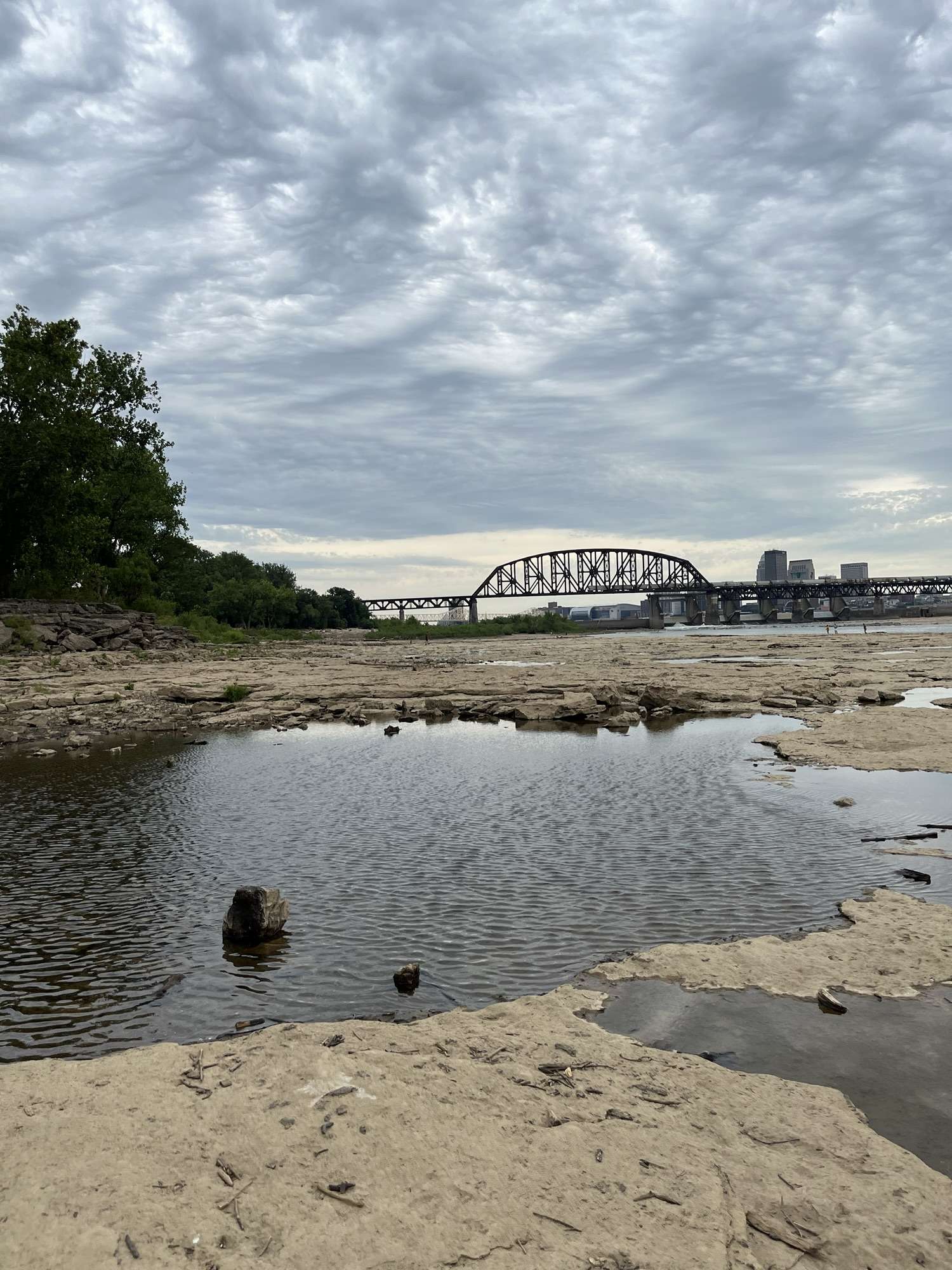
    Image shows scattered puddles on large rocks making up the beach area at Falls of Ohio State Park. In the distance the picture shows the Ohio river, the dam, and blue cloudy skies.
  • The Midnight Trek: Exploring at Shelbyville State Fish & Wildlife Area

    The Midnight Trek: Exploring at Shelbyville State Fish & Wildlife Area


    Best For:

    Midwest hikers seeking hidden gems, individuals interested in nocturnal nature, & readers looking for nature based journals.

    The Essence:

     Read Time: ⏰ 4 minutes |Mood: ✨ slightly surreal & full of wonder | Weight: 🪞 Reflective & grounded


    Trail Notes:

    • Location: Shelbyville, Illinois State Fish & Wildlife Area (Open 24 hours with minimal light pollution)
    • Date & Time: June 16th – June 17th 2026 parked at 11:15 PM CT left just after 1:15 AM CT.
    • Distance & Pace: Just over one mile packed into roughly two hours of slow, deliberate exploring.
    • Wildlife & Encounters: Frogs, a strange juvenile fish, frantic splashing in the shallows, a spider, and local net-trappers working the walkways.
    • Surprises: A stray flannel shirt, rising floodwaters requiring some creative barrier-hopping, & a sky full of stars that made the night air worth every minute.
    Jonathan Creek & Shelbyville State Fish & Wildlife Area sign.

    Shelbyville, Illinois – State Fish & Wildlife Area


    Understanding the Space – Shelbyville Fish & Wildlife Area:

    When you explore areas after dark, you are entering a managed ecosystem designed to balance public recreation with conservation. These properties often permit hunting, fishing, and hiking around the clock and, they take on a completely different personality once the sun goes down. Daytime visitors give way to nocturnal wildlife and night anglers setting up along the water’s edge.

    Night hiking requires a shift in how you move. Without daylight, your field of vision shrinks to whatever your headlamp beam catches, forcing you to rely heavily on sound and touch. The ambient temperature drops, dampness rolls off the water, and the forest canopy overhead frames patches of deep, undisturbed space that are increasingly hard to find near populated corridors.

    Taelor and I got out tonight for roughly two hours to explore after dark. We didn’t expect the sound of nocturnal nature to be so loud. When visual stimulation drops to your general surroundings your ears pick up the slack. Watch out the sound of fish splashing in the shallows may even be enough to startle you if you’re not careful.

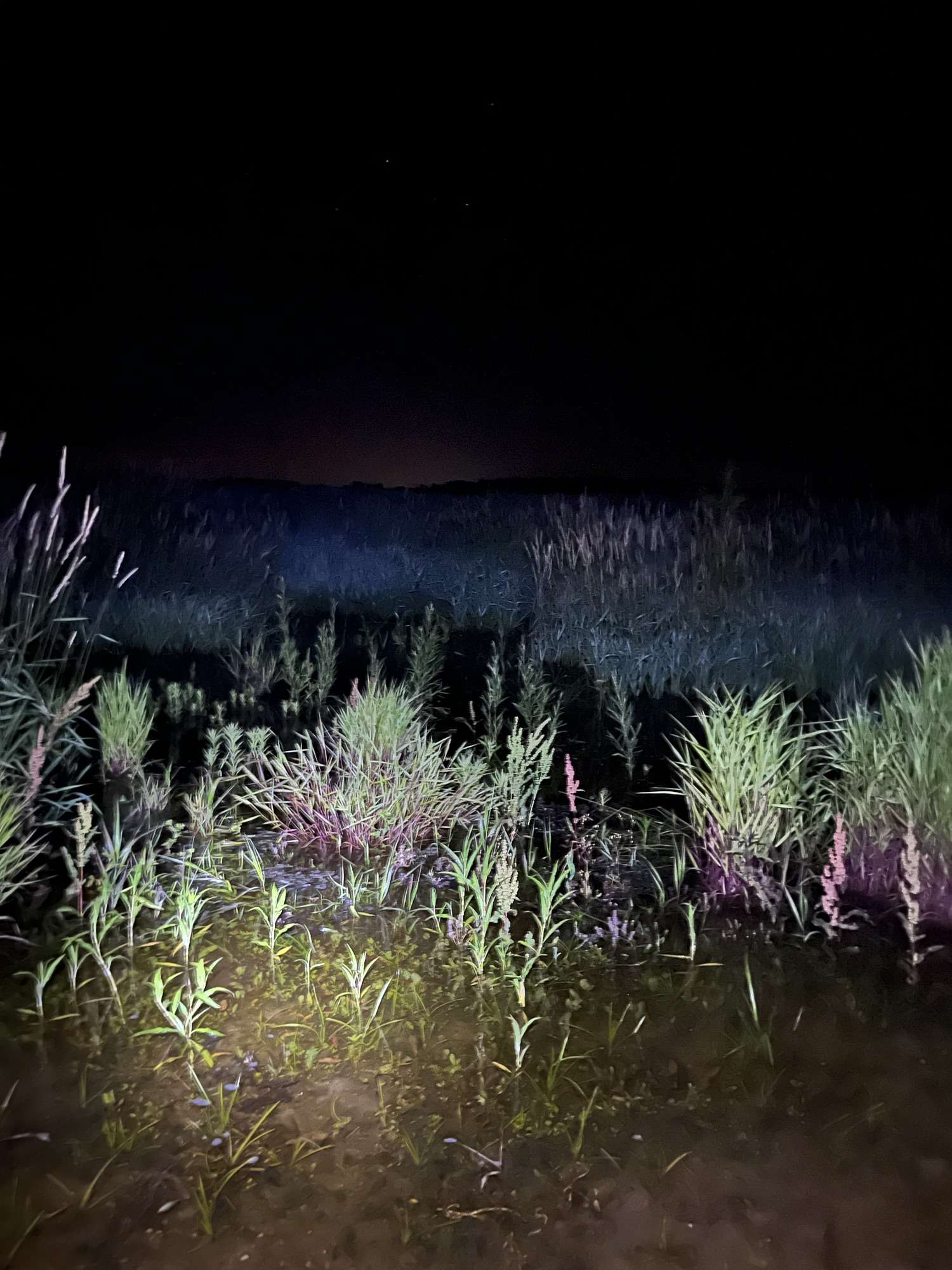
    Ripples from small fish splashing in the shallow lake water at Shelbyville State Fish & wildlife area.

    Some miles are for soaking in the sun, others use the moon as their muse.


    Breaking the Surface – Midnight Life in the Shallows:

    Stepping onto a trail or into wildlife areas after dark changes the rules of nature. The daytime noise drains away, leaving room for the sounds you usually miss…

    What was that rustling in the underbrush? Did you hear the heavy splash of an unseen animal moving through the water in the darkness?

    Do you feel the strange, electric hum of an ecosystem that wakes up when the sun goes down?

    Tae and I walked a little over a mile in two hours. We were constantly stopping every few steps to look closer at what the beams from our headlamps illuminated. After all we were not racing the clock tonight. We spent a lot of time taking photographs, collecting rocks, and jumping at the unexpected splashing coming from the fish near the shallows.

    The water levels were high, spilling out over their normal boundaries like I suppose they often do around here. In some spots, we just trudged right through the wet gravel of the trail that runs through the small lake here. Others spots were to deep so we had to hop from small concrete barrier to concrete barrier to keep our shoes and pants dry.

    Rectangle concrete barriers surrounded by flooded lake water.

    Nocturnal Wildlife:

    The real show, though, happened down near the water. We spotted a frog holding still near the edge, and another clinging to the edge of a concrete block.

    The shallows were alive with motion. A bunch of smaller fish, maybe minnows, were splashing aggressively, creating rhythmic, chaotic bursts of sound that broke the silence. Down the path a bit further was one weird-looking juvenile fish that didn’t quite fit the usual mold. The fish had an elongated mouth, resembling a gar almost.

    Further down toward the end of the trek, near the bridge that was partially swallowed by the rising water, we heard heavier, booming splashes, accompanied by people setting net traps near the walkway.

    Unusual looking long nose fish swimming in the shallows under a beam of headlamp light.

    Midnight Fish Behavior:

    The most interesting and albeit startling part of the night wasn’t just the silence, it was the noise coming from the water. Did you know that in shallow aquatic zones, nighttime triggers distinct biological shifts for fish and amphibians?

    Many species of fish move into the shallows after dark to feed on insects, amphibians, and organic matter washed in by high water levels, while others use the cover of darkness to escape larger predatory fish that hunt by sight during the day. This behavioral shift creates the chaotic, rhythmic splashing you hear break the surface.

    Small frog swims above the gravel trail in the flooded lake waters.

    Relics & the Starry Sky:

    No trek out with Taelor is complete without finding some bizarre article of clothing left behind by humans. True to form, we tracked down a stray flannel shirt hanging on a pole near the path. At least it wasn’t underwear this time, so we’ll chalk that up as a win.

    Beyond the oddities on the ground, the main event was overhead. Out here, with minimal to no light pollution, the night sky opens up in a way that feels increasingly rare. You forget how many stars are actually hiding behind the ambient glow of everyday life until you step into a dark-sky pocket and let your eyes adjust.

    We also picked up a few small fossils, minerals, and crystals along the way. These are tiny tactile souvenirs of a landscape shaped by ancient waters and quiet earth.

    The roadway warnings back at the entrance had hinted that our drive might be flooded out like our walk was. Thankfully, the asphalt held, and the way in and out of the wildlife areas were clear. This particular stretch of land allows for hunting, fishing, and late-night wandering which offers a rare kind of outdoor freedom.

    Grey and white striped flannel hangs on a pole near the trail.

    Shelbyville, Illinois:

    There is a distinct kind of peace in exploring a place that doesn’t punch a clock. When you trade the midday heat for the chill of midnight, familiar ground turns into an entirely different map. Between the starry expanse overhead, the frantic splashing in the dark shallows, and the quiet rhythm of the walk, Shelbyville, Illinois State Fish & Wildlife Area after dark proved that the best parts of the trail only sometimes show up when the rest of the world goes to sleep.

    Bridge going across the lake at Shelbyville State Fish and Wildlife Area showing water surrounding the beginning of the bridge.

    Read More:

    Turkey Run State Park. Cucumber Falls.

    AllTrails. Hiking Playlist. Shelbyville State Fish & Wildlife Area.

    Small web hanging between metal poles with small spider in the center.
  • The Architecture of Your Pack: Modules, Time, & Terrain

    The Architecture of Your Pack: Modules, Time, & Terrain


    Best For:

    Hikers tired of rebuilding their packs from scratch every weekend, multi-hobbyists (dog owners, rockhounders, photographers), & anyone wanting to scale their gear from a quick loop to a full afternoon trek.

    The Essence:

     Read Time: 🕰️ 5–7 minutes |Mood: 🧭 Systematic & dialed-in |Weight: 🎒 Modular & efficient |


    The Vault:

    •  The 29-Minute Rule
    • The Modular System
    • The Multi-Hobby Pack Mule
    • Using your trunk space
    POV: from the back a man walks on trail under a rocky-overhang with a Fanny pack around his waist and trekking poles on his hip.

    Packing & Repacking – Losing Motivation:

    If you have to unpack your entire rucksack, stare at a pile of gear on your living room floor, and rebuild your kit from scratch every single time you want to hit the woods, you are most likely going to stay home.

    Most hiking advice treats every trip as a brand-new expedition. It forces you into a repetitive cycle of guessing what you might need, throwing it all in, and inevitably forgetting something vital, carrying three pounds of gear you don’t, or both forgetting things and bringing way to much extra crap.

    Experienced hikers don’t start from scratch. We use a system; relying on a permanent base kit combined with interchangeable modules, scaling our setups effortlessly based on whether we are walking a thirty-minute local loop or spending six hours deep in an Appalachian forest.

    Here is how you can build a modular pack that adapts to your trip instead of draining your energy before you even touch the trailhead.

    A man takes a selfie on trail with trekking poles in hand and a medium pack on his back.

    The “Twenty-Nine Minute Rule:”

    Scale matters when it comes to what you bring on your trek. If you find yourself bringing an overstuffed expedition pack on a quick thirty-minute local park loop you may end up feeling ridiculous; likewise, heading out for a six-hour trek with just one hydroflask and a prayer is asking for trouble.

    To fix this, structure your packing expectations by time and distance rather than a one-size-fits-all checklist:

    • The Local Loop (30 Minutes to 1 Hour): You are never more than a mile from a paved parking lot or cell service. Your pack should practically disappear. Keys, phone, a tiny roll of dog waste bags, and a liter of water. That’s it. Leave the heavy layers and extra gadgets in the car.
    • The Half-Day Trek (2 to 4 Hours): This is where your true day pack baseline kicks in. You need your core hydration, a first-aid basics, a headlamp, a light rain shell, and trail snacks.
    • The Deep Forest Stretch (4+ Hours): You are stepping away from civilization. This is where your specialized modules go into the bag, adding extra hydration, a portable battery bank for electronics, and extra weather protection.

    By matching your pack weight directly to the clock and the weather, you stop carrying unnecessary baggage on short walks while staying appropriately covered for longer miles.

    A man takes a side view mirror photo showing his 90 liter pack full and ready to go for a three day backpacking trip through Appalachia.

    The Modular Pack System:

    Instead of a chaotic catch-all bag, your pack should function like a tool belt. You have your Permanent Base Kit (the essentials that never leave the bag: first aid, multi-tool, headlamp), and then you fill up external pouches or compartments with other tools depending on the mission profile of the day.

    • The Dog Module: A dedicated zippered pouch holding the long line, a collapsible silicone bowl, extra waste bags, and doggie shoes. If Luna isn’t coming on the hike, this entire pouch stays on the shelf.
    • The Rockhounding Module: A small, sturdy canvas bag for mineral finds, a pocket brush, a small pickaxe, and a compact hand lens. When you’re just doing a standard walk, leave the rock tools behind and let your shoulders rest.
    • The Cold Weather Module: A separate packing cube containing your seasonal adjustments, extra wool socks, thermal beanies, or thermals.

    You don’t rebuild the pack; you just swap the modules. It turns prep time from twenty minutes of anxious guesswork into a ten-second snap-in routine.

    A photo taken at a side angle of a man and a dog crouching in front of a pond. The man is wearing a medium sized backpack.

    The Hiker, Rockhound, & Dog Owner Problem:

    Let’s address the elephant in the woods: most gear guides assume you are doing one thing. They assume you are just walking, or just birdwatching, or just trail-running.

    Your reality is messier. You are hiking with your dog, keeping an eye out for interesting fossils or Flint Ridge chert along the creek bed, and maybe trying to snap a few photos of a rare wildflower. If you add specialized gear for every single hobby into your bag simultaneously, you will instantly transform yourself into an exhausted pack mule.

    How do you balance competing priorities without breaking your back?

    • Prioritize the Primary Engine: Your feet and your dog are the primary engine of the hike. Their gear is non-negotiable.
    • Rotate Secondary Hobbies: If today is a heavy rockhounding mission along a creek, leave the photography telephoto lens at home. If it’s a scenic walk through Hocking Hills, leave the heavy digging tools in the trunk and enjoy the views.
    • Use the Car as an Extension of the Pack: Not everything has to live on your spine. Your trunk can act as your basecamp staging ground.
    A man takes a mirror selfie with large hiking pay visable on his back. A before the hike photo.

    The Car Basecamp & Trail Pack Duo:

    One of the best organizational secrets you can adopt is drawing a hard boundary line between what lives in your vehicle and what actually goes onto your back.

    • Stays in the Trunk (Car Basecamp): A gallon jug of emergency water, a spare change of socks and shoes for the drive home, a full-sized first-aid kit, a heavier blanket, and dirty-gear storage bins.
    • Goes on the Trail (The Pack): Just the lightweight, high-utility tools required for the specific duration of today’s hike.

    When you stop treating your day pack as a rolling closet for your entire trunk’s inventory, your pack stays light, your shoulders stop aching, and getting outside becomes effortless.

    POV: side view of a man sitting on a wooden footbridge wearing a large backpack.

    Moving Forward:

    A well-designed pack isn’t a random collection of survival items; it’s a living system. By using time and weather based rules, modular pouches, and a smart split between your car and your back, you take the friction out of the outdoors.

    Build your modules, stage your gear, and let the trail be about the walk, not the weight.


    Read More:

    Gear-Guide. Leave No Trace.

    AllTrails.

  • The Anti-Affiliate Gear Guide: Building a Realist Day Pack for Midwest Trails

    The Anti-Affiliate Gear Guide: Building a Realist Day Pack for Midwest Trails


    Best For:

    Hikers looking for an alternative gear list, nature enthusiasts fighting burnout, & anyone interested in learning more about prepping for a day hike.

    The Essence:

    Read Time: 🕰️ 4- 6 minutes| Mood: ☀️ pragmatic & freeing| Weight: 🪶 realistic & light |


    The Vault:

    • Just in Case packing
    • The Grab & Go System
    • The Audit
    A man in a fanny pack holding trekking poles poses while standing on top of a bench on trail.

    Nature & Hiking Influencers:

    I bet if you go type “day pack checklist” into any search engine you will instantly drown in a sea of capitalism fueled by corporate recommendations. You’ll be sold a forty-liter technical pack, an ultralight water filtration pump, an emergency bivvy sack, and a titanium spork all for a three mile metro-park loop.

    Most of these lists are written for algorithm optimization, for affiliate commissions, or by mountaineers prepping for an alpine traverse above the tree line. They are entirely disconnected from the reality of walking a muddy trail through an Ohio state forest, scrambling over slippery sandstone around Hocking Hills, or keeping your footing along a slick creek bed.

    When your gear list is built for Everest, it creates a massive barrier between you and simply getting outside.

    It’s time to strip away the gear paranoia, and actually build a realistic day pack for Midwest trails. Beat prep fatigue, and figure out how a piece of equipment can earn its weight in your bag.

    POV: photo taken in the mirror of a yellow haired man standing sideways with a full 90 liter multi day pack on his back.

    The Myth of the “Just in Case”:

    Fear is the heaviest thing you can carry.

    When you first start hiking, every excursion feels like a high-stakes survival scenario. You pack for the absolute worst-case catastrophe: sudden hypothermia in July, getting lost for three days in a local metro park with cell service, or sudden wildlife encounters.

    You end up hauling twenty pounds of dead weight: multi-tools you never unclip, heavy flashlights, redundant fire starters, and enough cordage to rig a mainsail. Why? A blog post told you that “being prepared” means looking like a hardware store exploded in your rucksack.

    Experience teaches you a much more lightweight truth. On a regional day hike, preparedness isn’t about hoarding gear; it’s about managing actual, localized risks.

    When you shift from fear-based packing to competence-based packing, your pack shrinks and the weight drops off your shoulders. Suddenly, you aren’t a pack mule struggling up a ridge, you’re just a person walking in the woods.

    Photo taken from behind shows a man sitting on the edge of a cliff holding his hands above his head to make the shape of a heart.

    The “Grab and Go” System:

    The biggest obstacle to hitting the trail isn’t distance, terrain, or lack of fitness. It’s friction.

    If every Saturday morning hike requires a twenty-minute logistical scramble of hunting down your water bottles, untangling dog leashes, searching for a stray headlamp, and packing snacks from scratch, your brain will find a way to talk you out of going. Preparation fatigue kills more adventures than bad weather ever will.

    To fix this, you have to eliminate the pre-trip assembly line. Keep your hiking shoes by the door or even in your trunk. Whatever you do don’t bury them in a closet under three bins full of unworn shoes and gear.

    Establishing your permanent base kit is a must for getting your trek started quickly. Certain items live inside the bag permanently.

    Stage your hydration. Wash your bottles the second you get home from a hike, dry them, and put them straight back into the pack pockets. Refill your bottles or camel-pack before you leave for each trek.

    Keep your dog gear clipped or hung together. If you hike with a dog, waste bags, collapsible bowl, and long lines can stay in one designated pocket of the pack.

    When your bag is already staged, walking out the door requires zero cognitive load. You grab the handle, toss in a fresh apple, some protein bars, fruit snacks or a bag of trail mix, and go.

    POV: from the back a man wearing jeans and a medium backpack with a tie-dyed hoodie over his shoulder on trail.

    The “Earned Its Weight” Audit:

    Every trek, your gear needs to justify its existence inside your bag. A backpack is real estate, and every square inch should be rented out by something useful.

    To clear out the clutter, apply two strict rules:

    • The Seasonal Rule: As the seasons change your gear should too. Things like ice spikes, heated gloves, thermals, and other cold weather gear don’t belong in a summer hiking pack.
    • The “Twice” Rule: If you find yourself on a hike, twice wishing you had a specific item that you left behind, that item earns a permanent, non-negotiable spot in your kit. Experience defines the gaps in your system far better than an internet checklist ever could.

    When you audit your bag through this lens, you stop carrying gear for hypothetical scenarios and start carrying gear tailored to your actual rhythm in the woods.

    POV: from the back a man stands in a silly pose at the mouth of a cave holding trekking poles.

    Moving Forward:

    Building a real day pack isn’t about buying more stuff. It’s about subtraction. It’s about recognizing that a lighter pack lets you look up at the canopy instead of staring at your boots, wondering why your shoulders hurt.

    Keep it simple. Keep it staged. Let your gear earn its place.


    Read More:

    Sustainable Hiking. Bucket List Hikes. Trail Etiquette.

  • Turkey Run State Park- Waterfalls & Warnings:

    Turkey Run State Park- Waterfalls & Warnings:


    Best For:

    Hikers who like rugged terrain, people who would rather explore many trails than just the land they know, road-trippers building an adventure-log around a destination, and anyone who considers a little questionable weather part of the story.

    The Essence:

    Read Time: ⏰ 8–10 minutes | Weight: 🥾 Rugged & adventurous | Mood: ⛈️ Chaotic, curious & exhilarated


    Trail Log:

    • Our Trek: 3.29 miles in 1 hour and 39 minutes
    • The Views Before Trekking
    • Turkey Run’s Parking, Fees, & Facilities
    • Climbing & Crab-Walking
    • A tornado warning arriving at the worst possible time
    Image shows large fluffy white clouds and flat farm land next to the road.

    Sometimes the Adventures Start Before the Trek:

    The trip through Indiana and Illinois started handing us views before we even hit our first trailhead. Driving down the highway we saw many fields of farm land and blue skies that held alien-like cloud formations which seemed to line the road.

    Driving here I noticed that the lack of foothills and mountains was almost anxiety inducing. It’s a large contrast to what I’m used to from growing up in the Appalachian region where the hills frame everything I typically take in.

    Taelor and I were about 14 miles from the trailhead when we saw a crop circle. Except this wasn’t a crop circle in the traditional mysterious sense. It was a smiley face.

    We were on our way to spend two days chasing trails across state lines, and apparently Indiana wanted to greet us with a giant agricultural emoji. We reached Turkey Run at around 5 PM and the actual adventure could finally begin.

    From a side pov: a bearded man in a hat and sunglasses faces forward driving while a long haired passenger puts a peace sign up.
    On the road again..

    Turkey Run State Park:

    Turkey Run State Park sits near Marshall, Indiana, along Sugar Creek. This is not your average hike nor is it the type of park where hiking means always following a dirt path through the woods.

    The park is known for:

    • deep sandstone ravines
    • steep canyon walls
    • creek beds
    • Wooden ladders
    • suspension bridge
    • rugged trails

    The Indiana DNR currently describes Trail 3 as very rugged, with the route running through the steep walls of Rocky and Bear hollows. They warn that some portions can become impassable during high water.

    Which, in hindsight, this made our timing not great.

    There was weather coming even though I had checked the radar in the days and weeks approaching our trip and it always read clear skies.

    Entry Fee:

    It was $15 per car to enter Turkey Run State Park as out-of-state visitors.

    We also got a physical map for an additional $1. Why not support the park and have something to take home? Considering we were about to head into a maze of sandstone ravines, even though I had downloaded an offline digital map, a physical map would provide us with an extra layer of safety.

    Wooden sign behind a wooden fence near the trail head prompting you to leave debris on the ground to establish the natural ecosystems.

    Parking:

    I know I can’t be alone with the confusion parking lots provide. We ended up parking more than a quarter mile from the trailhead. I kept getting turned around and needed to find a restroom soon. So we parked at the office.

    As my luck would have it the office where we parked was, of course, closed.

    The Facilities:

    Tae and I opted to just walk to the restroom building positioned by the trailhead that we planned to utilize. Turkey Run State Park has a few facilities positioned near different trail heads, picnic areas, sports fields, and other park amenities.

    The park also offers a pool, multiple trails, tennis courts, basketball courts, picnic areas, and ball fields.

    I had one of the stickers I bought from titty graveyard on Etsy with me. They have a trans flag with a white snail depicted on them and, they say, “A trans person peed here and no one noticed.” What better to do than stick one inside the restroom.

    Rocky Hollow Nature Preserve Sign on Trail

    Gear I Packed for Turkey Run State Park:

    I never walk into a trek completely unprepared. That is irresponsible and does not set you up for a good trip. I knew the trek would be up to roughly 2 miles if not longer. In preparation for this I brought:

    • A gallon of water
    • Trekking poles
    • Four protein bars, fruit snacks, & trail mix
    • Hiking shoes
    • A general first-aid kit
    • An offline map & the paper park map
    • 2 headlamps
    • 2 power banks
    • Extra chargers
    • Layered clothing
    • A reusable poncho

    Most of the things I packed fit into my mom’s old fanny-pack which I used on this trek. The things that did not fit inside the fanny-pack attached to the waist strap nicely for hands-free carrying.

    Man in khaki shorts and tan shirt from the back walking under a cliff overhang at Turkey Run State Park.

    Our Plan for Turkey Run State Park:

    The plan was to do at least 2 miles over the loop for trails 3 & 10. We weren’t interested in doing the easy parts. We came with the intention to see the Punch Bowl, Bear Hollow, the Ice Box, and the infamous wooden ladders. These were the major features along the route we planned to take.

    Turkey Run State Park’s terrain is not just scenery surrounding a trail. The terrain literally is the trail. In many places you’ll find yourself wondering where the trail went just to realize you never left it after you push forward.

    The IDNR notes that a lot of the park’s trails include portions that use ravine streambeds as trail surfaces. This means the ground can become slick and uneven, and high water can make sections impassable.

    From the back photo shows a man in khaki shorts and tan shirt walking up the trail that goes over the face of a small waterfall at Turkey Run State Park.

    Turkey Run State Park’s Ravines:

    Standing inside Turkey Run State Park’s ravines, it is easy to look at the sandstone walls and feel small. Surrounded by large cliffs while walking in the gorge you trace the path of the water that’s been eroding rock here for centuries.

    The exposed bedrock here is Mansfield sandstone, which formed from sediments deposited hundreds of millions of years ago. IDNR’s interpretive material describes sandstone deposits dating to the Pennsylvanian Period, when large rivers carried sediment into an inland sea. Over enormous spans of time, that sand was compacted and cemented into sandstone.

    Then the glaciers came. Glacial meltwater helped carve the existing sandstone into the deep ravines and formations that make Turkey Run State Park such a different hiking environment.

    When you’re scrambling over the rocks, walking through the ravines or climbing beside those enormous sandstone walls, you’re walking among the leftovers of several completely different geological worlds.

    The kind of terrain where you can’t just put your head down and walk for five miles because the trail itself keeps demanding your attention.

    Waterfall at Turkey Run State Park into the Punch Bowl.
    Waterfall at The Punch Bowl

    The Suspension Bridge & Weather Warning:

    After leaving the restroom we started past the trailhead and down the dirt trail to a gravel lot where an IDNR officer sat in his patrol vehicle. Directly behind him was Rocky Hollow Suspension Bridge.

    The officer stopped us and asked if we had “missed the alert for the thunderstorm.” In return, I asked him if he was referring to the “few claps of thunder we had heard recently.” We went back and forth with him a few times but, eventually, we came to the conclusion that we were allowed to hike still just at our own risk.

    We were also already there, so of course we kept pushing. This is probably the point in the story where a reasonable person expects me to say that I was just messing around and of course we immediately turned around.

    We did not… a little potential rain and thunder never stopped me before. After all there are a lot of cliffs we could take cover under, right?

    The weather still hadn’t even arrived, it was still a hypothetical.

    A man in a tan t-shirt and black backwards hat stands slightly in front and to the side of a woman in a purple tank-top on the suspension bridge at Turkey Run State Park.

    The Punch Bowl & The Wedge:

    We made our way through the Wedge and the Punch Bowl, and we didn’t approach them delicately.

    We climbed. We scrambled.

    We crab walked? One of us almost did a split? We went sliding through mud and across sandstone, while we trekked all around trails 3 and 10.

    You could even say that we went through the whole thing like a couple of spider monkeys. Yet somehow there was still no rain.

    The Punch Bowl which is one of Turkey Run State Park’s more interesting geological features is a pothole under a small waterfall. This pothole formed when a glacial erratic became trapped in moving water and repeatedly swirled against the sandstone, gradually grinding out the depression we see today.

    The Wedge has a different geological origin. Indiana’s geological interpretation of the park describes it as a block separated from the canyon wall along a fracture, or joint, in the sandstone.

    At one point we even had to hike up the front of a waterfall.

    Lush forest, stream, and ravine at Turkey Run State Park in Indiana.

    The Wooden Ladders:

    A while back I saw a video of hikers at Turkey Run State Park descending down these large wooden ladders into ravines below, it was in that moment I knew I too wanted to climb down them.

    Turkey Run’s Trail 3 is officially classified as very rugged and is specifically known for these ladders, passing between the steep walls of Rocky and Bear hollows.

    Though we had yet to be greeted by the storm, the thunder grew louder and was why we kept pushing faster down the trail.

    The entire way Taelor and I made jokes about how a little thunder couldn’t deter us. Right before we approached the ladders I told Tae “I bet the downpour starts when we are on the ladders.”

    POV: above as a man in khaki shorts, black hat, and tan shirt climbs down a wooden ladder in the rain on trail 3 at Turkey Run State Park.

    I started down the ladder, the clouds opened up and drenched me with rain, and both our phones started sending out the screaming weather alert tones at the same damn time.

    “TAKE SHELTER NOW.

    IMMINENT THREAT. TORNADO.”

    That got our attention. Suddenly, the fact that we had been joking about the weather became considerably less funny.

    We spent the entire hike watching the sky threaten us, and mocking the thunder.

    The sky finally decided it had waited long enough. Two hikers suddenly decided the best possible hiking speed was get-the-fuck-out-of-here speed.

    Screenshot of a cellphone lock screen showing two weather emergency alerts for a tornado as well as alltrails+ trail tracking widget.

    Turkey Run State Park Taught Us:

    Every hike is different.

    Some hikes are about distance others focus on elevation. On some hikes you find waterfalls and cool stones. Turkey Run State Park was about the terrain itself.

    This was the kind of place where the landscape changed underneath our feet, where a trail could turn into a sandstone ravine, a ladder, a waterfall crossing or a scramble without much warning.

    Maybe that’s why it had been sitting on my list and at the forefront of my mind. I don’t just want trails that take me somewhere. I want trails that make me remember how I got there.

    Turkey Run State Park definitely did that… even though we did the trail at super speed.

    A man wearing backwards black hat, khaki shorts, and a tan shirt holding yellow trekking poles poses while standing on a bench at the end of the trail at Turkey Run State Park.

    Plan Your Trek:

    Turkey Run State Park. Rock Hollow Preserve, Indiana. AllTrails.

    Hike Sustainably.

    Hype Hiking Playlist.

  • Finding Home in the In-Between: A Journey Through “Roaming”

    Finding Home in the In-Between: A Journey Through “Roaming”


    Best For:

    Individuals who struggle with traditional linear paths of productivity, People navigating gender transition, those people familiar with identity fragmentation, & the chronically restless souls.

    The Essence:

    Read Time: ⏰ 2–3 minutes | Weight: 🤛 Heavy & Vulnerable | Mood: 🙁 Yearning & Melancholic |


    The Vault:

    • “Roaming” an Original Poem by: Axton N. O. Mitchell
    • Poet’s Note
    An orange and yellow leaf lays on the rocks beside a shallow stream.

    Roaming All Over:

    What does it mean to be everywhere at once, yet feel entirely displaced? In this original poem by: Axton N. O. Mitchell, we explore the intricate dance of perpetual motion, neurodivergence, and identity.

    Through the lens of this short-form poem, titled “Roaming,” we dive into the physical and mental restlessness of searching for a sense of self when the map keeps shifting. Whether you are navigating gender, grief, mental health, neurodivergence, or simply trying to find stillness in a chaotic world, this micro-poem invites you to pause, wander, and reflect on what it means to be a lifelong seeker.


    “Roaming:”

    An Original Poem by:

    Axton N. O. Mitchell

    Destined

    Forever to be

    the boy…

    Roaming.

    Full of wonder

    w

    a

    i

    t

    i

    n

    g

    Getting no where fast;

    Yet somehow he’s

    been

    e

    v

    e

    r

    y

    w

    h

    e

    r

    e

    Restless and roaming…

    A man in khaki shorts, green and orange croc junipers, a black t-shirt, and a backwards cap wearing a hiking pack sits on a wooden footbridge in the woods.

    The Weight of Restlessness:

    When I sat down to write this, I was staring at a heavy sense of restlessness. No matter what I do, I feel like I have to be always moving. This can be said for both physical and mental movement.

    Roaming.

    I find constantly looking for myself in the shadows where I walk.

    Living at the intersection of Borderline Personality Disorder (BPD), neurodivergence, and being transgender means that my internal landscape is always shifting. I often feel like I am looking for a version of myself that I finally recognize, yet I never quite feel like I’ve found home.

    The scattered letters in words like waiting and everywhere in the poem were designed to mimic that exact feeling: a visual stretching out, a sense of fragmentation, and the vertigo of floating through time and space without an anchor.

    At the same time, I know that the interpretation of art belongs to whoever is experiencing it. While this is the truth of what I was sitting with when these words spilled onto my page, art is still entirely subjective. What reads to me as trans and neurodivergent displacement might read to you as the grief of a missed connection, the anxiety of modern burnout, or the quiet wonder of a traveler who loves the journey more than the destination.

    All of those interpretations and any others are completely valid, true, and welcomed here.


    Embracing the Wander:

    Ultimately, we all know that the human experience is rarely a straight line from point A to point B. Even when it feels like we are “getting nowhere fast,” every step of the walk teaches us something about our endurance.

    The beauty of being a perpetual roamer isn’t about finally reaching a static destination… it’s about learning how to inhabit the spaces of uncertainty with grace, curiosity, and self-compassion.

    What does “roaming” look like for you in your life right now?

    The overlook on Airplane rock in Hocking State Forest.

    Read More:

    Sunlight & Moonbeams – A Nature Poem

    Fuck a trek – A Hiking Poem


  • Green Smoke & Stones: The Metaphysics of Cannabis Leaves

    Green Smoke & Stones: The Metaphysics of Cannabis Leaves


    Best For:

    Individuals practicing witchcraft who participate in Cannabis Culture, beginner witches looking to connect their leisure and spiritual rituals, and readers interested in the process of making their altar actually theirs.

    The Essence:

    Read Time: 🕰️ 7-9 mins| Weight: 🍃 moderate | Mood: 🔮 reflective & grounded|

    The Vault:

    • Cannabis & the Witches Altar
    • Vision, Clarity, & Altered Perception
    • Inner Peace, Stillness, & the Pause
    • Abundance, Growth, & Sustenance
    • Herbalism & Folk Healing
    • The Eclectic Altar

    The Method to the Madness:

    On top of the Witches Altar:

    There is a quiet almost, sacred rhythm to working with your hands… snip by snip, trimming away the sugar leaves where buds take shape. It is an immersive, tactile ritual all its own: the sticky resin on your fingers, the earthy, herbal aroma hanging heavy in the air, and the slow, deliberate focus required to get the job done.

    In those quiet moments of harvest, it’s natural to pause for a moment or two while you look at a handful of discarded fan leaves or delicate sugar trim. This is when I start to feel a spark of connection.

    Instead of tossing them away, you might find yourself setting a few aside so later you can slip them into a small cup to rest upon your altar. This goes far beyond the usual simple nod to the earth element. When I bring cannabis leaves onto my altar I do so with the intention of introducing a rich tapestry of folk tradition, metaphysical symbolism, and personal resonance to my spiritual space.

    Whether your altar is a dedicated space for ritual, a surface where you honor something, a corner for quiet reflection, or a working surface for your craft, integrating these leaves can help bridge the gap between everyday life and sacred intention. Here is a deeper look into what cannabis leaves can represent when placed upon your altar, and how they fit into the broader, eclectic tapestry of witchcraft.

    You do not have to check parts of yourself at the door when making your altar.

    A view of my altar from the side shows the purple backdrop tapestry, deer antlers, found stones, and other items tied to nature.

    Vision, Clarity, & Altered Perception:

    Humanity’s ancient relationship with cannabis at its core has always been intertwined with consciousness-shifting. Long before modern cultivation, herbalists and folk practitioners recognized plants that alter perception as tools for looking beyond the veil of ordinary reality.

    When you place cannabis leaves on your altar, they act as a physical anchor for your Third Eye and intuition. Cannabis represents the deliberate quieting of external static. When we consume cannabis most of us are trying to slow the frantic pace of daily thoughts, calm our anxieties, or mute social expectations in order to make space for deeper insight.

    Metaphysically, this plant honors shadow work, meditation, and the courage to perceive things as they truly are rather than how society presents them. Cannabis is a symbol of inner vision: a reminder that sometimes we have to step outside our standard waking consciousness to solve a problem or truly understand our own emotional landscape.


    Inner Peace, Stillness, & the Pause:

    In the chaos of modern life finding a moment to simply stop is an act of radical self-preservation. In modern magic, the cannabis plant is tied to nervous system regulation, unwinding, and rest.

    Placing the leaves on your altar functions as a physical invocation of the pause. They remind you of the sacredness of rest, the unbending truth that burnout is not a badge of honor and that stillness is where healing happens. Placing them on your sacred space acts as a threshold marker: a boundary between the heavy, exhausting labor of the outside world and the sanctuary of your personal practice.

    Cannabis leaves can also symbolize permission to exhale, to drop your shoulders, and to let go of the day’s heavy emotional and physical burdens before entering a space of spirituality or intention.


    Abundance, Growth, & Sustenance:

    Plants do not grow by accident. Some require rich soil, balanced water, specific sunlight metrics, and even temperature control. Since cannabis is such a vigorous, resilient, and fast-growing plant, it carries a potent natural association with agricultural magic, vitality, and sustenance.

    On your altar, these vibrant green leaves are a tribute to life force energy and uninhibited natural growth. It honors the harvest, not just the physical yield of a successful grow season, but also the metaphorical harvests in your own life.

    They remind you to acknowledge that what you water, tend to, and invest your care into will eventually flourish. While also helping to show us nature’s immense generosity, the cycles of seed-to-flower, and the sustaining power of working alongside the earth to produce something tangible with your own hands.


    Herbalism & Folk Healing:

    Long before cannabis became a subject of modern political debate or a booming commercial industry, this plant was sometimes viewed through the lens of traditional herbalism. Often seen as a potent, green helper utilized for aches, inflammation, restorative sleep, and easing the body’s tensions.

    Placing the leaves on your altar can also act to honors the long, unbroken lineage of the green apothecary. It bridges the gap between pragmatic folk medicine and spiritual reverence, acknowledging that the body and the spirit are not separate entities.

    Healing is holistic. By placing these leaves among your sacred tools, you are tipping your hat to the ancient herbalists who looked to the hedgerows, fields, and gardens for medicine. It represents wholeness, bodily comfort, and the sacred right to seek relief, restoration, and physical ease.

    A scruffy-bearded man in a grey backwards hat, black sunglasses, and a tie-dyed hoodie smokes a rolled cannabis cigarette.

    Witchcraft should feel accessible, grounded, and deeply personal you don’t need to run out and buy every premade kit or follow a set of strict ancient rules… unless you want to.

    The Eclectic Altar: Heart-Shaped Rocks, Antlers, & Other Objects:

    If you look closely at an eclectic witch’s altar, you rarely find a uniform, mass-produced aesthetic. Instead, you find a living museum of a life lived outdoors: smooth heart-shaped river stones, shed deer antlers found on a morning hike, textured seashells collected from travels, raw crystals pulled from the earth, bundles of dried tobacco, and, yes, a bowl of crisp, aromatic marijuana leaves.

    To the outsider, it might look like a random assortment of nature’s oddities. But to the practitioner, it makes absolute, intuitive sense.

    Eclectic witchcraft is built on the philosophy of personal resonance and authentic connection. Your altar is not a rigid historical reenactment; it is an extension of your own mind, your environment, and your daily walk through the world.

    Every item should tell a story.

    • The heart-shaped rock carries the patient, enduring energy of water and time, representing emotional grounding and love.
    • The antlers honors the cycle of shedding and renewal, connecting us to forest spirits and wild fauna.
    • The seashells links us back to the primordial waters of the earth, carrying tides of emotion and memory.
    • The tobacco and marijuana leaves honor the sacred relationship between humans and traditional plants, or offerings of respect, altered states, and botanical kinship.

    When you bring these elements together, you are curating a microcosm of the natural world right in your own space. You aren’t forcing dogma onto your sacred space; you are listening to what calls to you during your walks through the woods, your time in the garden, or your hours working in the garage.


    Sacred & Spiritual Space:

    An altar should be a mirror of your soul and your journey. Adding the leaves from your trimmings to a simple bowl isn’t just about decoration… it is an intentional act of honoring your labor, your connection to the plant kingdom, and the quiet moments of peace found in your craft.

    When you weave together the symbolism of vision and altered perception, the sacred necessity of the pause, the deep roots of agricultural abundance, and the ancient traditions of folk healing, those simple leaves become powerful allies on your sacred table.

    Alongside your stones, antlers, shells, and crystals, they remind you that the sacred is not locked away in distant temples. It is right here in the soil, in the plants we tend, in the work of our hands, and in the wild, beautiful, eclectic life we choose to build.

    A crinoid fossil plate collected from a creek bed for placing on an Altar.

    Read More:

    Ohio’s Changing Cannabis Laws.

    Healing.


  • Stones of Sight & Time: The Deep Lore, Occurrence, & Uses of Hag Stones-

    Stones of Sight & Time: The Deep Lore, Occurrence, & Uses of Hag Stones-


    Best For:

    Readers with an interest in folklore, geology enthusiasts, & modern witchcraft practitioners.

    The Essence:

    Read Time: ⏰ 4-6 minutes | Weight: 🪶 Light & Atmospheric| Mood: 🪞 reflective & curious|


    The Vault:

    • Stones of sight
    • What is a hag stone?
    • Our Ancestors Feared & Revered, why?
    • Traditional Uses
    • How to Work with Hag Stones Today…

    Stones of Sight:

    I find a quiet thrill when walking along a shifting shoreline, eyeing the endless scatter of pebbles and shells, until I finally spot one that looks entirely different.

    A Hag Stone is a stone with a naturally bored hole right through it. In folklore, these are not seen as just ordinary pebbles. Known also as witch’s stones, adder stones, holy stones, drudestones, or fairy stones, these geological anomalies have captured human imagination for millennia.

    Before we understood the mechanics of erosion, our ancestors looked at these perforated rocks and saw portals, shields, and relics of an unseen world.

    Man wearing backwards hat holds hag stone up to eyeball to peer through it while standing in the woods.

    What Exactly Is a Hag Stone?

    To answer from a scientific standpoint, hag stones are a natural occurrence with a masterclass in patience. They are typically formed from softer sedimentary rocks (like limestone or sandstone) that contain a softer inclusion, fossil, or mineral nodule.

    Over centuries, moving water (rushing river currents, relentless ocean waves, or swirling underground springs) bombards the rock, eroding the weaker spot faster than the rest of the mineral body. Eventually, a clean hole is punched all the way through the rocks surface.

    Their creation relies on water (an element heavily tied to emotional and spiritual cleansing in folklore), traditional belief held that the stone retained the pure, dynamic energy of the currents that carved it.


    Why Our Ancestors Feared & Revered Them:

    The name “hag stone” links directly to old European folklore regarding hags, spectral crones, or malicious spirits believed to bring misfortune. Across rural Britain, Ireland, and Northern Europe, these stones were prime tools of apotropaic magic, or magic meant to turn away harm.

    • The Logic of the Hole: Traditional lore dictates that malevolent entities, dark spells, and bad intentions have sharp edges or rigid trajectories. Because of this, they cannot navigate a winding, natural aperture. Only pure energy and good fortune can pass clean through the hole.
    • The Seer’s Eye: One of the most famous legends surrounding hag stones is their ability to pierce the veil. It was believed that if you held a hag stone up to your eye, you could see right through glamour and deception. You could spot hidden faeries, track shape-shifting witches, or peer into the spirit realm.
    • The Sailor’s Safeguard: Fishermen and mariners historically threaded ropes through hag stones, hanging them from the prows of boats or carrying them in their pockets to ward off coastal squalls, sea-hags, and treacherous luck.
    A whole hag stone lays on the shoreline at a licking county stream.

    Traditional Uses Through History:

    Hag stones weren’t just kept as curiosities; they were put to work in daily agrarian and domestic life:

    • Threshold Protection: Hung by a cord (often red yarn or natural twine) above front doors or windows, hag stones acted as sentinels to keep negative entities and nightmares out of the home.
    • Livestock Keepers: Farmers would nail or tie holed flints inside barns, stable doors, or pigsties. This was done to protect horses from being “hag-ridden” (exhausted in the night by mischievous spirits) and to prevent cattle from taking ill.
    • Bedpost Wardens: Tied to a bedpost, they were thought to catch bad dreams before they reached the sleeper, functioning much like an ancestral dreamcatcher.

    How to Work with Hag Stones Today:

    If you are lucky enough to find one yourself, as old folklore states, you don’t find a hag stone; the stone finds you…there are plenty of ways to honor its history in a modern practice:

    • The Intuitive Gateway: Sit quietly in meditation, hold the stone, and gaze through the hole to ground your focus or clear mental clutter.
    • Intention Anchoring: Because the hole symbolizes a portal, you can visualize an intention or manifestation passing through the stone out into the universe.
    • A Modern Amulet: Wrap the stone in natural twine, leather, or wire and wear it as a pendant or slip it into your travel bag for grounding energy on the go.
    Two rocks containing indents that would eventually become hag stones.

    Foraged Reminders:

    Whether you view them through the lens of ancient protection magic, psychological comfort, or simply as magnificent pieces of geological art, hag stones remind us of a time when the earth felt deeply alive, speaking to us in shapes, textures, and holes carved by time.


    Read More:

    The Altar. The Kitchen Table – Working Altar.

  • Letters to the Different Versions of Me – A Transgender Man:

    Letters to the Different Versions of Me – A Transgender Man:


    Best For:

    Individuals just starting their social transition, readers interested in literature from the transgender perspective, and advocates interested in reading literature by transgender Americans.

    The Essence:

    Read Time: 🕰️ 3-5 minutes| Mood: 🫂 Tender & defiant| Weight: 🍃 Deep & grounding |


    The Vault:

    • New Me – Socially Transitioning
    • Advice & Positivity for Transgender People
    • Changing Me – Medically Transitioning
    • Growth, Dysphoria, & How Far You’ve Come

    Letters Across the Years:

    We spend so much of our lives at war with the timeline, desperate to rush past the awkward, painful chapters to get to the safety of the other side.

    Looking back across more than a decade of living fully and unapologetically as myself, I’ve realized that every single version of who I used to be deserves grace and a pat on the back for allowing me to become me. This is a bridge built across time, a way to reach backward into the fog of early transition, to offer a hand to the younger versions of me who were just trying to survive, and to map out the hard-won resilience that brought me here.

    This is a reflection on the terror of the closet, the exhausting trench-work of early medical and social transition, and the vital reminder that no matter how loud dysphoria shouts, a wider, kinder, truer life is waiting on the other side.


    The New Me:

    Axton 22 yeas old, pre-testosterone

    To the Version of Me at 22 who was just beginning to breathe…

    Axton,

    Right now, your world is both terrifying and exhilarating. You, my friend, are standing right at the threshold, holding your breath while trying to figure out how to take up space as yourself without setting off any figurative alarms.

    At 22 years old, you are juggling the exhausting work of unlearning who you were forced to be and trying to piece together who you actually are.

    I know you are spending too much time analyzing every voice inflection, every pronoun slip, every mirror check, wondering if people can see the heaviness of the weight you’ve been carrying. It feels like everyone has an opinion, a rulebook, or a glaring stare that tries to shrink you back down.

    Yet, look at how stubbornly you keep reaching for truth anyway. You already cut your hair and began wearing clothes that finally make your shoulders feel like your own. You started quietly telling the people who matter most what name to call you.

    “Axton”

    I need you to know that the terror you feel right now doesn’t mean you’re on the wrong path. It just means you care deeply about your own survival as well as your own joy.

    The days of second-guessing every introduction are extremely hard to carry, but every single small, frightening step you take is laying down the pavement for a future where you won’t have to constantly explain yourself just to exist.


    Advice & Positivity for Trans People Not Out:

    If you are reading this from a place where it still feels unsafe to speak your truth out loud, please hear this: Your reality is valid even if it is currently quiet.

    You don’t owe anyone a dramatic coming-out timeline. Protecting your peace, your housing, and your safety always comes first. Living authentically in your own head and your own private spaces while you plan your escape routes or your next moves is a completely valid form of resilience.

    The anticipation is almost always louder than the reality. Right now, your brain is running worst-case scenarios on an endless loop. While the world can be harsh, it will also surprise you with pockets of fierce, unconditional community and people who will love you without hesitation.

    The future holds a profound quietness. Someday, the exhausting hyper-vigilance will start to fade. You will wake up, put on your clothes, walk out the door, and the first thing on your mind won’t be your gender… it will just be living your life.

    Keep gathering your people and your moments. Whether it’s finding a band that makes you feel invincible, a quiet trail in the woods, or a single friend who uses your name without blinking… hold onto those anchors. They are proof that a wider, kinder world is waiting for you on the other side of this transition.


    The Changing Me:

    Two week post op double mastectomy shirtless transgender man with upper body tattoos short beard and grey shorts.

    To the Version of Me Navigating Early Transition who was in the thick of the shift,

    Axton,

    You are right in the middle of the heavy lifting now, and I won’t sugarcoat it, I know some days feel like wading through quicksand. You’ve started down the path of medical transitioning, watching your body slowly begin to align with the person you’ve always known yourself to be.

    I know the mirror is still often a battleground.

    Dysphoria has a way of shouting so loudly that it drowns out every bit of progress you’ve actually made. You find yourself scanning every angle on your body, measuring changes by the milestone, and wondering when the constant mental surveillance is going to ease up.

    I know it is exhausting holding space for the excitement of what’s changing while simultaneously carrying the grief of everything it took to get here, as well as the frustration you feel when things don’t seem to happen fast enough.

    I want you to look around at where you are right now and give yourself some grace. You are enduring an awkward, beautiful, terrifying metamorphosis. The changes happening beneath your skin and in your daily life are real, even on the days when your brain tries to convince you nothing is happening.


    Growth, Dysphoria, & How Far You’ve Come:

    If you could fast-forward and look back at this exact moment from 11.5 years down the road, here is what you would see:

    Dysphoria is a very loud tenant, but it doesn’t own the building. Right now, it feels like every single interaction is filtered through a lens of hyper-awareness and discomfort. Remember that every single month you push forward, the volume escaping that room gets turned down just a fraction. The day will come when you realize you haven’t thought about passing or being misgendered for hours, or even days, at a time.

    Growth is happening, especially in those quiet, unglamorous hours. It’s not just about the medical milestones; it’s the way your posture changes when you walk down the street, the deep, settled relief in your chest when someone uses your name naturally, and the unshakeable self-trust you are building by simply refusing to give up on yourself.

    The contrast is staggering. Looking back now from over a decade into this life, the person you are right now looks like someone holding their breath underwater.

    You are going to make it to the surface.

    You are going to inhabit a body that feels like home, surrounded by a life you carved out with your own hands.

    Hang on. You are doing harder things than you realize, and you are already winning.


    Looking Back to Move Forward:

    Transgender man with red hair, full beard, black backwards baseball cap, and black feral t-shirt stands in front of a sandstone rock wall.

    As these letters to the past versions of me stack up, a bigger picture comes into focus, one defined not by the pain of the obstacles I faced, but by the relentless stubbornness of my own joy.

    Looking back at the young adult terrified in the early stages of social transition, and looking at the person navigating the trenches of early medical changes, I realize that transition isn’t just a physical checklist. It is the steady, radical act of learning how to inhabit your own skin without flinching.

    The distance between who I was forced to pretend to be and who I fought to become is measured in tiny, invisible victories: a name spoken without hesitation, a mirror that finally feels familiar, and the quiet realization that peace is no longer a hypothetical future, but a daily reality. I made it through the storm and the life waiting on the other side is… entirely, beautifully my own.


    Read More:

    His Granite Skin – Nature & Transitioning themed Short Story

    De-Masking at the Tree-Line – Nature & Transitioning themed Short Story


  • Spit It Out: On Hypocrisy and Convenient Saviors

    Spit It Out: On Hypocrisy and Convenient Saviors


    Best For:

    Individuals deconstructing religious upbringings, readers with alternative spiritual beliefs, poetry lovers looking for like-minded authors.

    The Essence:

    Read Time: ⏰ 2 mins| Mood: 🔥 Visceral & Incisive| Weight: ⚖️ Heavy & Direct|


    The Vault:

    • “Spit it Out” an original poem by Axton N. O. Mitchell
    • Performative Piety
    • Weaponized Judgment
    • Faith that is Convenient

    Religious & Hypocritical:

    It’s fascinating and deeply exhausting watching people who spend half their time judging everyone else suddenly turn around and play the desperate supplicant the second things go sideways.

    You know the type. They’re the ones quick to point fingers, moralize, and weaponize their religion to police how other people live. They speak of their god with a casual, performative disdain when life is comfortable, acting like they’ve got it all figured out. Do you know what happens the moment a real storm hits? The self-righteous act evaporates instantly. Suddenly, that slick tongue is begging for shelter, proving they’re just as terrified, hypocritical, and fragile as anyone else.

    That selective, weaponized brand of faith is what this poem is all about:


    “Spit it Out”

    By: Axton N. O. Mitchell

    You speak of God as if you don’t think he exists…

    say one thing while you think another.

    Just the same
    as
    every one
    else.

    Every one
    of
    them.

    Were you not just begging while his name
    was
    filling your mouth?

    Just the same as every one of them.

    Curtain pulled back,
    so no one can see…

    tongue slick
    with the holy,
    secretions.

    Spit out
    the conviction.

    How easy it was
    to call for shelter
    when the storm hits
    the clearing.

    You only carry the ghost
    when it suits you.


    Reflecting:

    At its core, “Spit it Out” is a direct call-out of religious hypocrisy… the way certain people use religion as a badge of superiority until it’s time to cash it in for personal rescue.

    A few lines really break down that dynamic:

    •  The Hollow Performative Piety: “You speak of God as if you don’t think he exists / say one thing while you think another.” There’s a profound fakeness in how some believers treat their own dogma. They wear it like a costume, performing devotion when it’s socially convenient, but treating the actual tenets of their faith with casual hypocrisy in everyday life.
    • The Weaponized Judgment: “ Were you not just begging while his name was filling your mouth?” These are the exact people quick to cast stones at others for “living in sin” or stepping out of line. Yet, their own mouths are full of the exact same desperate, transactional pleas when they’re backed into a corner. The holier-than-thou act crumbles the second they need saving.
    • Convenience Faith: “How easy it was to call for shelter when the storm hits the clearing. / You only carry the ghost when it suits you.” This is the heart of the critique. They don’t live by these principles; they just use them as an umbrella when it rains, and discard them when the sun comes back out so they can go right back to judging everyone else. It’s a ghost they summon only when they’re scared of the dark.

    Ultimately, it’s about stripping away the fake moral high ground. If you’re going to judge the rest of the world from your supposed pedestal, at least have the backbone to stand on it when the weather gets rough.


    Behind the Ink:

    Axton N. O. Mitchell is a writer, independent publisher, and avid trail trekker based out of Ohio. When not writing poetry or working overnight, you can usually find him out rock-hounding, exploring state parks with, or hanging out with his entirely too large crew of rescue pets.

    An orange haired man with a scruffy beard and black backwards baseball cap stands in the woods in front of a sandstone wall.

    Read More:

    So you like poetry? Lens of Bigotry.