
Best for:
Ohio explorers navigating seasonal trail shifts, fans of historic covered bridges, dog owners needing a tick-season reality check, waterfall chasers seeking Fairfield County hidden gems, industrial history buffs, and nature advocates tired of trail litter.
April in Ohio:
The goal was the Gorge Park Trail at Rock Hill, but the reality was a closed gate and a “Construction” notice.
That’s the nature of hiking, you can plan for whatever you want but, don’t you forget nature has its own mind. The trail tells you what to do. Since we were already in the area with Luna and the gear was ready, we weren’t about to just head back to Newark empty-handed.
I pulled up the map and pivoted to the Rock Mill Lake Wildlife Area. It’s the kind of spot most people overlook in favor of the historic mill nearby, but I wanted to see if the 1.4-mile loop actually offered a legitimate hike or just a muddy walk through a field.
Change of Plans:

Kylie, Luna, and I set out on April 10th with high hopes of hitting the gorge trail at Stebelton Park at Rock Mill.
At roughly noon, the Ohio spring heat was already showing its teeth. Though in all honesty it wasn’t exactly a heatwave yet, it was warm enough that the air felt thick.
Of course it left Kylie and me sticky and sweaty just a few minutes into our adventure. Kylie, my dog Luna, and I were ready for the mill and waterfall up close, but we were met with a bit of a scheduling reality check.
I had it in my head that the gorge trail opened on March 24th. However, after reverifying the message I received from Fairfield County Parks reaching out to me on Facebook a few weeks back, I realized I’d misread the date.
The trail that leads down to the waterfall at the mill doesn’t open until April 24th. With the main attraction gated off, we pivoted to the Rock Mill Lake trail just down the road to get our weekly fix of nature.
Navigating the Field & Rock Mill Lake:
The trail itself is a 1.4-mile out-and-back that we clocked in at about 35 minutes. I guess despite stopping, taking in views, and photography we were still able to keep pace at a steady clip.

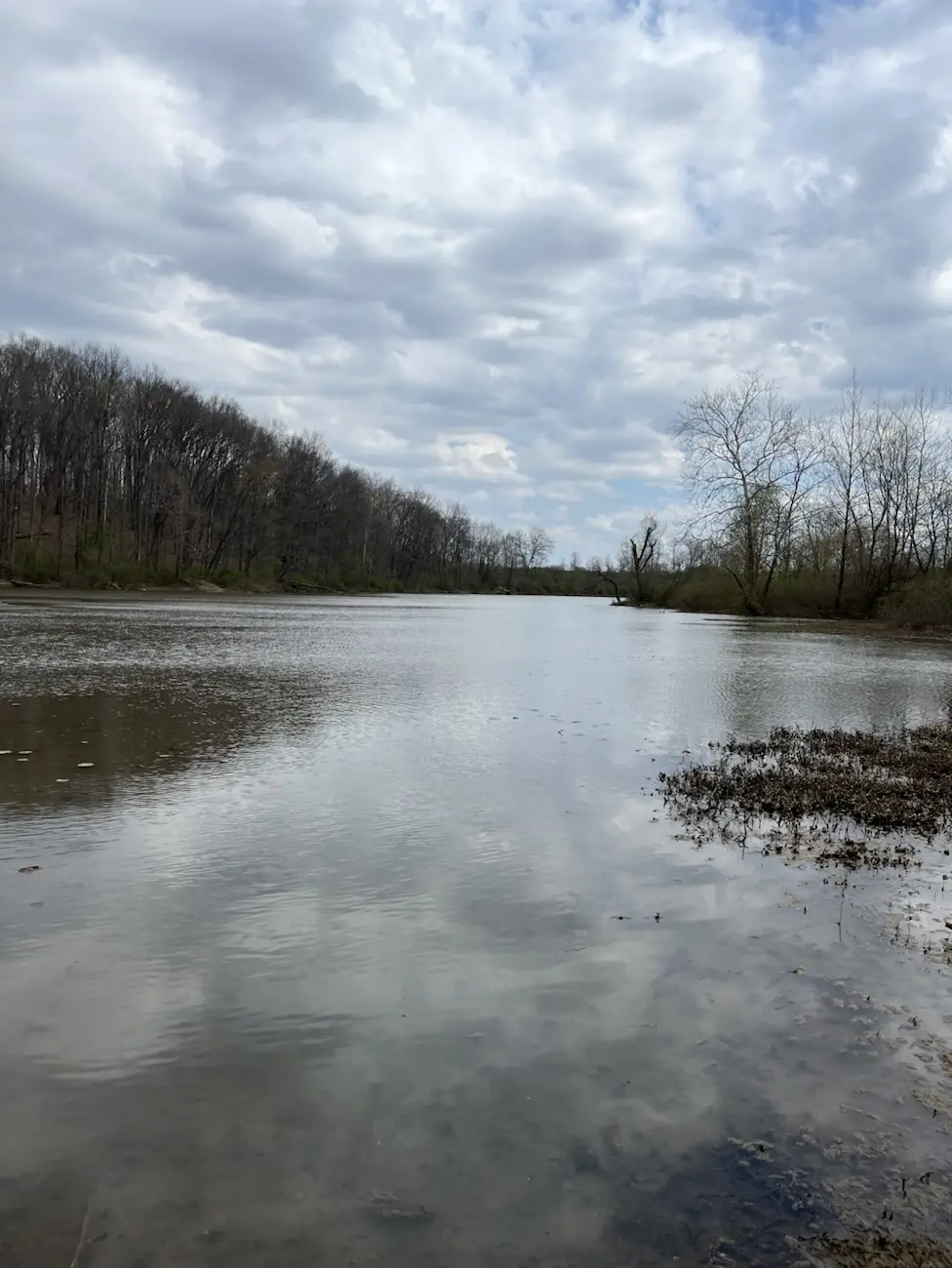
From the first few steps out of the parking lot and onto the path the lightly wooded area opens up to a small lake.
I would honestly refer to it as a large pond if I didn’t know better but, it is called Rock Mill Lake. The trail is rather damp and muddy despite the lack of rain.
Though it does hug and cross the lake. On the far side the lake shore opens up to a grassy incline.
Upon cresting the grassy knoll you will find a unique stretch of land where it feels less as if you’re in a forest. For a short 360 degree view you’ll begin to think you’re traversing through a working farm and its neighboring tree lines.
After walking a short ways through the fields of rolling Ohio foothills, treetops in the distance, and rustic farm structures, you’ll be glad to enter the tree-line on the last edge of the lake.

Here on the very far side of Rock Mill Lake is a massive rock perched right on the shoreline perfectly. Already adorned with a classic rope swing hanging out of a tree and over the water.
It’s the kind of spot that looks like a summer dream from a distant, nostalgic memory. Which begs us to return equipped with lake day items. Though, our current trip’s reality was a bit harder to swallow. The area was unfortunately covered in trash and broken glass, which is a massive ew. Especially for individuals like me hiking with a dog or who is an avid nature and conservation advocate.

The Legacy of Rock Mill and the Hocking River:
Even when the trails are closed, the mill itself is an imposing piece of history. The current structure was built in 1824. Though, the original site dates back to 1799.
Stebelton operated as a gristmill for nearly a century before closing its commercial doors in 1905. The geography here is what made it a prime location for early industry; the mill sits 90 feet above the gorge where the Hocking River plunges over a 14-foot waterfall.
Why the Rock Mill Gorge Trail has Been Closed:
The gorge trail remains closed until late April, due to the trails unique geology. The Hocking River has carved and eroded through soft Black Hand Sandstone here for years.

In the off season months, the combination of melt and heavy precipitation makes these slopes incredibly unstable. Opening the trail too early would lead to massive soil erosion, and potentially dangerous conditions for hikers navigating the steep descent to the water. Seasonal closures act as protection for the site and the trail- comers alike.
Mill Hours: Starting in May, the mill is open for tours on Wednesdays and Saturdays from 11:00 AM to 2:00 PM, and Sundays from 1:00 PM to 4:00 PM. The mill and gorge close yearly in November.
The Iconic Queen Post at Rock Mill:
The iconic covered bridge positioned directly alongside the gristmill is the Queen Post. This iconic Fairfield County landmark dates back to 1901.

A humble 37-foot span that was constructed by Jacob “Bluejeans” Brandt. This is one of the last remaining examples of a mill and covered bridge combination in the entire country. It features a Queen Post truss design, which is a classic wooden support system that uses two vertical posts to distribute the weight across the span.
Though the covered bridge looks like it has been there forever, it was actually built to replace an earlier structure that couldn’t withstand the Hocking River’s temperamental flooding.
This covered bridge was listed on the National Register of Historic Places in 1976 and underwent a major restoration in 2008 to ensure it stays standing 35 feet above the gorge. While it no longer carries vehicular traffic, it serves as the perfect vantage point for photographers looking to capture the mill and the falls in a single frame.
Looking for More Covered Bridges?
If you’re a fan of the covered bridge at Rock Mill Park, you should know Fairfield County is the holy grail for them.
Did you know that Fairfield County actually has more original covered bridges than any other county in Ohio?
Just a short drive away, you can find the Johnston Covered Bridge in Two Glaciers Park, which was built in 1887. This is a massive covered bridge with a 98-foot span. Surprisingly it still rests on its original abutments over Clear Creek. It’s unique because of its double canopies. These are like little wooden awnings over the windows that let you see the intricate Howe truss system from the outside.

Another nearby gem is the Hanaway Covered Bridge, which is famous for its lopsided look. It was built on a curve in 1881 and only has a canopy on one side. Drivers in the 1930s could actually see if someone was coming from the other direction before pulling in due to this.
If you’re looking for something closer to the city, the McCleery Covered Bridge now sits along the Lancaster bike path. It was actually the first bridge built by Jacob Brandt. Yes, the same “Bluejeans” Brandt who built the one at Rock Mill. However, this bridge had to be shortened significantly over the years due to dry rot.
These spots are perfect for quick stops if you’re trying to make a full day out of a trail of covered bridges.
The Tick Invasion: A Critical Safety Warning-
If the trash wasn’t enough of a deterrent, the ticks were out in full force. The slightly high grass in the farm fields was littered with ticks.
At one point during the hike, I had to stop and pull a literal handful of them off Luna, in one swoop… seriously consider the amount of ticks that is.
With the warmer, humid weather, they are waking up hungry, and this trail like many others I’m sure, is currently a prime hunting ground.
Identifying the Risks to Humans and Pups:
Tick-borne illnesses like Lyme Disease or Rocky Mountain Spotted Fever are no joke. In humans, early onset symptoms usually appear within 3 to 30 days and include a “bullseye” rash (approximately 70% of time), fever, and muscle aches.

If left untreated, prolonged symptoms can escalate to severe joint pain, heart palpitations, and neurological issues like Bell’s palsy.
For dogs like Luna, the signs are a bit different. You might notice “shifting leg lameness,” where they limp on one leg one day and a different one the next.
Other early signs include a loss of appetite and a sudden fever. Long-term, untreated tick bites in dogs can lead to chronic kidney issues and painful, swollen joints. If your dog seems lethargic or stiff weeks after a hike, it’s time for a vet visit.
Natural Defenses and Prevention:
While chemical repellents are commonly used, like DEET. There are natural ways to help keep these hitchhikers away.
Ticks are highly sensitive to scent, and certain essential oils can act as powerful deterrents.
Effective Repellents:
- Lemon Eucalyptus oil is the heavy hitter for humans
- Clove and Thyme Oils: Studies suggest that clove bud oil and thyme oil are highly effective deterrents. A combination of citronella and thyme has specifically been found to be one of the most effective natural mixtures against ticks.
- Rose Geranium oil is a popular natural choice for use on dogs just a drop on the collar (avoid direct skin contact) can help.
- Peppermint and Cedarwood oils are also known to create a scent barrier that ticks find repulsive.
- Lavender Oil: Often cited as being as effective as DEET in some studies, lavender not only repels adult ticks but may also prevent their eggs from hatching.
- Neem Oil: A natural insecticide and repellent that is generally safe for pets and humans when diluted.
Pet Safety: PLEASE use extreme caution with pets. Some oils, like eucalyptus and tea tree, can be toxic to cats and dogs if used incorrectly. Always consult a veterinarian first.

Yard Management Strategies:
- Gravel or Wood Chip Barriers: A 3-foot wide barrier of gravel or wood chips between wooded areas and your lawn can prevent ticks from migrating into your yard.
- Short Grass: Ticks thrive in tall grass; keeping your lawn mowed regularly reduces their habitat.
- Diatomaceous Earth: This fossilized algae powder can be sprinkled in the garden to dehydrate and kill ticks.
Ticks have a waxy outer coating on their exoskeletons that helps them retain moisture. The microscopic particles of DE are extremely sharp and highly absorbent.
Natural Landscaping Options:
If you want to keep your yard less hospitable to ticks, you can plant these naturally tick repelling species:
- Chrysanthemums: These flowers contain pyrethrin, a natural neurotoxin that kills and repels ticks.
- Marigolds: They produce a strong scent and contain pyrethrum, a compound used in many commercial repellents.
- Rosemary and Sage: Both herbs have strong aromatic oils that ticks avoid.
- Garlic: Planting garlic around borders can create a sulfurous barrier ticks tend to avoid.
Always do a thorough tail-to-nose check the second you get back to the trailhead. It only takes a few seconds for one to latch on, but a proactive check can save you and your pets weeks of trouble.
Extra Pointers when it Comes to Ticks:
- Prompt Removal is Critical: Removing a tick within the first 24 hours drastically reduces the risk of most bacterial infections, especially Lyme disease.
- Partially Fed Ticks: If a tick was previously attached to another host and then reattaches to you, it can transmit diseases much faster. Since now the pathogens are already active in its saliva.
- Physical Indicators: An “engorged” or puffy-looking tick has likely been attached for at least 36 hours, indicating a higher risk of infection.
The Final Verdict:

What isn’t mentioned when you’re looking at the trail map is the specific kind of silence you get out here.
Unlike the crowded boardwalks of Hocking Hills, Rock Mill Lake is untouched. It’s a transition space, caught between a managed wildlife area and a working farm.
A brisk 35-minute loop that served as a reminder: the “backup” plan usually ends up being the most honest experience of the day.
It’s not a destination hike, but if you’re already hitting the covered bridges in Fairfield County, it’s a solid way to burn an extra half-hour in nature.
Whatever you do just don’t skip the tick check before you climb back in the car.


Leave a Reply