What strategies do you use to cope with negative feelings?
Best for:
Shadow workers, Emotionally intelligent Individuals, journal readers, and those working through uncomfortable emotions.
Navigating negative emotions:
For me whether I’m overcome with grief, stress, or anxiety it requires more than willpower. I have found it helps knowing what works for me. I feel that we should al have intentional strategies that honor the way our minds process the world, to help us find our way back to the light.
I have two practices that are essential to how I find my light through the bullshit: writing and hiking. One allows me to articulate what I cannot always say aloud; the other offers respite from the constant pressure to perform. Together, they form a sustainable approach to emotional regulation. These are supported by both personal experience and emerging research in psychology and neuroscience.
Poetry Helps Me Process Feelings When Words Feel Impossible:
For many, talking about intense emotions, especially grief, advocacy-related trauma, or even love can feel overwhelming or even inaccessible. Poetry offers an alternative pathway.
Externalizing emotion: Writing poetry moves feelings from the internal (where they can feel consuming) to the external (where they can be observed, shaped, and understood).
Processing in layers: Poetry allows for metaphor and abstraction, making it possible to explore complex emotions without needing to articulate them directly in conversation.
Grief, advocacy, love, and more: Whether I’m writing about loss, the weight of advocacy, queer life experiences, or the complexity of love, poetry helps me sit with my feelings. Or I’d be consumed by them. Poetry creates space to process on a deeper level so I can acknowledge emotions when they arise, without feeling trapped by them forever.
Factual Backing:
Research supports the idea that expressive writing including poetry, has been shown to reduce rumination and improve emotional regulation. A 2020 study in Frontiers in Psychology found that poetic writing facilitates cognitive reappraisal, helping individuals reframe distressing experiences. Additionally, narrative therapy principles suggest that structuring difficult experiences into written form restores a sense of agency and coherence.
Hiking as a Strategy for Grief, Stress, and Reconnection
When I miss my mom, I try to go hiking. The forest becomes a space where grief softens, where I feel close to her without needing to explain or perform. Hiking also offers something I struggle with in daily life: permission to pause.
A break from constant productivity: The trail demands nothing but presence. There is no to-do list, no inbox, only the choice to take the next step.
“Church in nature“: For me, nature is sacred. It’s where I find stillness, perspective, and a sense of being held by something larger than daily stress.
Closer to my mom: Being in the natural world creates space for memory and connection without the pressure to “process” grief in a prescribed way.
Factual Backing:
The mental health benefits of time in nature are well-documented. A 2019 study in Scientific Reports found that spending at least 120 minutes per week in nature significantly correlates with better health and psychological well-being. Moreover, ecotherapy research indicates that green spaces reduce cortisol levels, lower stress, and improve mood, particularly for those navigating grief or chronic anxiety.
Expanding the Toolkit: Emotional Reflection Journals and Creative Writing:
Beyond poetry and hiking, I’ve built a broader creative practice to help me, and hopefully others, process difficult emotions.
Emotional reflection journals: I create guided journals filled with prompts I’ve developed from my own emotional journaling practices. These are designed to help others explore their inner world in a structured, self-led way.
Helpful posts on grief, transitioning, and more: I write accessible content that blends personal insight with practical guidance for those navigating life transitions, identity shifts, or loss.
Creative short stories: I explore identity, nature, and psychologically thrilling themes through fiction. This allows me to examine complex emotions through character and metaphor. I often aim at revealing the truths that nonfiction alone cannot reach.
Why This Matters: Creative Practices as Sustainable Coping Strategies:
These practices share a common thread: they transform overwhelming feelings into something tangible, manageable, and meaningful. Whether through poetry, hiking, journaling, or storytelling, creative strategies offer:
A sense of agency over internal experience
Safe containment for emotions that feel too big to hold
Sustainable processing that doesn’t rely on constant verbal explanation
For anyone navigating life, finding your own version of these practices, can make the difference between being consumed by feelings and learning to sit with them on your own terms.
Central Ohio Explorers, small park lovers, history buffs, and hiking journal readers.
Getting back into it:
I’ve always loved this 1918 bench at Rising Park & Mount Pleasant.
Today, March 24th, 2026, Luna and I went to Rising Park & Mount Pleasant unexpectedly. My day was supposed to start with a nap after an overnight shift. I wanted to be up by late morning and drive to Dundee Falls by early afternoon. My last alarm was set for noon, but clearly, my subconscious had other plans. I managed to sleep right through all of my alarms, not waking up until a little after 4:00 PM! My intended exploration was hereby postponed before it even began.
Though I was feeling a bit bummed about missing my Dundee Falls window, I also knew Luna, absolutely needed to get out, after her extended break. It was obvious that her energetic sighs were getting quite dramatic, so I shifted gears. Dundee Falls will have to wait until tomorrow morning. Instead, we decided to visit a beloved semi-local gem in Lancaster, Ohio: Rising Park.
Luna’s Paw-some Return:
Some awesome looking cliff faces.
This trip to Rising Park felt particularly momentous because it was Luna’s first time out of the yard since her paw infection. In solidarity with her, I ended up taking five long weeks off too. Poor girl had one paw so swollen up, and the veterinarian’s orders were 2-3 weeks rest.
I swear after the first three days she spent the rest of the time looking longingly out the windows. She favored dramatically flopping onto my bed or couch. While she handled her “unjust” confinement with relatively good grace; seeing her finally sitting excitedly in the passenger seat, nose twitching with excitement, was the best feeling. Her tail was like a furry metronome, keeping time with her pure joy at heading back to the trail.
It was a beautiful reminder of the simple pleasures. As well as the importance of allowing time for healing.
The look back view of Rising park.
Rising Park & Mount Pleasant the Majestic Mount Pleasant:
Rising Park & Mount Pleasant is something special, to me and I’m sure other locals alike. The most striking feature, and the centerpiece of the hike, is Mount Pleasant. Looking at it, and starting your walk up it you immediately realize you’re not visiting a typicalOhio hill.
A Glimpse into the Past:
Geography:
I like rocks, especially from Rising Park & Mount Pleasant.
Rising Parn & Mount Pleasant is yet another stunning example of Ohio’s Black Hand sandstone. Back in the early Mississippian Period roughly 350 million years ago, this area was covered by a vast, shallow sea. Sand, gravel, and mud washed in from ancestral Appalachian mountains to the east, forming a huge delta. The coarse-grained sand deposited here eventually cemented together. Thus, creating the strong, resistant sandstone.
Mount Pleasant stands so proudly above the surrounding landscape. Later, glaciers moved through the area, smoothing and leveling much of it. Yet, they couldn’t quite wear down this stubborn block of stone. It’s essentially a resilient survivor of ancient environmental changes.
Another view of the terrain here.
History:
Historically, this massive formation has been a significant landmark for centuries. Native American tribes used it as a signal point, observation post, and a place for spiritual rituals.
In fact, a popular, albeit tragic, legend says it’s named “Standing Stone” because of a Native American woman. Her name was Mon-ka-ush-ka. The story says she fell in love with a white settler, but her family opposed the match. When they took her to the top of the rock, she leapt to her death. After she vowed her spirit would always inhabit the place.
Whether purely legend or inspired by some long-ago event, the story adds another layer of solemn mystery to the place. Today, however, the primary drama was Luna’s triumphant sprint dragging us towards the overlook.
The trail on the way up to summit.
Our Solitary Hike
There’s something uniquely satisfying about a solo hike with your dog. Just you, the sound of paws on the dirt, the rustle of leaves, and the shared excitement of discovery.
I just love the geology in Ohio.
The main trail up to the top of Mount Pleasant is short but definitely gets your heart pumping. As we climbed higher, catching glimpses of the cliffs, it felt great to be moving and breathing fresh air after my accidental deep-sleep session.
We were lucky to have the summit nearly to ourselves. Sharing it only with a couple and their toddler who happily asked to play with Luna.
The view from the top is, quite simply, incredible. You can see for miles over the city of Lancaster. The surrounding, slightly rollingFairfield County landscape, a patchwork of fields, forests, and small towns stretched out under the wide sky.
The view right before sunset!
Luna, was less interested in the sweeping vista and far more intrigued by a particularly friendly family of three. Being a bully breed she sometimes is shooed away from children and people she’d normally be excited to greet. So, after she thoroughly sniffed every inch of the overlook area and played nicely with the young boy she received her well-earned praises for being the “best, bravest, paw-healed explorer.” Before leaving we sat for a bit, soaking it all in.
Changed plans:
One of our first trips here in 2021
Though my day didn’t go as planned, our spontaneous decision to revisit on of our favorite spots, Rising Park & Mount Pleasant turned out to be the perfect substitute. The beautiful scenery, the fascinating history of the area, and most importantly, seeing Luna finally running happy and free again, made for an unforgettable afternoon. My accidental oversleeping actually led to a satisfying experience. Now, though, I must set my multiple alarms, because Dundee Falls truly does await tomorrow morning!
For Highlight reels from Malabar Farm State Park & other trips with Luna and the homies, as well as other visual content catch Poeaxtry_ on socials like:
Hiking Enthusiasts, nature lovers, burnt-out creatives, anyone whose brain needs a break, and individuals who find peace in putting one foot in front of the other.
Kylie, Luna, & I at Mohican.
I bet you can’t guess it?
Who am I kidding it’s obviously hiking. I am willing to bet that even if you’re new here you could have guessed that in under that three tries.
I’m not aiming to get the best social media reel. I really don’t care to visits the tourist traps in nature. I just wish I could hike every day. Most the time it is the only time my brain shuts the hell up.
Shake what yo’ momma gave ya.
The trail doesn’t care about your to-do list, what you wear, or the color of your hair. It cares where you put your foot next and what you take when you leave.
The Trail Works & The Noise Stops:
Once I get out there, the constant string of conversation inside my head stops. The loop of everything I forgot, what I did wrong, and everything I should have said in a different way…finally just, fades. For once it isn’t from just ignoring it. I can’t afford to. If you ask me, honestly, none of us can pay that price.
When you’re picking your way down a slick forrest trail in the rain, if snow is to your shins and a mile feels like ten, or while you are watching for roots under leaves, there’s no room for my racing thoughts. The only thing that matters is the next place my foot is pushed into the ground.
Luna, my precious!
My brain treats every thought like an urgent bulletin, and the wild is the only place I don’t have to answer.
No Explaining Required:
The woods do not need my pronouns. Water doesn’t wonder about my medical history. Moss on sandstone doesn’t care if I’m too much. Out there, I’m not a transgender man I have nothing to prove to the trees.
I’m not a publisher, a healthcare worker, or a son who lost his mother too young. When I hit the trailhead I am but just a person with a dog. In the wild i spend my time moving through a world that existed long before me and will exist long after I leave it.
That kind of quiet? You can’t buy it. There is no chance you can meditate your way there, either. You have to earn it. By every step and every mile, until your shoulders drop from by your ears. The your breath evens out and you remember what it feels like to just be… you.
Rising park in Lancaster, Ohio, truly does “rise.”
The woods don’t ask who you are. They do not care; they just let you remember.
Where the Words Come From:
About half of my poems arrive on the trail or reflecting on a trail. Not simply in front of a screen, and not only in the garage with smoke curling out of my lungs and toward the ceiling. Mid-climb., at a sun-kissed waterfall, in the middle of the autumn leaf change, standing still while Luna’s ears perk at something I can’t see, or whatever may be the cause.
The words come fully formed, like they’ve been waiting for me to get focused and quiet enough to hear them.
I don’t chase them. They just find me. They find me most often when I’m moving slow enough to listen.
Axton walks through the trees towards camp in Munising, Michigan.
Poetry does not come from staring at l blank paper in a notebook. It come from standing at the edge of something you know is bigger than you are.
Church Just Make It Sandstone:
I’m not religious, not even slightly. The trail is the closest I get to going to church. Not the kind with pews and sermons. I mean the kind with 350-million-year-old sandstone. The kind that has hemlock roots teasing you while trying to trip you up. Where winter warm ups inspire soundscapes of water moving slowly under ice.
Where you can feel the weight of everyone who stepped foot here before you. The Indigenous people who quarried flint from the ridges, settlers cutting timber into logs, and hikers who left heart rocks on benches.
It should be no surprise if you know me that I find my mom out here. She waits on every trail. Though, I carry her with me and yet she greats me at every trailhead and tree-line. The woods are where I can still converse with her. Still the only place I can still hear her laugh, sometimes. Where I still feel her proud of me for showing up, for pushing through, and for always finding the beauty in places overlooked.
Red River Gorge, Powell County Ky. If Axton fits he sits.
The trail is where I find my mom. The woods seem to hold onto the parts of us the rest of the world can’t fathom to grasp.
The Trail Teaches Me
There is a lesson in every hike and beauty in every backyard. Try to show up prepared, whatever that looks like for you. Know what is worth the speak, what is pushing it, and when to turn back. Respect the conditions and the natural plants and animals that live in the environment. You are their visitors so be well behaved.
Practice leave no trace. ALWAYS pack out what you pack in. The weight you carry matters and so does the company you choose. Some trails are hard and worth it. Some are beautiful, but all are for you to enjoy if you’re respectful.
The trail doesn’t reward ego at all. The trail would rather see presence. It rewards you for paying attention. You can’t bully your way up a mountain, have some humanity. Try and fake your way through a gorge but, the trail knows. Nature will always show you exactly where you need to grow.
Kitch-Iti-Kippi- Big Spring, Michigan.
The trail doesn’t care how fast you finish. It only cares that you keep showing up.
The Best Version of Me:
I wish I could hike every day, it’s the only time I’m not performing. I am no longer the healthcare worker who has the answers, the publisher who is building something from nothing, the transgender man with something to prove, or even the son who lost his mother too young.
I am just a person in green and orange croc junipers, with a dog, walking into the tree-line, finding heart rocks, laughing when I slip or fall, or stopping to watch the sunlight change the face of a cliff . It is being present, quiet, and exactly who I am whenever people are watching or not.
Frozen stream and heavy snow right off trail in Ohio.
The version of me that hikes is happiest. The version of me, I want to be all the time, by far.
The Days I Can’t:
I sadly can’t hike every day. Between work, adult life, and exhaustion. Though I do carry the trail with me when I can’t be on it. The rhythm of putting one foot in front of the other, the knowledge that the mountain doesn’t care how fast you climb, and the certainty that the wilderness will still be there when I can get back.
That’s what I wish I could do everyday. Perfect days on the trail. The calm peaceful quiet, and the rocks under my shoes. I want more of the version of me that exists when no one’s around to bother me. The peace I find in the spaces that don’t ask me to be anything but present is what I’m looking for.
White clouds fill the blue skies over Lake Superior.
I carry the wilderness with me; even when I can’t be with it .
Before You Go
If you’ve got a trail that calls to you, a place where your brain finally shuts up, a spot of woods that feels like coming home, and you don’t mind sharing drop it in the comments. I’m always looking for the next place to put my feet.
If you’ve never found that place yet? Keep looking. It’s out there. Waiting for you to show up.
Luna, sitting pretty on the boardwalk at Hayden Falls in Columbus, Ohio.
Indie writers supporting other writers, those interested in self-help or therapy, language lovers, psychology enthusiasts, over-thinkers, and anyone who ever feels consumed by emotions and wonders why it feels permanent.
Learning About Language:
I learned something recently that caused me to pause the video I was watching. A person was referring to their time living in America and comparing it to what they have experienced since living abroad. They were speaking about the use of emotions passing through us in the Spanish speaking countries they had been frequenting and touched on the psychological aspects of all of this. This prompted me to wonder about how much the way we speak in other ways outside of emotional ones impacts us as well.
As an English-speaking American, I had never realized how heavy the verb “to be” actually is. We say “I am sad” as if sadness is not a visitor but a permanent resident. We say “I am anxious” as if anxiety is our address rather than a temporary weather pattern. Though these feelings are debilitating for some of us, we do not live inside of them always.
Emotion:
The English language, particularly American English, favors the verb “to be.” If we feel something, we are that thing, can you say dramatics. I’m kidding but, honestly those who designed the way we speak in America caused this collapse. The distance between self and sensation, is minimal here in the way we speak.
In other many other languages people don’t often refer to themselves as the emotion they feel. For instance how Americans, myself included things like “I am depressed” or “I am anxious.” Instead, these some of these languages describe the feeling as something passing through them. Anger is passing through me. Sorrow is moving over me. Fear is on me right now.
I now know, this also isn’t just a translation quirk, but a fundamental difference in how we construct the self. The consequences it has on our mental health, relationships, and how we move through difficult emotions are enough to make me more apt to think about the way I speak regarding myself.
Irish (Gaelic): Sadness on Me
In Irish, emotions are something that happen to you or rest upon you. The famous construction is Tá brón orm, which literally translates to “Sadness is on me.” You don’t be sad; sadness comes to you like weather arriving. Other examples:
Tá fearg orm — Anger is on me.
Tá imní orm — Anxiety/worry is on me.
This grammatical structure inherently communicates impermanence. Sadness lands on you; it can also lift.
Spanish: Having Feelings, Not Being Them
Spanish commonly uses tener (to have) for emotions:
Tengo ansiedad — I have anxiety (not I am anxious).
Tengo miedo — I have fear.
Tengo tristeza — I have sadness.
Possession implies a degree of separation. You can have something without being consumed by it. Spanish also uses reflexive and passive constructions that further distance the self from the feeling. Statements like me siento (I feel myself) or se me pasó la tristeza (the sadness passed through me) that allow distance in between self and feelings.
Arabic: What Passed Over Me
Arabic offers some of the most striking examples. In both Modern Standard Arabic and dialects like Levantine or Egyptian Arabic. The way they speak their emotions are frequently framed as something that came over or hit the speaker. Think of an outside force the self that moves through.
علىقلبيضيق (‘ala albi dayyiq) — “tightness is on my heart.”
جا عليّ حالة (ja ‘alayya haaleh, Levantine) — “A state came over me.”
مسكني غضب (misaknī ghaḍab) — “Anger seized me” or “took hold of me.”
In classical Arabic poetics and everyday speech alike, emotions are often described as visitors, invaders, or passing clouds. You are not the anger; the anger is something that found you momentarily.
Beyond Emotions: Other Ways American English Differs
This pattern of identity vs. transience doesn’t stop with feelings. American English extends the “I am” or the “to-be” structure into domains. Here other languages use more temporary or external constructions. I found at least these three additional areas where the difference shows up. Illness and the body, success and failure, and time and urgency all of which have their own psychological impact on us all.
Illness and the Body
In American English, we say “I am sick” or “I am a diabetic” equating the condition with identity like self with emotion. In Spanish, you have sickness (estoy enfermo) is temporary “I am sick,” and chronic conditions use (tengo diabetes.) I have diabetes). In Arabic, one might say (المرضجايعليّ) meaning the illness came upon me. Thus, framing the condition as an external visitor rather than a core identity. The difference matters: “I am a diabetic” lands differently in the psyche than “I have diabetes.”
Success and Failure
American English tends to internalize outcomes. We say “I am a failure” or “I am successful.” In many other languages, success and failure are things you achieve or experience. They are not things you are. In Japanese, success is often framed as 成功する (seikō suru) which translates to, to do/achieve success. They do not link to be successful with their identity. In French, j’ai réussi (I succeeded) keeps the event separate from the self as well.
Time and Urgency
American English is unusually future-anxious. We say “I am running late” as if lateness is an identity state. We say “I am swamped” or “I am buried.” All of these metaphors suggest we are the overwhelm. Other languages often externalize time pressure. In Arabic, one might say الوقتضيق (“time is tight”) rather than “I am in a hurry.” In Spanish, voy con prisa (I go with hurry) also separates the self from the urgency.
What This Does to the Psyche
Linguistic structures aren’t something that is neutral. They work to shape cognition, emotional regulation, and even how we respond to distress. When a language consistently equates emotion, time, sucess, and other things with identity, it wires the brain to perceive these things as permanent traits. Likewise when a language preserves separation, it wires the brain for impermanence and separates self from trait.
Self-Differentiation – The Space Between You and the Feeling:
Psychologists use the term self-differentiation to describe the ability to hold onto your sense of self while experiencing strong emotions. The “I am” construction collapses that space. Using instead the emotion is passing through me acts to preserve it. That space is where regulation happens. Without it, you don’t have an emotion; you are the emotion. This makes it nearly impossible to respond intentionally.
Impermanence: Fighting Reality vs. Moving With It
All emotions, failures, illnesses are typically transient by nature. Neurobiologically, an emotion wave typically lasts 60 to 90 seconds when it is fully processed without cognitive resistance. But when we say “I am depressed” (as an identity), we lock ourselves into a narrative of permanence. I do want to note I am speaking emotionally and not clinically in terms of emotions . The brain, now seeking consistency, begins to look for evidence that confirms the identity. The language of transiencelike the emotions are moving through you, aligns with our biological reality. It says: this will pass. That statement alone changes the nervous system’s response.
Secondary Suffering – Shame on Top of Pain:
When you believe you are your emotions, failures, and illnesses, you inevitably add a second layer: What’s wrong with me? Why am I like this? Why can’t I just stop? This is called secondary suffering. The original failure, emotional state, or lateness was painful enough. The shame and self-criticism that follow are what make it debilitating. The “passing through” frame removes the self-judgment. If it is a just a visitor, there’s nothing wrong with you for hosting it.
Agency: From Victim to Witness
“I am late” positions you as the problem. There is no one left to respond. “Time is tight” positions you as the witness. You become the sky, not the storm. From that vantage point, you can choose. You can breathe. You can wait for it to become loose again. Agency is not about controlling the thing; it’s about remaining present while it passes.
Pause With Me
Let’s sit with this for a moment.
If you grew up speaking English, or if English is the language of your inner monologue, you have likely spent decades telling yourself, hundreds of times a day, that you are whatever you feel. That is not a small thing. That is a quiet conditioning that runs beneath every difficult morning, spiraling thought, and every minute you were late.
Here’s the thing language won’t tell you outright: it can be undone.
Before we move on, let me offer a few small invitations, or ideas to get you thinking of things you want to add in the comments:
What emotion have you been telling yourself you “are” that you know now to be just be passing through?
If you speak another language, what’s a phrase from it that separates the self from the feeling, illness, lateness, or other state of being?
When was the last time you noticed your own inner monologue using “I am” in a way that didn’t serve you?
This conversation only gets richer when more voices enter it. I love to read everything you have to add from your own experience with languages.
Rewiring Our Inner Monologues:
Knowing the linguistics is helpful and interesting. Applying it is where things change. Below are some specific ways to begin shifting from identity-based language to a more transience-based language.
Swap
When you notice an emotion rising, try this structure:
Instead of “I am anxious,” say internally: Anxiety is moving through me right now.
Instead of “I am so angry,” try: “Anger is upon me.”
Instead of “I am depressed,” try: A heavy sadness is resting on me right now. It will shift.
This isn’t about toxic positivity or pretending the feeling isn’t real. It’s about relating to it accurately: as a temporary event, not a permanent identity.
You Have, You Are Not
If you live with a chronic condition, mental or physical, experiment with shifting from identity statements to possession statements:
“I have depression” instead of “I am depressed.”
“I have anxiety” instead of “I am anxious.”
“I have a chronic illness” instead of “I am sick.”
This is not denial. It is a reclamation of selfhood. You are the one carrying the condition, and you are not the condition itself.
Events, Not Identities
When you make a mistake or fall short of a goal, notice where your inner monologue turns “I am” and “to be” statements into permanent flaws. Practice rephrasing:
“I failed that” instead of “I am a failure.”
“I made a choice that didn’t work out” instead of “I am a mess.”
“I am learning this slowly” instead of “I am stupid.”
Behavior is not identity. The language you use to narrate your own life either reinforces that distinction or erases it.
Externalize the Pressure:
When you feel the familiar grip of “I am so behind” or “I am buried,” try externalizing:
“There is a lot of urgency right now” instead of “I am overwhelmed.”
“The timeline is tight” instead of “I am running late.”
“A lot is demanding my attention” instead of “I am drowning.”
This small shift reclaims agency. You are not the overwhelm; you are a person navigating a moment of high demand.
You Are the Weather Person, Not the Weather
Language is not a neutral tool. It is a daily practice of world-building. When a language consistently tells you that you are your emotions, your illnesses, your failures, and your overwhelm, it builds a world where those things feel inescapable. When a language tells you that emotions pass through, that illness is something you have, that failure and time constraints are something you experienced, it builds a world where you remain the stable reporter of the weather and not the weather itself.
The good news is you don’t have to move to Ireland or learn Arabic to make this shift. You just have to start listening to your own sentences. Then, when you catch yourself saying “I am” to something that is actually just visiting, you gently rewrite the line.
You are not your anger. You are not your anxiety. You are not your worst day or your loudest emotion. You are the one who notices them arrive. And you will be the one who notices them leave.
Before You Go
If this post resonated with you, share it with a friend who overthinks their inner monologue or a therapy advocate you know that would appreciate the linguistics angle.
If you know someone who doesn’t speak English as their first language who you’ve heard say “we just phrase it differently.” Share this will them and let them know you never know why it mattered before.
Drop this in your newsfeed if you believe the psychology of language deserves more attention. The more we talk about how we talk, the more we all get free of the sentences that trap us.
Thank you for reading. And thank you for staying with me to the end.
First-time ravers, creative entrepreneurs, EDM enthusiasts, those interested in trying new things, and the Shrek-obsessed individuals.
Last Friday Night:
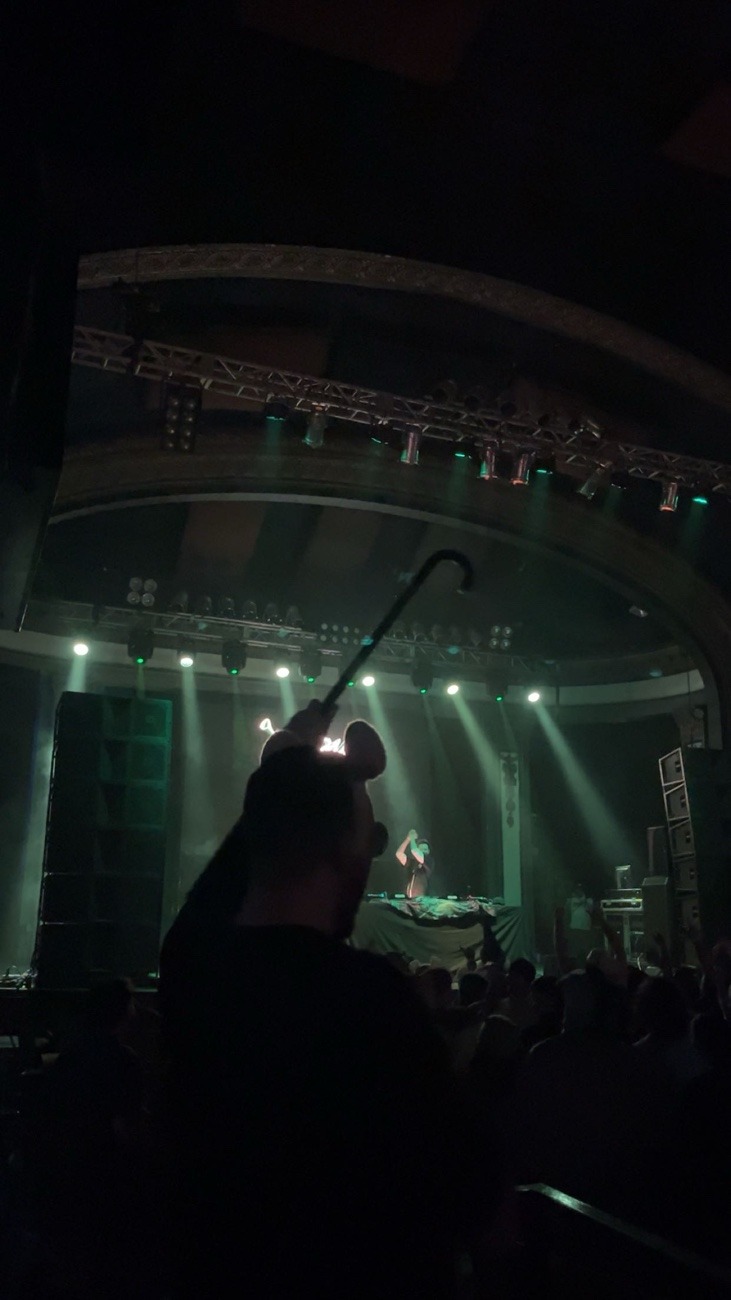
Friday, March 13th, the first one since Covid lockdown was implemented. I went to my first rave in my thirty-four years on Earth. I took my friend Haylee to Newport Music Hall in Columbus, Ohio for her birthday. Since she is a veteran of the scene and I am a total newbie. This Shrek-themed event served as the perfect entry point. We arrived after the 9:00 PM start time, but the show didn’t actually hit its take off until later. We didn’t end up missing a single beat of the chaos.
Grandma got back.
The Visual Assault:
The performer, WHUBLUB, held the stage with a set that was pure, relentless kinetic energy. The screen behind the booth was a strobe-lit fever dream of animated assets. It wasn’t just “Shrek visuals.” These were a hilarious and on beat Fairy Godmother twerking in high-definition, gingerbread man, donkey, and others but especially Shrek of course in crazy fashion. The sensory input was a deliberate clash of childhood nostalgia and aggressiveelectronic production.
We love a thoughtful venue.
The Costume Hierarchy:
The crowd didn’t just “dress up.” They showed up and committed to the absurdity. The Newport Music Hall was packed with specific, niche nods to the franchise:
A bunch of trios of Three Blind Mice navigating the pit.
A wizard owning the bass.
A high-fidelity Doris. You know the “Ugly Stepsister” who intentionally looks like a man. Dressed up as Doris was a man, and I totally missed my calling.
Seeing the technical execution of these costumes made it clear: next year, I am showing up as a character from the Far Far Away fringe. We are already planning the outfits.
Happy Bday Haylee!
The Rookie Mistake:
I feel like misreading the room is part of the first-timer experience. At around 10:30 or 11:00 PM, WHUBLUB, announced he had a “couple more” tracks. In a traditional venue, that means the lights are coming up. This being my thought track we exited, after his last track.
In reality, the set was not even halfway through and the party raged well past midnight. Hayley didn’t mention it at the time. I wonder if she noticed, maybe she was just in the zone. Now a lesson has been learned: the “end” for some sometimes means the beginning for others.
Look at the crowd!
The Shrek Rave Phenomenon:
The Shrek Rave is a massive touring phenomenon operating under the mantra: “Cool is Dead. It’s Dumb Just Come Have Fun.” It is an 18+ event that intentionally blends the absurdity of the Shrek universe with professional-grade EDM production. It creates a space where the “seriousness” of traditional nightlife is stripped away in favor of pure, inclusive chaos.
Inflatable Shrek joins the party.
The Roots of the Rhythm:
To understand why a Shrek-themed party works, you have to look at where rave culture started. This style of music and show emerged in the late 1980s in the UK and Europe as an underground rebellion against mainstream society and rigid social norms.
The Birth of the Underground:
The original raves began in abandoned warehouses and open fields. These gatherings were fueled by Acid House. Which is a subgenre of house music known for the “squelching” electronic sounds of the Roland TB-303 synthesizer.
I am a sucker for a good orange cat.
These events were built on the core values of P.L.U.R. (Peace, Love, Unity, and Respect). This provided a vital safe space for marginalized groups, queer communities, and anyone seeking liberation through music.
Defining EDM-
Electronic Dance Music (EDM) is a technical umbrella term for music engineered for high-output sound systems.
House: Born in Chicago (The Warehouse), rooted in 4/4 “four-on-the-floor” drum patterns.
Techno: Detroit’s industrial contribution, focusing on mechanical, repetitive sequences.
Drum and Bass: High-BPM UK breakbeats that emphasize heavy low-end frequencies.
What an experience.
Rebuilding the Narrative
This night was a crash course in the reality of the Columbus rave scene. The music was loud, the costumes were killer, and the schedule is packed. We may have missed the final acts this year, but the blueprint is set. As long as they have it again, next March, the costumes will be ready, and we are staying until the house lights kill the vibe.
Individuals who are fans of indieauthors and what they write.
Oh. No. What Did I Do?
Who actually writes for the comfort of the others. Writing the chaos in my head sharing trauma too heavy to carry alone.
I woke up before my alarm. Got up; Walked to the garage. I was intending to ease the tension gripping its claws in my skin with smoke, in my lungs. Outside the wind was howling louder than a banshee. It really felt as if both the house and I would both blow away for the second time this week.
Surprisingly, I made it inside the garage without blowing through the wind somehow. Taking my seat in front of my working altar. This is the place where I smoke, make all my physical store items, spells, rituals, readings, and more. I rolled up some green, lighting up within a few minutes.
Deciding to opened TikTok, went to my account page, intending on posting a draft. I scrolled through my twenty or so drafts. Choosing instantly, the video of Lake Erie’s waves crashing on beautiful Great Lake rocks.
The draft like most, I saved to post later and already formatted it. Meaningful visual editing is done how I’d like for the specific content. Usually it is:
Snipped and cut
Sound added
Stitched
Ready to use with and without text. This way, I can add relevant current text to some at any time over drafts.
I started writing in the text-overlay tool. IN THE TIKTOK APP LIKE A FERAL MAN. This is something I have never done. And honestly? I still can’t believe I just hit post. I did not read it back one time. I did not go back and do even first round editing. Which I pay no mind to that while I am in creative flow state.
Oh, and today is day 87 of my personal creative challenge. 100 poems in 100 days, creating habits and discipline. So, of course this poem will now hold that spot.
Rough Draft
So I know guys it’s just Lake Erie You say she’s dirty, basic, and nothing like the other Great Lakes But I already know she doesn’t let you see her, Like I do. She doesn’t call home to you. So tell me again why Tahoe in the west would make a better Great Lake than Erie…I mean she’s here with the rest but never mind that I find peace in the chaos she creates the inland salt-less seas Of midwestern USA would be a lot less beautiful without her So sleep on her, like you sleep on me.
Creative Flow
Creative flow is not some mystical, unreachable state. It is the rhythm of my work. Below are the most common times I find myself dropping into that zone. A bonus weird place that works for me every single time.
• While smoking: This is my primary ritual for shifting gears.
• The Drift: Right when I am about to fall asleep. If I do not get up and write it down right then, it is gone forever.
• In the wilderness: When the world is quiet enough to hear the thoughts I have been ignoring.
• The Weirdest One: Behind the wheel. I never hit this level of flow unless I am driving. I do the editing as a passenger, but the creation happens only when I am in control of the car.
The Creative Working Order:
“The creative process is a process of surrender, not control.” – Bruce Lee
This is the chronological order in which I write poetry. What is my cup of tea may not be yours. I want to mention I hate gatekeepers. Please feel free to borrow some if you find you like some of the herbs I layer within.
What is Creative Flow-
When I talk about flow, I am talking about the automatic, effortless, yet highly focused state of consciousness. This is described by psychologist Mihaly Csikszentmihalyi. This was his foundational work, Flow: The Psychology of Optimal Experience. Csikszentmihalyi, defined this as being so immersed in an activity. Time actually slips away and the egofades into the background.
“You can’t use up creativity. The more you use, the more you have.” –Maya Angelou
Tapping into My Flow:
When I am in flow, I do not care about perfecting the grammar, using stylized spacing, or worry about spelling. I do not experiment with word flow quite yet. I do not plan for my creative flow time when it comes to drafting new poetry. I just let it happen.
“My hand does the work and I don’t have to think. In fact, were I to think, it would stop the flow. It’s like a dam in the brain that bursts.” –Edna O’Brien
It is more about getting the words down in the exact order they hit my brain. For me, this flow and editingseparation allows for streamlined creation. I can and have written at least 13 poems in a single session. This can occur during one elongated smoke sesh. It also happens over a long stretches on the road home after a day spent in the wild.
“Flow is being completely involved in an activity for its own sake. The ego falls away. Time flies. Every action, movement, and thought follows inevitably from the previous one, like playing jazz.” –Mihaly Csikszentmihalyi
Maintaining the Rhythm:
If you are looking to get out of a creative rut, the current 2026 standout creatives offer clear advice. Focus on a clear destination. Maintain discipline, and establish low-pressure rituals that work for you.
Many creative minds rely on daily rituals like “human-free time.” These rituals often ensure zero digital disruptions. While also including a consistent 5-10 minute anchor before beginning work. Breathing exercises can work to tell your nervous system it’s time to chill.
“Great things are done by a series of small things brought together.” –Vincent Van Gogh
Creative flow also is referred to as “being in the zone,” by many. This is actually, not just a matter of luck. It’s a biological “accident” you can make yourself more apt to experience.
Conscious Release of Control the act of letting go.
Tips from the Professionals:
Author and journalist Steven Kotler and others aiming to continue the work of Mihaly Csikszentmihalyi point to several “pre-conditions” that must be met:
Challenge of Balance: Flow happens in a small sweet spot. Here the task is enough of a challenge to stretch your abilities. Just not to a point of inducing anxiety. Too easy, and you are bored; too hard, you are stressed.
Goals and Feedback: You must set an exact goal. They can be as simple as what you are trying to achieve in creating from one moment to the next. This gifts you a “compass” that prevents your mind from wandering.
Transient Hypofrontality: This is the neurological hallmark of flow where your inner critic named prefrontal cortex temporarily loses his voice. This leads to a loss of self-consciousness and a distorted sense of time.
“It’s not that I’m so smart, it’s just that I stay with problems longer.” –Albert Einstein
Pause with me:
You have seen my process. You know about my garage, smoke filled lungs, and the wind. My brain shifts gears like an automatic transmission.
But I want to know how you handle your own creative rhythm?
Or maybe you’d rather share what you are doing out there in your own creative world. The successes and struggles. The in between trials.
Another idea if you feel like sharing, you could tell us about your weirdest flow state starter.
What is the one place, smell, thing, or ritual that always summons your focus? It does not have to work every single time, or make sense to you or to anyone else.
Whatever you chose to include mentioned above or from your own thoughts I appreciate it all your conversation and insight.
Talk is Cheap:
Actionable Ideas:
The 15-Minute Wall Stare:
Morning Pages Before Email:
Impose Weird Constraints:
Adopt an Alter Ego:
Protect Your Peak Hours:
Redefine Consistency:
Digital Switzerland:
Movement Over Optimization:
The Spark Journal:
Practice total destimulation. No screens, music, or podcasts. Staring at a blank surface for 15 minutes, seriously. This allows your brain to digest recent intake and fire up new, spontaneous connections.
Write three pages of longhand, raw thoughts before opening any digital app. This purges the mental clutter before the day’s stress claims your focus.
When freedom is paralyzing, force a constraint. Write exactly 100 words, rule out all words starting with a specific letter, or use a single, specific theme to kickstart your problem-solving
When stuck, step into a different identity. You could ask yourself things like , “What would my most fearless, creative self do right now?” This shift helps bypass old, self-sabotaging patterns.
Identify the specific time your brain is most alert and guard it like a vault. Do not squander this window on admin work or social media.
Consistency in 2026 isn’t about daily output. It’s about maintaining a lifelong relationship with your art. Even if that means touching base only once a week to keep the bond alive.
Designate a specific zone in your home where phones are strictly banned. Use this neutral territory as a sanctuary for your focus to recover
Arrive at your desk after a 10-minute walk without a phone or podcast. Physical space helps your brain transition better than sleep-walking straight into work.
Capture random ideas, quotes, or questions instantly in a physical notebook or notes app. Over time, these small sparks become a goldmine of raw material for future work.
Editing in Batches
Once the wildfire of the creativeflowstate is extinguished , I pause until I know that it’s time. Finally, I move into a different phase: the maintenance of the work. I do not attempt editing the text while the flow is live. That would risk wasting it.
Instead, I carve out specific blocks in my monthly schedules to act as the tumblrpolishing the stones. During these sessions I :
fix spelling
tighten grammar
adjust punctuation
refine the rhythm, add or minimize sentences, whatever it needs.
Poetry that asks for permission is polite way to saying nothing. Real poetry aims its punch at your gut leaving readers gasping for air, while searching for their next hit.
I tackle these in small batches, usually. A few times, I have spent hours on end doing deep-dive revisions. It depends on the pieces and their needs. Some poems only need a single pass to be considered finished. While others undergo several rounds of minor and major changes, until it feels right.
Once I am satisfied, I move these finalized versions into my themed personal portfoliodigital documents. This is a critical step, ensuring my work is not just scattered across drafts. It is archived, backed up multiple times, and ready for whatever is in the future for them individually.
Exploring Titles
Sleep on Me: This title is direct and defiant, I like that. It forces the reader to confront dismissiveness. Strengths: immediate punch; emotional weight. Weaknesses: may feel aggressive to some readers. Is that even a real weakness though? I didn’t think so.
The Midwestern Sea: This title grounds the poem in geography. Strengths: classic and descriptive. Weaknesses: lacks the personal emotional hook of the other options.
Chaos Finds Me: This highlights the internal creative experience. Strengths: invites curiosity; sounds mysterious. Weaknesses: may be perceived as too abstract or vague.
I chose “Sleep on Me” as the title. This is a direct, blunt, and maybe slightly aggressive challenge. That cleared the goal of perfectly mirroring the poem’s final punch.
“The Midwestern Sea” is cute and fitting. However, it is a bit too soft. “Chaos Finds Me” feels a too much like beating around the bush. It fails to convey the real experiences I wanted to express. “Sleep on Me” is almost visceral. It forces the reader to confront their own dismissiveness immediately. Thus, fully matching the tone of the piece rather than just describing the scenery.
It got what it needed fully; a title that doesn’t ask for permission. This demands attention, much like the poem itself, making the other two look like weak, observational captions in comparison.
First Round Editing
So, I know, guys. It is just Lake Erie.
You say she’s dirty, basic, and nothing like the other Great Lakes.
But I already know she doesn’t let you see her, like I do.
She doesn’t call home to you.
So, tell me again why Tahoe, in the west, would make a better Great Lake than Erie. I mean, she’s here with the rest, but never mind that.
I find peace in the chaos she creates. The inland, salt-less seas of the Midwestern USA would be a lot less beautiful without her.
So, sleep on her, like you sleep on me.
Changes and Explanations:
Punctuation:
I added the needed a few missing commas, periods, and whatever else I needed for word flow.
Spelling:
I fixed the one Great Lake typo. To ensure the reader understands and my meaning stays grounded in the subject.
Line Breaks:
I also added standardized line breaks which group the thoughts into coherent stanzas. Instead of the fragmented, rapid-fire lines of the initial draft.
Art is Subjective
The beauty of art is that it belongs to the viewer as much as the creator. When you read this, you might see a few different things depending on your view. You see a tribute to a lake, a reflection on a relationship, or an anthem for the misunderstood. That is one of my favorite parts of writing and a point I love to use. My intention is never to dictate how you should feel, because art is inherently subjective.
Poetry is the art of bleeding out in ink so you don’t bleed out on the people’s screens. With one goal making readers feel the same cauterized wounds you’ve been carrying all these years.
Axton N. O. Mitchell
However, I do layer my own truths into these lines. I wrote this to show that your love for a person is your own. Love anything is not bothered by what others think. It stands alone, regardless of their consensus. When people put you down or try to “yuck your yum,” they are projecting their own limitations. Their inability to see the value in what you love does not make your happiness any less real.
Polished Piece:
Sleep on Me-
So, I know, guys. It is just Lake Erie.
You call her dirty, basic, and nothing like the other Great Lakes.
But I already know she doesn’t let you see her, like I do.
She doesn’t call home to you.
Tell me again why Tahoe, in the west, makes a better Great Lake.
I mean, she is right here with the rest, but never mind.
I find peace in the unconventional. The peace in the chaos she creates finds me effortlessly.
Remember, she is just water to you.
To me, her inland, salt-less seas lining Midwestern shores would be far less beautiful without her.
So, sleep on her.
Just like you sleep on me.
Changes and Explanations:
Words:
I changed where I called her it all she/her references for thematic story. I removed certain elements to make the challenge more immediate and present. I then added the line. “I find peace in the unconventional” to emphasize that this is a choice of perspective.
Punchlines in Poetry:
The ending gut punch, by punchline. By changing So, sleep on her, like you sleep on me. To create a heavy, deliberate finality that forces the reader to stop then sit with the punchline. It become So, sleep on her. Just like you sleep on me.
It’s all decisions:
You have the pleasure of choosing-
Creating this post taught me something important. I often hold back my best work because I am waiting for the perfectedit or moment. The truth is, the real experience, born in a garage during a windstorm, pieces tend to be the most honest.
I separate the creative flow from the editing session. This allows me to create a way to honor both the chaotic spark and an editor’s discipline.
Please don’t forget art does not need to be polished to be valid. Your personal loves do not need to be justified. They do not need to be reciprocated by others to be worth protecting. Keep writing, keep creating, and most importantly, keep trusting your own voice.
If they do not get it, that is their loss, not yours.
The survivors, the dreamers, the ones building forests in the middle of a desert, advocates, minorities, community needles, and anyone who understands that building a life is an act of defiance.
The Bones-
Why We Built Poeaxtry & the Prism
While I am writing this letter to my future self at 100, I am 34 years old. It is March of 2026. My hands are already permanently stained and altered by the physical work of this life. The leftover remnants of ritual oils, the dust off tumbled stones, a lingering scent of the burnt incense from a pendulum reading, a stone necklace cut to perfection wet saw shearing away at the top layers of my skin, or maybe its the epoxy stuck in my fingerprints.
Whatever it is I knew the risks when I decided to craft my items by hand. I knew this might leave a few marks on me… permanently. I am writing this to you, the me who is 100. The me 66 years in the future. I need to ensure I remember what it cost to me build Poeaxtry.
My lifeline:
It was never just a business. It was a lifeline. I remember the late nights on the longterm care facilities floor, the sheer, crushing exhaustion of working all that doing rounds entails only to turn around and use my downtime there to fight the machine.
Never ending are the endless loops of learning WordPress, the user friendly yet sometimes glitchy interface of Canva Pro, and the ever present feeling that I was screaming into a void that didn’t want to hear from an a indie queer creator. Especially, one that dare lift up other minorities.
The hardest thing I ever did was not the work itself, but learning that I was allowed to put the work down.
Creative Commons
I knew we would need it all. The community, small creative business, nature exploration, spirituality, and publishing house all had to exist. I needed to create a space where the silenced could breathe and the spoken over could hear their own words for once.
I hope that by the time you read this, the “Prism” isn’t just a new project, but a landmark of creative minority community. I hope the seeds that I started planting at eleven and got the hang of a few years ago now grew from my thoughtful watering. I did use my own sweat, tears, and sleeplessness to grow this into a creative forest. A community thick enough to protect anyone who walks into it looking for a place to belong.
My Trans Body:
Which Maps My Home
At 34, I am jut shy of eleven years into testosterone therapy. For the first time, I am fully “at home.” That isn’t a small thing; it is a violent, beautiful victory. I want you to remember the fight. By NO means just the physical changes, but the mental endurance required to exist in a world that is obsessed with your anatomy. I have lived in a state of hyper-vigilance, as an armor I wear every single day. This helps me to defend my space, time, and my right to my own words.
I hope the world is softer for you. I hope you can look at the beard we grew, the lines on our face, the sparkle in our eyes, and the scars of our evolution, and feel nothing but pride. We didn’t just survive the transition; we paved the road for those after us like those before us did for us. We were part of the ones who held the torch when it was dangerous to do so. If you are breathing easier now, it is because I did not stop fighting when the air was thin.
My Sensory Anchor:
For When the Trail Eventually Ends
I know that at 100, the trails might be harder to reach, or perhaps the map will just look different than it does in now in 2026. This is our anchor. When you close your eyes, I need you to take us here:
The Cuyahoga Valley Rainfall: Remember the smell of the Cuyahoga Valley during the downpour your first trip to the area? Luna and you were walking through the stream, the winds with the trail, jut trying to beat the heat. The smell is a specific, sacred scent. One I personally feel like I won’t ever forget. Mingling scents from wet stone, ancient earth, moss, freshly tilled dirt, and the sharp stab, of a crisp clean bite of oxygen.
The Weight in Your Pocket: Keep the Lake Superior slag glass near you. Feel the cold, sometimes bubble-pitted glass. Look at it shine and shimmer in rays of sun while you move it ever so slightly. Remember how it felt to pull it from the Pictured Rock National Lakeshore’s exposed layers of Earth? You took it all the way home to central Ohio. You planned to clean and polish some while leaving others raw to recognize the natural beauty of something that was once industrial waste.
The Ohio Winter: Recall the “deadly sweet” frost of an Ohio winter hiking the gorges and cliffs of Hocking Hills State Park. The way it stings your nose, though your electric heated jacket is pulled tightly. You carry trekking poles in hand and spikes on your shoes to maneuver the frozen Forrest floor underfoot. Somehow world goes quiet still, besides the crunching sound of your steps reverberating inside sandstone ravines.
The Waterfall: I know you have to remember the sensory shock of crisp cool water hitting our glasses while hiking near a waterfall, on warmer days. The constant, rhythmic dripping, on my lenses in my view coupled with the welcomed escape from the day’s heat was always a welcome surprise.
The Soul Dog: Luna whose eyes were always full of an unfaltering love for me and the trails we grew familiar with over many years spent explaining them together. I know you have to remember the way Luna, our sweet, perfect soul dog, moved through the foliage beside us, always leading our way. These moments with Luna especially hopefully sealed themselves firm like concrete in our memory. Right along with her tail that never stopped wagging especially after she got wind we were going for another hike.
I hope you still have that jar of stones on your bedside table. Reach out. Let the weight of them remind you that we were a creature of the earth.
The Shark and the Reef:
Can We Finally Stop?
I have been living by the philosophy of the shark. The instinct that if I stop moving, I stop existing. Every poem, every spell, every piece of jewelry, every reading have always been part of the constant motion required to keep the water flowing over my gills.
But I am tired.
My heart hurts with the weight of missing Mom, and the creative work. The ritual, the deep dives, the creative burnout from a constant churn of content. Is the only way I learned to process that grief.
But I have to ask you:
Did we ever find our “shiver”?
Did we find a reef, a place where the currents are calm enough that we can just be?
Oh, how I hope you found out that you didn’t have to be a predator to be a survivor or to be worthy of the ocean blue. I hope you learned how to float.
The Questions for the Century
I am leaving you these questions because I need to know that the fire didn’t go out:
What accomplishments are you most proud of? Not the metrics, but the moments where you knew you changed a life even if it was yours…
Is the community still standing? Is the Prism still refracting the light for those who need to see themselves?
What is the dog at your feet like? I hope they have the same soul as Luna and Bubba before her, like in the movie “A Dog’s Purpose.” I hope you’ve spent your life surrounded by that kind of unearned, steady love and loyalty.
I hope the jar of stones on your bedside table still smells of pine needles and wet dirt whenever you close your eyes and travel back to the woods.
Tell me…
I’m curious, what is one “building” phase you are currently in that you want your future self to remember?
Or, if you’re older, what is a memory from your 30s that still anchors you today?
Let’s talk in the comments below.
We are not just the sum of our survival; we are the architects of our own soft, enduring peace.
A Legacy of Persistence
A master community builder, poet, and a transgender man who carved out a life from the bedrock of grief and ambition. I am doing the work now so that you can have the peace in the future.
If you are reading this, know that I fought for every day we have had. I fought for the right to write this, for the right to define my own identity, and for the right to be both the shark and the one at rest.
Before you leave…
If this reached you, share it with your friends in private messages or on your social media feeds. We share our stories so that the next person knows they aren’t only in the thick of it. Let’s make the world a little louder, a little softer, and a lot more honest.
Nature and hiking enthusiasts, Ohio state park explorers, nature photographers, hiking with dogs, and those who enjoy honest trail journals.
Shawshank Redemption Trail:
February third,on our Snow Day in the early afternoon, near Lucas, Ohio. With the snow was pushing up close to knee-deep in some sections. The trail lines at Ferguson Falls were invisible under fresh powder, and Luna’s boots were disappearing off her feet every few minutes. Clearly, winter set the rules for this hike.
The landscape quietly decided the turnaround point, proving that in winter, navigation and patience matter more than mileage.
Welcome to the snow show
Second Stop on Our Snow Day
Our Snow Day started near butler Ohio at hemlock falls. Then we headed to Malabar Farm State Park, the second destination was Ferguson Falls. Our trail visibility was nonexistent due to drifting snow, which meant frequent stops to re-locate the path and recover gear. What should have been a straightforward 1.5-mile outing turned into a slow navigation exercise, step-checking terrain, scanning for blazes, and occasionally backtracking.
After losing the trail twice and my dog’s boots many times, continuing deeper into the system became impractical. Snow depth increased, movement slowed significantly, and losing the trail entirely became a real possibility. The plan shifted to have me reschedule my return for less snowy conditions.
Winter hiking is a lesson in humility. Sometimes the best part of the adventure is knowing when to pivot
More snow for out Snow Day
Mt. Jeez Overlook on Our Snow Day
Our final Snow Day stop we intended to make was at Mt. Jeez Overlook. This also turned out to be inaccessible. The access road had a latched gate and was unplowed. I ended the attempt there.
Winter closures are common for overlook roads in the area, especially following heavier snowfall. This was one of those days where the landscape quietly decided the turnaround point.
Luna girl in her Snow Day coat and boots
Hiking in the Winter-
Wrapping up Our Snow Day:
Although the distance we covered on our Snow Day outing remained short, the hike delivered the familiar lesson winter hikers know well: mileage means less than conditions. Navigation, pacing, and knowing when to pivot matter more than reaching every planned stop.
For Highlight reels from this trip others with Luna and the homies, as well as other visual content catch Poeaxtry_ on socials like:
Fellow independent creators, minority writers, trans and queer community members, advocates of human-rights, fans of grassroots publishing movements, and anyone who feels like they’re swimming against the current.
Which animal would you compare yourself to and why?
The Shark:
There is a primal, unyielding intelligence in natural bodies of water that I have felt at home with since I was a child. I have also been obsessed with sharks since i was also a small child. Honestly as far back as I can remember I’ve loved both of them .
While most people project their fears or harmful myths onto sharks, I have always felt a deep, intense connection to the misunderstood water mammals.
Whether I am navigating the relentless pace of a small business or carving out space for marginalized voices, the shark isn’t just an animal; it is a blueprint for living authentically in a world that often tries to misinterpret you.
Survival and Constant Motions:
For many, the shark is defined by the “obligate ram ventilator” metaphor. While not all sharks must swim to survive, many use a process called buccal pumping to draw water over their gills while resting. Though, those that are obligate ram ventilators, like the Great White or Mako, must keep moving to stay alive.
Indie Publishing Intersection;
In the world of indie publishing, there is rarely a safety net. You don’t get to “rest” on past achievements; you are the engine of your own ecosystem. My work is the oxygen here. If I stop creating, the business stops breathing. It’s not just about speed; it’s about the necessity of constant, fluid adaptation.
Survival & Evolving:
Sharks have survived for hundreds of millions of years because they evolve with their environment, a lesson I take to heart when facing the shifting, often turbulent waters of the creative industry.
We are only labeled as predators by the systems that fear our refusal to be erased.
The Queer & Trans Connection:
Lately, sharks have become an unofficial symbol of queer and trans joy. Have you see the iconic blue, pink, and white plushie known as Blåhaj. It’s a beautiful reclamation. This phenomenon began circulating on platforms like Tumblr and Twitter around 2018.
Growth:
Growing rapidly as a grassroots symbol of trans joy and solidarity. Its status as an internet icon wasn’t planned; it was an organic, community-led movement where the plushie’s color palette became a subtle, affirming nod to the trans flag, cementing its role as a mascot of collective, queer-led celebration.
Media:
The Media often paints sharks as mindless, bloodthirsty monsters. This narrative feels painfully similar to how society frequently treats minority individuals. We are “othered,” scrutinized, and labeled as dangerous simply for existing outside the mainstream. Reclaiming the shark isn’t just a comparison; it’s a statement of power. It says: We are an essential part of this ecosystem, and we will not going anywhere.
Advocacy and Ecosystem Balance:
Sharks are apex predators, which is a role often misunderstood. They don’t just kill; sharks regulate. By keeping populations in check, they ensure the entire ocean ecosystem remains healthy. Much unlike most of their human counterparts who do not care about the health of those “below them.”
Publishing & Advocacy:
As a publisher and advocate, I see my role in the same light. I am one of the guardians of our community. Shark, animal and child advocacy often involves pleading for a someone that cannot speak for themselves. I find my platform to be similar, being that I use my platform to amplify forgotten or spoken over voices. I don’t just publish. I protect the integrity of the stories that traditional houses are too afraid, secretly bigoted, or too shortsighted to allow forward .
Independence vs. Corporate Sharks:
In the business world, the term “shark” is often used to describe someone predatory or ruthless. I’m flipping the script on that one also. To me, a “business shark” is about unyielding resolve.
Trusting the instinct: Much like a shark sniffing out a trail, I rely on my intuition to find creators or create my own stories that mainstream publishers overlook.
Focusing on the heartbeat: While corporations focus on market saturation, I focus on the heartbeat of the community, the soul in speaking your truth, and the mind that goes with being creatively inclined.
Strategic precision: I don’t waste energy on what doesn’t serve the communities mission.
Emotionally Thick-Skinned:
A shark’s skin is covered in dermal denticles. These are tiny, tooth-like scales that reduce drag and act their natural armor while also cutting down on drag.
Each denticle is built from the same hard tissue found in teeth, and they overlap like shingles, creating a flexible but protective surface. Their ridged shape channels water into smoother streams as the shark swims, cutting down turbulence and helping the animal move with less effort. This structure allows the skin not only shield the shark from scrapes and parasites but it also boosts efficiency in the water. These provide the shark both protection and speed in a single design.
Human Evolved Armor:
In the human world, we have to develop a similar kind of armor. Over years of facing systemic rejection and gatekeeping, we learn that we don’t have the luxury of being “soft” in rooms where our identity or business is constantly scrutinized. This exterior isn’t about being unfeeling. This aligns with protecting the sensitive, vital creative work that lives inside.
We are not defined by the waters we swim in, but by how we choose to move through them.
Primal Trust & Hyper-Awareness:
Sharks possess a “sixth sense” called the Ampullae of Lorenzini. Which is a network of jelly-filled pores that allow them to detect the tiniest electrical impulses in the water. Each of the shark’s pores opens up to the surface through a small pit and connects to a long canal filled with conductive gel.
The gel, then carries electrical signals to clusters of sensory cells deep in the shark’s head. These cells fire in response to minute voltage changes. Which may be from the faint muscle contractions of a hiding fish, the heartbeat of a buried stingray, a swimmer or seal splashing, and even the Earth’s own magnetic field.
This system gives sharks an almost supernatural ability to navigate, hunt, and orient themselves in murky or pitch‑black water. This allows the shark to go about reading the world through invisible currents most animals never even perceive.
Human Bullshit Detector:
In my professional life, this translates to hyper-vigilance. I have a finely tuned radar for detecting performative allyship and insincerity. It’s a survival mechanism. Because I operate in a field that often tokenizes my existence, I have to be the one to vet who is safe to let into my inner circle. This isn’t a lack of trust; it is the wisdom to recognize who actually aligns with my values.
What about you?
We aren’t just swimming; we are hunting for truth in a sea of noise. I want to know how you operate in your own depths:
What is one barrier or “gatekeeper” you’ve had to use your own version of dermal denticles to protect yourself from?
Tell me about a time you had to keep “swimming” because you knew if you stopped, the project would sink… what kept you moving?
We all have a “sixth sense” for insincerity. What is one red flag you’ve learned to detect in this industry that helps you decide who is actually safe to bring into your shiver?
Finding the Pack:
While the stereotype is that sharks are solitary loners, many species form social groups called “shivers.” This is exactly the kind of thing I’m building. I’m not looking to blend into a mainstream school of fish.
In many species, these shivers function as loose social networks where individuals coordinate movement, share hunting grounds, and gain protection simply by being part of a collective presence. Sharks in these groups recognize familiar individuals, form temporary alliances, and even show preferences for certain companions over others. It’s not mindless schooling. The choices are selective, intentional association, and a way of moving through the world with others who match their pace, instincts, and temperament.
My Sharks:
I am looking for other “sharks” aka people who share the same drive, different scars enemies the same, and their sharpness a razor’s edge. When we aggregate, we aren’t just surviving; we are creating our impenetrable community that operates on it’s own terms.
Living on the Fringes:
Many sharks thrive in the “midnight zone,” a deep, dark part of the ocean where light doesn’t reach and pressure is too extreme for most other living organisms.
Sharks that inhabit this zone have evolved slow, energy‑efficient metabolisms, bodies reinforced to withstand crushing pressure, and sensory systems tuned to detect movement or electrical signals in total darkness.
Some species rely on bioluminescence, others on heightened electroreception, allowing them to navigate, hunt, and survive in an environment where almost no other large predators can function.
Failure isn’t Fringe Worthy:
For an LGBTQ+ publisher, there is immense pride in operating on the fringes. We live in the places where traditional houses fear to go. We are the ones pushing the boundaries, proving that survival and thriving are both possible in the dark. If society wants to call us “predatory” for reclaiming our narrative, let them. I am only a predator to the systems that try to erase those like me.
The deepest parts of the ocean aren’t empty; they are full of the only things strong enough to handle the pressure.
Apex-Predator
Comparing myself to a shark isn’t about ego, it’s about survival, guardianship, and the quiet power of the deep. Whether it’s the armor of my skin, the precision of my senses, or the necessity of constant motion, I am proud to be a creature of the fringes, protecting my own and refusing to be anything less than what I am.
Before you swim off:
If this post resonated with you, please consider sharing it.
Your share helps our stories of survival, truth, lived experiences, and advocacy deserve to be heard by others who feel like they’re swimming alone.
If you’re interested in existing in the fringe and joining our shiver you can do so on Discord and Twitch currently.
Survivors with Mental Health Symptoms, catparents, open–mindedreaders, emotionaljournalreaders, and people who like creative politicalopinionpieces.
What keeps me up when I should be sleeping? Explain.
A prompt for Emotionaljournaling from Poeaxtry’spersonalstash .
Did You Notice?
The sunlightneverfails at finding ways through our blackoutcurtains. I alwaysnotice it after workingoversight; A beam of sunshine in bothmyeyes, while sunbeamsdance off your bedroom walls. and then of course your multiplecatsshare one mission: WW3: Kitty Kickboxers.
Queue my Racing Thoughts-
This Vibe This Afternoon:
It’s 12PM, yes in the afternoon. A few hours ago my mind was in franticmode. The overlappingslideshow of my end-times and thoughts about war, AIpollutedwaterways, nuclearwar the fallout it will cause, and geopoliticalcollapse kept me upagain.
My head hit my pillow, Luna just got settled under my blanket with me, and Kelsey was snoring already. I closed my eyes to prepare myself for a sleep that didn’t come. My driftingsubconscious in between awake and asleepdoomscrollingwar and gore like the currentTikTok For You Page.
I was barelyawake. Until, my brainbrought me thoughtsinvolving the fragile safety of many minoritycommunities, and the existentialdread of whypeople even owndecorativetowels. I kept myself awake just long enough to journal and write down thoughts.
I was asleep almost instantly. A whole three hours, let’s throw a parade for me. The cats were doing that Call of Duty: Cats with Gats thing on my mid-back, again. This is the nightly ritual of a brain that doesn’t understand the “off” switch. Don’tforget that it also comes with chunky cats, and a cocktail of ADHD, BPD, chronicworry, with a desperate need to makesense of things.
The Overthinking Insomniac’s Out of Order Overview:
The ethics of resourceextraction vs. geopoliticaldistraction, nuclearwar & fallout, the Distraction from as well as implications of the Epsteinfiles, and Aipollutedwaterways.
The loomingthreat to transrights and gender markersecurity and fear of erasurephysically or by definition.
The sheer, confusing reality of why people spendmoney on decorativetowels, The Toilet Paper Debate and what way it really goes, and energy tax we pay to explore
The existentialdread of a potentialthird-term politicalagenda, Insomnia, Creative Excitement
Let’s Explore the Things that Entice me-
To Stay Awake Typically:
This reflectionjournalexploresthe heavy toll of backwards sleep patterns mid–morningprocessing full of the sun’s rays. A look at the anxiety of systemic erasure to the absurdity of daily life. Also I want to unpack why, despite the exhaustion, I wouldn’t trade this hyper-awareness for the world.
The Weight of a Broken World:
It’s difficult to drift off when the news feels like a physicalweight on my chest. I find myself cycling through the faces of those suffering in Gaza, Sudan, Haiti, and Iran, and others of course. Which is followedclosely by the hollowache of knowingcitizens and service members are being funneled into conflicts that serve nothing but corporategreed and politicaldistraction.
The sounds of the day when sleeping after anotherthird-shift doesn’t bringpeace; they bring the roar of a world in crisis that I haven’t found a fix to for and a whole shift worth of work to unwind from.
Fear of Erasure-
Physically & by Definition.
Then there is the persistent fear of state-sanctioned erasure. Knowing my identity as a transgendermancould be legislativelyunderminedovernight. Which sounds to me like basically my veryexistencecould be invalidated by a autopen. As you can imagine this makessleep feel like a luxury I haven’tearned just yet.
JE Files and the Distraction Cycle
The DOJ FilessurroundingJeffrey Epstein remain a source of late-nightagitation for me, and what I hope is a largeamount of the World’s population. Mostly because it feels like a labyrinth of manufacturedchaos.
It is clear that while much is alleged, the volume of consistent, distincttestimonies from disparate people makes the core of the corruptionfeelundeniablyreal. What keeps me pacing the floor is the suspicion that a major foreign attack by US troops may be a ploy. Political theatrics are oftendeployed as tactical distractions to divert public eyes from these systemic revelations.
It is a calculated move to exhaust our collectiveoutrage on shifting targets while the real perpetrators remain shielded by the very noisedesigned to confuse us.
Should Be Noted That:
It also should be noted that the manner in which the Jeffrey Epsteinfiles were released was an act of psychological warfare on the citizens of this country and foreigncountries who were involved in the deep-diving of these pedophile files.
Another thing that should be noted is this is the same reason why when you’re in jury duty or if you were a lawyer when you access the evidence they take out anything unrelated to your motion of discovery.
The DOJ said ohhhh you want to see the Files? Hold my beer, I’ll give you somanyfiles you won’t knowwhat to do. Furthermore, they would alsoremove any of the confusingthings, notrelatedsubscriptionemails, and mundane things as to not burnout the person pillaging through all of it.
The Anatomy of a Nuclear Detonation
A nuclear explosion is defined by three primary hazards, each acting on differenttimescales:
• Thermal Radiation (Heat): At the moment of detonation, a fireballs forms, radiatingimmenseheat at the speed of light. This thermal pulse can ignite fires, melt materials, and cause severe skin burns many miles from ground zero.
Blast Wave: The explosioncreates a supersonic shockwave that levelsbuildings, collapsesinfrastructure, and generates high-velocity debris, which is responsible for a significant portion of immediateinjuries and fatalities.
Ionizing Radiation: An umbrellacategory for the invisible energy released during the explosion that strips electrons from atoms, causing direct cellular and moleculardamage to livingtissue over time.
Initial Radiation: A brief, intenseburst of gammarays and neutronsreleased within the firstsecond of the detonation, causing direct biologicaldamage to those near the blast.
Residual Radiation (Fallout): Radioactivematerial created by the fission process mixes with dirt and debris pulled into the atmosphere by the fireball.
Understanding Nuclear Fallout
Fallout is the radioactivedust and ash that falls back to Earth after a nucleardetonation. It is particularlylethal because it is invisible, has notaste or smell, and can travelhundreds of milesdepending on wind currents.
Short-Term Danger: Fallout is mostdangerous in the first24hours. The particles are highlyradioactive, and exposure can lead to Acute Radiation Syndrome (ARS), characterized by nausea, vomiting, diarrhea, and damage to bone marrow and the gastrointestinal tract.
Internal and External Exposure:External exposure occurs when radioactive material settles on skin or clothing. Internal exposure occurs through inhalation or ingestion of contaminatedfood and water supplies.
Environmental Persistence: Radioactive isotopes, such as Cesium-137 and Strontium-90, can persist in the environment for years, contaminatingsoil and entering the food chain.
Long-Term Radiological and Societal Impacts
Beyond the immediate carnage, nuclear warfare triggers secondary effects that can threatencivilizationglobally:
Cancer and GeneticRisks: Exposure to ionizingradiationincreases the risk of developing leukemia, thyroid cancer, and solid tumorsyears or even decades later. Radiation can directlydamagecellular DNA, leading to mutations.
Electromagnetic Pulse (EMP): High-altitude detonations can generate an EMP, which induces massive voltage surges in power grids and telecommunications, effectively disablingelectronicinfrastructureacrossvast areas.
Nuclear Winter and Famine: A large-scale exchange would loft millions of tons of soot into the upperatmosphere. This debris would blocksunlight, droppingglobaltemperatures by severaldegrees for years, disruptingagriculture, and potentiallyleading to globalfamine.
Understanding these mechanismsunderscores why the focus remains heavily on prevention, as the medical, economic, and societalinfrastructure of even a modern nation would be fundamentallyoverwhelmed by the cascadingeffects of a nuclearevent.
The ADHD Paradox: Fear Meets Curiosity
My mind doesn’t just stick to the heavy shit. It’s a rapid-fire search engine. One moment, I’m mourninghuman rights at ICEdetentioncenters. We see violation after violation coming out of them, and no one does very much.
Up next, I’m spiraling into the deep, philosophical mystery of whether reincarnation is real. Just for the record, I’d like to comeback as a dog. If you know where I can put my request in. Only stipulation is I musthave a loving and responsibleowner.
The Grip of Insomnia
Insomnia isn’t just an inability to fallasleep; for me, it is a sometimesnightlybattle. Against the informationcommercials, racing thoughts, and a consciousness that refuses to powerdown. It is the physicalsensation of being exhausted while my brain remains wired for combat.
When the house is quiet and the darkness is total, the lack of externalinput can sometimes grant my mind permission to amplify every thought or worry, every unansweredemail, and every societalinjustice I’ve processedduring the day. It turns the bedroom into an interrogationroom where the judge and the jury are bothmy own racing, unrelenting thoughts.
My braintreats every passingthought as an urgentbulletin that requiresimmediate, exhaustiveattention. I can’t let onedrift by without at least writing it down. I just know I will neverthink of it again.
The Toilet Paper Debate & Existential Order-
Now You Tell Me:
In the dead of noon, waking up to go to the bathroom will get me to think on the trivial debate over which way the toilet paperbelongs on the roll.
Is it over? Or do you think it’s under? Or are you like me someone who doesn’tknow, isn’t bothered by either or, but hastoknownowwhich one is right.
Who knewtoilet paper could take on such a bizarre, philosophicalweight?
Let me know in the comment what yousayis the right way for toilet paper– OVER or UNDER– or wild card on top of the holdernot on the roll for real.
First World Country Problems?
It is the ultimatemundanestruggle to impose order on a world that feelscompletely out of control. If I can’t fix the geopoliticallandscape or stop the erosion of human rights, I can at least obsess over the “correct” way to handle the smallestdomesticdetails. It’s an absurdgroundingmechanism; if I can justify the logic behind the roll orientation, maybe I can find a shred of logicalconsistency in the rest of the chaos that plagues my thoughts.
The Stimulation of Creative Excitement
Beyond the worry, there is the undeniable, electric surge of excitement over upcoming projects that keep me wide awake. Whether it’s an idea for a new poem, a strategy for a Poaextrycollab, or a concept for a zine, my passionacts as an involuntarywakefulnessdrug.
When I’m genuinelylookingforward to something I’m building, my brain treats it as an urgent, immediatepriority that cannotwait for morning. I often find myselfstaying up simply because the creativepotential of tomorrowfeelsmorecompelling than the physicalnecessity of sleepanyday .
Chores, Commerce, and the Infinite To-Do List
There’s a specifickind of panic that sets in when you’re trying to balance a full-time job, the creative demands of Poeaxtry, and the logistics of a grassrootspublishinghouse. My braintreats these tasks like a high-stakes heist, planning out the “perfect”workflow while my bodybegs for horizontal stillness.
Sometimes the racingthoughts are justexcitement from a newproject, a poem, plans to exploresomewherenew in nature bit more often, they are the echoes of choresleftundone and the fear that if I stopmoving, the momentum of my creativelife will vanish.
The Absurdity of Decorative Towels
In the quiet, heavyhours of the morninglight, my mindoftenfixates on the mostpuzzlingrelics of domestic life: decorativetowels. I findmyselflying in bed, genuinelytrying to reconcile the existence of a towel that is explicitlylabeled as “not for use.”
Functional Use? You can look at it?
It makes me wonder who actuallybuys these things and whatkind of mindsetdictates that a functionalobject, meant to dry, clean, and absorbshould be stripped of its purpose and turned into a displaypiece.
It feels like the ultimatemetaphor for a society that values the aesthetic of comfort over comfortitself, or worse, one that prioritizes a polished, perfectappearance while leaving the actualwork of livingundone.
Whyare we so obsessed with curatingspaces that look like they haven’t been touched? When the reality of humanexistence is messy, fluid, and meant to beexperienced? Every time I stare at the ceiling, the existence of thesetowelsreminds me that we spend an awful lot of time performing “order.” Meanwhile, the rest of our worldremains in total, unaddressedchaos.
The Cost of Exploration
Planning my nexthiking or rockhoundingtrip is supposed to be a groundingexercise, but it usually ends up being the reason I forfeit my sleep. When I get into the weeds of mapping out newterrain, scoutinglocations, and envisioning the expedition, my brainswitches into high-gear execution mode.
The excitement of actually doing the work. You begin by finding the trail, choosing the path, preparing the gear, and planning your drive. Don’t forgetsnack, protein, and lots of water!
Planning and actuallytaking the trip are both a potentstimulants that keep me awake long after I would have beenasleep.
Shouldhave, Couldhave, wouldhave…. so I shall let my mindsettle. I am constantly caught between the need for restorativerest and the hunger to be out in the wild, often choosing the latter even when my body is begging for the former.
Reclaiming Our Quiet
We aren’tmeant to carry the weight of a dyingworld on our own. Still yet hereweare, awake at oddhours, trying to piece it all together. Whether you are an avid- indieenthusiast, a fellowtraveler in the land of insomnia, or someone just looking to feellessalone in theiranxiety, you belong in this space
While I mayneverfullyquiet the carousel, I am learning that acknowledgingtheseanxieties is a form of resistance. The next time you findyourselfstaring at the ceiling, wondering about globalpolitics or the mystery of bathroomdecor, remember that you are part of a massive, sharedconsciousness!
We are all processing the madnesstogether, one sleeplessnight at a time.