solitude seekers, amateur geologists, rockhounds, and hikers looking for primitive trails away from the main Hocking Hills tourist hubs.
Thank you Kylie for your guest appearance.
Discovering the Quiet Side of Hiking Hocking State Forest
While the nearby state park draws the masses, the Hocking State Forest Rappelling Area offers a rich chance to view, the unfiltered Appalachian plateau. Located off Big Pine Road, this 99-acre designated zone is the only state land in the county where climbing and rappelling are permitted.
For hikers, this means a trail system that hugs the base of massive vertical walls, winding through recess caves and past some of the tallest and quietest waterfalls in the region.
On March 27th a great mid 50-degree day, Kylie and I set out to explore the hollows and cliffs that define this rugged landscape. The air was crisp, and the silence of the forest was a sharp, welcome contrast to the bustling trails of Old Man’s Cave.
The man is in awe.
Navigating the Cliffs and Big Spring Trail:
Our trek began at the parking area in-front of the iconic hemlock trail in the Hocking Hills region. Crossing the road and the bridge from the lot act as gateways to two distinct experiences. To the left, the trail follows the stream to the base of the climbing cliffs, a waterfall, and the fat man-squeeze ; to the right lies the path to one of Ohio’s hidden giants and many smaller falls.
We just love the views at hocking.
The Rappelling Walls and Fat Man Squeeze
We went to the left after the bridge first which leads you directly under the shadow of nearly a mile of sandstone cliffs. This area is a geological playground featuring:
Safe travels Kylie.
Fat Man Squeeze: A narrow natural passage formed by “slump blocks” massive chunks of sandstone that have pulled away from the main cliff face due to gravity and erosion.
Table Top Rock: A unique flat-topped formation located about a half-mile along the Buckeye Trail section, offering a clear example of the area’s resistant upper layers.
The vibe here is cathedral-like. The massive overhangs create recess caves that trap sound and cool air, making even a three-mile hike feel like a journey into a different era.
Table top rock.
Big Spring Hollow Waterfalls:
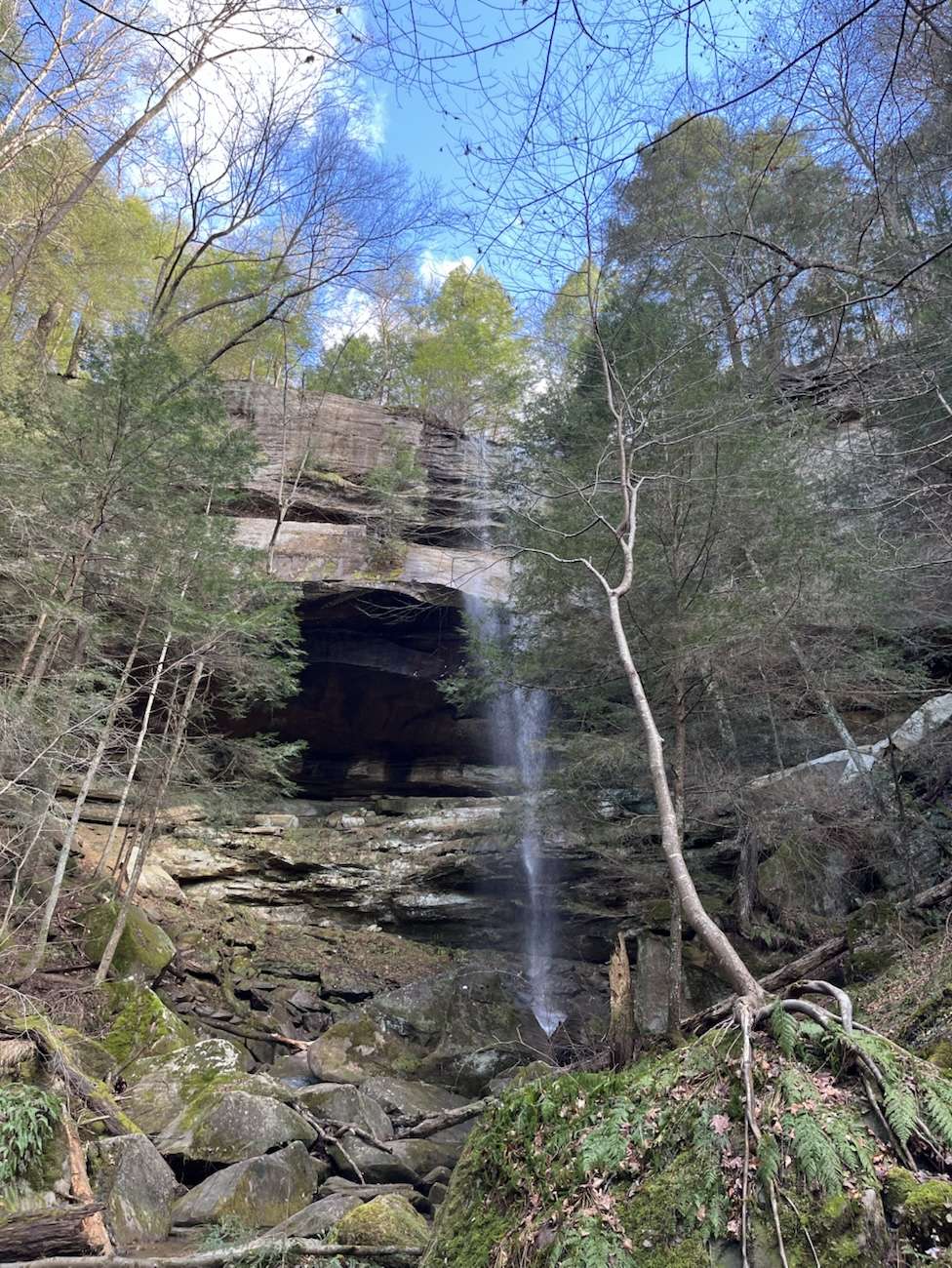
After exploring the cliff line, the fat man squeeze, and the waterfall at the end of the rappelling area, we doubled back to the bridge. Upon reaching the bridge we headed right toward the Big Spring Trail. This path culminates at Big Spring Hollow Falls, which stands at an impressive 120 feet, making it one of the tallest waterfalls in the state, and my favorite so far in Hocking State Forest.
The Climb: At the end of the trail, a scramble up the rocks gets you close to the main cascade.
The Recess Cave: another waterfall drops over a smaller horseshoe-shaped overhang. Standing inside the cave, you can watch the secondary fall trickle down the mossy face of the Black Hand Sandstone. This is actually the first fall on the trail though you need to cross a shallow stream together to it.
I just want to be inside… her.
The Geology of the Hollows:
The towering features of the Hocking State Forest are carved from Black Hand Sandstone. This was formed over 350 million years ago during the Mississippian Period, this rock was deposited as river delta sediment.
The view I live for.
The squeezes and caves you encounter are the result of differential weathering. The sandstone has three distinct layers: the top and bottom are hard and cemented, while the middle layer is soft and easily eroded by wind and water. When that middle layer wears away, it creates the deep recess caves we explore. When the weight of the heavy top layer becomes too much, vertical joints (cracks) cause massive blocks to shift, creating the narrow “Fat Man Squeeze” passages that hikers love to navigate.
The view up.
Final Thoughts from the Trail:
We clocked a little over 3 miles total, leaving the Amazing Grace trail for a future venture. Before heading out, Kylie and I found a spot on some downed logs near the waterfall and cave on Big Spring trail to just sit and take it all in with a cigar.
Another view I live for.
There’s a specific kind of peace found in the Hocking State Forest that you just can’t find anywhere else. I feel it is found in a mix of ancient stone history and the simple quiet of the Ohio woods.
Cross-country adventurers, history buffs, Appalachian explorers, train travelers and rail enthusiasts.
You’re going on a cross-country trip. Airplane, train, bus, car, or bike?
Moving Beyond the Highway:
The Power of the Rail-
Scenic train rides will always win me over when compared to typical modern American travel.
Whether you are staring out the window of a Greyhound bus from West Virginia to Las Vegas, flying over the farmlands that make up the patchwork quilt of America’s farms from 30,000 feet above, or navigating the white-knuckle traffic of a cross-country drive, the road can be a grind.
The scenic rails in America offer a different kind of movement, one that feels much more intentional. Beautiful and wild, the rugged elevation of the Monongahela National Forest or the sun-drenched cliffs and ocean views of Cali; the rails allow you to witness the geography of the country instead of just passing through it carelessly on the I-40.
The shift from a greyhound bus ride for 16-hours (not counting layovers) to a sleeper car isn’t just even really about luxury; it’s about the connection between the tracks and the history of the land we all share.
The Appalachian Legacy: Cass Scenic Railroad-
Before I ever headed west, I found the gold standard for historical rail right in Scenic Cass, West Virginia. The Cass Scenic Railroad is a living museum of industrial grit and history.
As if the views were not enough the trains here use Shay locomotives. Which are geared steam engines originally designed in 1901. They were designed with the purpose of haul massive loads of timber up insane grades that would make a standard engine stall.
The Climb to Bald Knob-
The ride from the town of Cass to the Bald Knob overlook on Snowshoe Mountain is a masterclass in engineering. At an elevation of 4,842 feet, Bald Knob is the third-highest point in West Virginia.
The steam engine train negotiates grades as steep as 11% using a “switchback” system, zigzagging up the mountain where the forest shifts from hardwoods to the dense spruce of the high country.
The Engineer’s View:
I loved this experience as a kids, and I just couldn’t get enough of it on our visits. My uncle Rex used to conduct this train. I remember when I had aunts, uncles, and cousins that made up a lot of the Cass population.
During the 1990s-2000s, we’d visit a few times yearly, ride the train, catch up, and enjoy the old fashioned ice cream. Just from watching my uncle on this train as a young kid I knew driving these “Iron Mules” took more than just skill. You have to respect and understanding the mountain’s temperament.
What You See:
On a clear day at the summit, you can see across the valley to the National Radio Astronomy Observatory at Green Bank. And of course rolling hills, trees, and those iconic West Virginian Mountain View’s.
Coastal Majesty: The Coast Starlight
If you are looking for a more coastal trip that defines the West, the Coast Starlight is the ultimate answer. Running daily between Los Angeles and Seattle, this route is famous for a reason: it hugs the Pacific Ocean shoreline for over 100 miles.
Navigating the West Coast
The Ocean View:
The most iconic stretch occurs between Santa Barbara and San Luis Obispo. The tracks sit on the very edge of the cliffs, offering views of the Pacific that are completely inaccessible by car.
Day Trips & Long Hauls:
You can use the Pacific Surfliner for shorter day trips along the Southern California coast, but for the full experience, a Roomette on the Starlight is the way to go.
Pricing:
Coach seats can start around $100, while private Roomettes (which include meals and a bed) typically range from $400 to $900 depending on the season and how far in advance you book.
Expanding the Horizon: Other Iconic Routes-
While the Coast Starlight owns the Pacific, other scenic train rides in America dominate the interior:
The California Zephyr: Stretching from Chicago to San Francisco, this is the most beautiful way to see the Colorado Rockies and the Sierra Nevadas.
The Empire Builder: This route follows the northern border, cutting through Glacier National Park and the rugged beauty of the Pacific Northwest
The Crescent: For those heading east, this line connects New Orleans to New York, passing through thirteen states and offering a deep look at the American South.
Pedal the Iron: The Expansion of Rail Biking in America-
If you want to move beyond the passenger car and actually feel the track beneath you, rail biking in America is the ultimate outside the box expansion for any cross-country trip. These aren’t your standard mountain bikes; they are custom-built, four-wheeled pedal cars, equipped with the REX Propulsion System, or electric assistance.
These sit directly on decommissioned railroad tracks. As of 2026, there are approximately 18 to 20 active rail biking locations across the United States, operated primarily by industry leaders like Rail Explorers and Revolution Rail Co., who have repurposed these ghost rails into interactive corridors where you are the engine.
Where to Ride and What it Costs-
While the industry is growing, a few specific “divisions” offer the best mix of history and scenery:
The Bluegrass Division (Versailles, Kentucky): Operated by Rail Explorers, this 10-mile round trip cuts through heart of horse country and limestone cliffs, ending at a turnaround high above the Kentucky River near the Wild Turkey Distillery. A Tandem Explorer (2 riders) starts at $105, while a Quad Explorer (4 riders) starts at $199.
The Elk River Division (Clay, West Virginia): This is the rugged Appalachian experience, following the Buffalo Creek & Gauley Railroad. You’ll pedal along the river and through dense forest over historic bridges. Prices are consistent with the national average, ranging from $50 to $60 per seat.
The Adirondack & Cape May Divisions (New York/New Jersey): Revolution Rail Co. dominates the Northeast, offering rides through the Adirondack mountains and the salt marshes of Cape May. These trips focus on biodiversity and seasonal foliage, with prices starting around $90 per bike.
The Cooperstown Division (New York): This ride follows the Susquehanna River, offering a lush, northern forest vibe that is a perfect contrast to the Southern and Western tracks.
The Boulder City Division (Nevada): For a complete shift in geography, this 8-mile Mojave Desert trip offers a stark, sun-drenched landscape. They even offer “Lantern Tours” for riding under the desert stars.
The Experience: Effort Without the Exhaustion
The beauty of these “pedal cars” is that you get the physical connection to the rails without the burnout. The electric motors kick in on inclines, allowing you to focus on the “click-clack” of the steel and the environment. Because there is no steering required, you can spend the entire trip looking at the gorge or the treeline, making it a rare way to actually be in the environment rather than just passing through it at 60 mph.
It’s a quiet, immersive, and increasingly popular way to reclaim the American rail legacy for yourself.
The Subterranean Rail Experience: Mine Trains
If you want to understand the grit that built the tracks, you have to go beneath them. Scenic train rides in America aren’t always about the horizon; sometimes they are about the deep-earth history of the regions they traverse.
In places like the Colorado Rockies or the coal country of Pennsylvania, the rail experience is literally carved into the stone. These subterranean tours connect the “scenic” beauty of the mountain peaks to the raw, geological reality of the mines that once fueled the nation’s expansion.
The Georgetown Loop Railroad (Silver Plume, CO): This is a rare “Train & Mine” combo. You take a historic narrow-gauge train through the Clear Creek Canyon and disembark at a remote station only accessible by rail. From there, you go 500 feet into the Everett Silver Mine. It is a 44°F (\bm{6.6}°C) environment year-round, requiring hard hats and closed-toe shoes.
Lackawanna Coal Mine Tour (Scranton, PA): Here, you board a mine car, a specialized piece of rail equipment, and descend 300 feet vertically into the Clark Vein. It is an immersive look at the anthracite coal industry, connecting the “black diamond” history of the East to the modern rail lines that still carry freight through the valley today.
What it Costs:
These tours are generally affordable, ranging from $25 to $40 for the mine entry, or around $60 to $70 for a bundled train-and-mine ticket.
The “Private Varnish”: The Apex of Rail Luxury
For the traveler who wants a legacy experience that rivals a private jet, there is “Private Varnish.” This is the industry term for Private Rail Car Charters. These are privately owned, vintage luxury cars. They are often from the golden age of rail in the 1940s and 50s. These can be legally “hooked” to the back of scheduled Amtrak trains. It is the most exclusive way to see the West Coast or the cross-country routes, offering a view from the very last window of the train.
The Experience:
You aren’t just a passenger; you are the owner of the space. These cars come with master bedrooms, full kitchens, mahogany-lined dining rooms, and a dedicated onboard chef and steward. It is the ultimate flex for a milestone anniversary or a “once-in-a-lifetime” family trip.
The Logistics:
You choose the route… whether it’s the Coast Starlight along the Pacific or the California Zephyr through the Rockies. Then the car is attached to the manifest.
What it Costs:
This is the highest-end rail experience available. Charters typically start at $15,000 per day, which includes the “haulage” fees paid to Amtrak and the full service of the onboard staff. While expensive, it is the only way to experience the American landscape in total, uninterrupted privacy.
Scenic Railway Rides & First Class Views:
The transition from the steep, coal-fired grades of West Virginia’s Cass Scenic Railroad to the vast, salty expanses of the Coast Starlight represents the full spectrum of the American experience. One is rooted in the history of labor and the Appalachian peaks; the other is a celebration of the horizon and the Pacific frontier. Whether you are following in the footsteps of an engineer uncle or charting a new path across the country, scenic train rides in America prove that the journey isn’t just about getting there—it’s about the view from the window.
Advocates for drug policy reform, holistic health practitioners, historians of the war on drugs, investigative journalists, individuals in recovery.
The War on Drugs: A Legacy of Engineered Crisis and Broken Medicine
The Origin Point: State-Sponsored Addiction
To understand why holistic medicine is under attack today, we have to look at the “beginning” of the modern era of prohibition. The 1980s didn’t just see a rise in drug use; it saw the strategic implementation of drug distribution to fund geopolitical wars.
While the “Just Say No” campaign was in full swing, the CIA-linked Contra scandal proved that federal agencies were turning a blind eye to massive quantities of cocaine entering the U.S. This “state-sponsored” influx flooded marginalized communities with cheap powder, which was then “chemically broken” into crack cocaine.
This wasn’t an accident; it was a blueprint. It allowed the government to criminalize specific demographics, fuel the private prison industry, and create a permanent underclass, all while lining the pockets of the military-industrial complex.
The Chemical Sabotage of Holistic Medicine
The same playbook is being used today against plants like Kratom (Mitragyna speciosa). For thousands of years, this plant existed as a holistic tool with “natural brakes.” Raw Kratom leaf contains a complex matrix of alkaloids that signal the body when it has had too much (nausea, dizziness).
However, we have entered an era of chemical isolation and synthesis:
The 7-OH Pivot: 7-Hydroxymitragynine (7-OH) is a naturally occurring alkaloid in Kratom, but in the leaf, it is present in minute, safe amounts.
Breaking the Balance: Labs are now isolating and synthesizing 7-OH into hyper-potent tablets. By removing the plant’s natural indicators, we create a “broken” version of the medicine that mimics the intensity of high-level opiates.
The Blame Game: When these lab-created synthetics cause issues, the headlines don’t blame the lab or the isolation process, they blame the “dangerous plant.” This gives the government the “moral” authority to ban the natural leaf, effectively handing the market over to pharmaceutical companies.
The Marijuana Parallel: Delta-8 and Designer Drugs
We see the exact same “breaking” process with Marijuana. Because the natural plant remains federally restricted, the market has pivoted to Delta-8, Delta-10, and other synthetic cannabinoids.
These aren’t “natural” alternatives. They are often created by taking CBD and applying harsh chemical catalysts to change its molecular structure. Much like the K2, Spice, and “Bath Salts” of previous generations, these designer drugs are a direct result of prohibition. When you ban the natural thing, the “Iron Law of Prohibition” dictates that the market will create something more potent, more synthetic, and more dangerous to bypass the law.
The Profit Pipeline: From Pills to Street Fentanyl
The transition from holistic medicine to a death crisis is most visible in the opiate epidemic.
Commodity Medicine: Billionaire-backed pharmaceutical companies pushed “safe” synthetic opiates like OxyContin, knowing they were addictive.
The Pivot: When the pills were cut off, the “market” didn’t disappear, it evolved into Heroin.
The Synthesis: To maximize profit and minimize the need for land (poppy fields), Street Fentanyl was introduced. It is easier to smuggle, cheaper to make in a lab, and is now killing the very people who were funneled into addiction by the medical system.
When the Profit Well Runs Dry
The War on Drugs is not about safety; it is about control and commodification. It stops when the “dirty addicts,” the poor and marginalized, are dead, or when the profit well finally runs dry. By criminalizing the natural and forcing us into a synthetic-only landscape, the system ensures that billionaires remain the gatekeepers of our health.
When we choose to “break” a medicine in a lab and then blame the natural plant for the resulting crisis, we are watching a systemic failure in real-time. We must stop letting the “War on Drugs” be an excuse to dismantle the holistic tools that have worked for thousands of years.
Emotional reflection readers, those navigating loss, the naturalist by hobby, those with interest in the geography of grief, and spiritual explorers.
2.What part of your past still echoes the loudest?
The Infinite Loop of Presence:
I head into the wilderness seeking what I know I will never locate indoors. I cannot hold this inside the four walls I call my home. I aim to get outdoors in the woods at least a few times a week, if I’m lucky enough to do so. Out there in the wild I find the only place large enough to hold what’s left of my mother, her memory.
It is not a circular journey and yet it doesn’t follow a straight line either. This is not directed by a typical map. While standing in the mist of the Beach City Wildlife Area, with only my dog by my side, the distance between the past and the physical present collapses.
I am not just a hiker with a dog on a trail; I am a vessel for a connection that I refuse to allow be severed by a physical absence. I go into the woods to keep the things my mother and I loved together alive. Hereby, ensuring the flame of that shared joy doesn’t flicker out in the static of my daily life.
The Spirit in the Current:
The loudest echo from my past is the presence of my mother. She is and always will be the atmosphere of the trail itself. March 25th, 2026 on my recent 2.6-mile trek near Dundee Falls, her presence wasn’t minimized to a memory trapped in a house or a photograph.
I found her walking in the sudden shift of the wind and the steady, rhythmic pulse of the flowing water against sandstone. It is through her I also learned the geography of grief when I realized that I don’t go to the woods to locate her as if she were lost; I go to meet her where she is now. She is the elemental force that guides my way. My mother is the map to my adventures as well as the motivation.
New Views and Old Echoes:
There is a profound purpose in taking her to places she never saw while alive. I typically try to hike as much as I can at least once weekly, but prefer when I can go on multiple times a week at that. This way I can always take her to new horizons and breath-taking views.
While Luna and I navigated the path from the smaller waterfall to the bigger waterfall, I felt her experiencing it right along with us. There is a genuine joy in that exploration; a sense of three souls moving through the Ohio landscape together. Sadly, that joy is always layered with the sharp, cold spray of reality, just like the spray from the cold waterfall misting us. Every time I want to make a comment or a wish to share an awe-struck glance…
I have to remember again that she is only ever going to be with me in spirit, for the rest of my days in this life. The worst part is this moment isn’t uncommon. It is a moment that all new trails I come to explore own claim over. I expect it now I’ve been met with it so commonly, it’s practically second nature. The high of the adventure and the let down of the coming to terms with reality.
The Ebb and the Rage:
My grief is like the water cycle that ebbs and flows. A diagram of it would show something similar to the streams linking the multiple Dundee waterfalls.
There are days when the current is weak, a gentle background hum that accompanies my steps. Then, like clockwork, the rain comes. Followed by a grief that rages like an overflowing watershed after a brutal Ohio thunderstorm.
I have learned that the raging waters are just as much “her” as the whispers in the wind are. The pain of that realization is a persistent, patient force motivating my movement and continuing my momentum.
As I continue to move forward walking through it, I am letting the water carve the rocks of my heart and soul. I am working to make more rounded instead of sharp edges. The “gone-ness” one day will hopefully feel more like a natural part of the scenery.
Acceptance in the Mist:
Can you point to it on a map? Maybe locate its address, the latitude and longitude coordinates if nothing else? Sadly, again… no.
Acceptance isn’t a destination to point to on a world map; it’s the waterfalls straying mists hitting your face when you stand too close to the falls. It’s a full body realization. It is all I get: the joy of the trek and the weight of the loss.
In my journal, I usually come back to ask myself again what lesson these repetitive moments are aiming at teaching me. The answer I come back to after trails like that of Dundee falls is that grief like water never stays the same. Though, the river always remains.
Yes, my mother’s physical form is gone, but her echo is as permanent as the Black Hand Sandstone making up Ohio’s geology. I find her by moving forward into the wild because that is where my memory of her lives most vividly. Every mile I drive and every following step I force myself to take are the evidence that love doesn’t stop when life does: it just changes its form.
Trail Reflections for the Soul:
The Vessel: Your body and breath are the primary tools for carrying those you’ve lost into new spaces.
The Sound of Grief: Whether it is a trickle or a roar, mimics the sounds of water. This is a reminder that your emotions are a natural, necessary cycle.
New Horizons: Taking a lost loved one to a “new” place is a way to continue your story together rather than just re-reading the old chapters.
Spirit in the Wind: Look for the “echo” in the elements that leave no scars, like the wind in the trees and the light on the creek.
Grinding through the Emotional Reflections Journaling Work:
Next time you are on the trail, try to be the person who notices the small things, not just the small waterfalls. I mean actually try to notice the spirits of those who visit places with you after their physical life ended as well. Where do you find them in the invisible layers of the environment? Where do you see the geography of grief?
The Geography of Grief:
The water at Dundee doesn’t just flow: it carves its own path and demands space. Flowing water, currents are a persistent, patient force that has spent thousands of years shaping the sandstone into ravines.
My mother’s spirit has become part of that geology, I just replaced the flow of water with grief. She is in the soft winds that move through the leaves and the spray that hits my face when the current is high.
The reality is I don’t go into the wild to find her as if she were lost. I go to the places her memory almost can convince me she’s alive. Cherish your loved ones; one day all you may have are the places where their spirits come alive. I locate my momma’s energy by moving forward into the wild; that is where our story continues.
Take the Journey with You – Waterfall Confessions:
If this reflection resonates with your own walk through grief or other emotions, you can now own the full Waterfall Confessions Collection. Available as a digital download and a self printable collection for only $2, links provided to direct purchase at the end of post.
I am sharing three entries as deep dives into how I use my own journal collections for emotional support. I do plan to share one more prompt from this specific set as a final sneak peek inside. You can read the first one here.
This specific emotional reflection journal is designed to be versatile with you in mind. I have tried to provide you with the ability to use this while you are physically on the trail, for post-hike reflections at home, or even to process memories of places you visited long ago. While also being usable digitally and accessible to easily print on your own.
Near the back of the collection, you’ll find a dedicated space to track the locations you’ve reflected on. This is provided to help you keep your reflections and adventures organized.
Don’t front I have quite a few other emotional and creative journals planned for you. This one is only the beginning. The upcoming releases like this collection and the one before it were designed to support your endeavors both creatively and emotionally. I do so by providing a structured yet fluid way to navigate creative prompts for art and literature as well as prompts designed to move you through the emotional hurdles life may hand you.
Individuals seeking to improve their emotional intelligence, those with an in-tune social awareness, and those who actually see other people.
What’s something most people don’t understand?
Why People Struggle with Nuance, Empathy, Free Will, & Identity
The Efficiency Trap, Why Nuance is a Mental Luxury:
People ignore Human Cognitive Biases and Perspective in order to allow themselves the comforts of thinking of themselves as objective observers, but the human brain is less like a high-definition camera and more like a stressed-out independent creator cutting a content on a deadline.
In human-history to survive, our ancestors needed to be able to make split-second “friend or foe” decisions. Today, that same survival mechanism manifests as a resistance to human cognitive biases and perspective shifts that require mental heavy lifting.
Gray Areas
Processing “shades of gray” is metabolically expensive. When we encounter a complex social issue, our brains naturally reach for heuristics (mental shortcuts) to categorize information into binary boxes of good or bad. This preference for simplicity is why human cognitive biases and perspective often lean toward polarization; it’s simply easier to win an argument than it is to understand one.
The Barriers to Nuanced Thinking
Most people struggle with nuance not out of malice, but due to a combination of internal and external pressures:
CognitiveEfficiency: The brain prefers “black or white” thinking to conserve energy.
Emotional Reactivity: In a “hot” state, we use our “emotional elephant” to drive decisions rather than logic.
Tribalism: Social pressure to fit into a group rewards rigid thinking and punishes “gray” areas.
The Desire to Win: Conversations are often treated as zero-sum games rather than collaborative explorations.
Mental Bandwidth: Deeply analyzing multi-faceted arguments requires time and energy most people don’t feel they have.
Confirmation Bias: We instinctively seek information that validates our current worldviews.
The Empathy Gap: Feeling vs. Knowing
One of the most profound human cognitive biases and perspectives hurdles is the “interpersonal empathy gap.” This is known as the psychological phenomenon where we cannot accurately predict or relate to the feelings of someone else because we aren’t currently in their emotional shoes.
If you are currently calm and well-fed (a “cold” state), your brain struggles to simulate the visceral desperation of someone who is terrified or starving (a “hot” state).
Then we judge others for “overreacting” because we are remembering the fact of a past struggle without being able to “re-feel” the intensity of it. Our brains effectively mute the volume of other people’s pain to protect our own comfort.
Free Will – A Gift for Me, a Script for You:
We are surprisingly protective of our own free will while being dismissive of everyone else’s. This creates a massive disconnect in how we judge behavior. When we mess up, we point to the situation that caused the mistake. It could be traffic, a bad night’s sleep, or a misunderstanding, but when others mess up, we point to their character.
This is driven by the Actor-Observer Bias and the Fundamental Attribution Error. Think about it, we have a front-row seat to our own internal struggles and intentions. We see our choices as free and complex.
However, and more importantly we only see the “finalproduct” of other people’s actions. Then we tend to place judgment on them, without access to their internal monologue, we assume they are simply “following their nature,” making their world feel more predictable and, therefore, safer for us to navigate.
Why the Empathy Gap Persists:
1. State-Dependent Cognition: Our understanding is locked into our current mental state.
2. Memory Constraints: We remember the data of our past pain but loses the sensory intensity.
3. Cognitive Cost: True empathy is emotionally taxing and requires significant mental “bandwidth.”
4. Self-Interest: When our own needs aren’t met, we naturally prioritize our own outcomes over others.
Identity as a Boundary
Identity should be a description of who we are, but human cognitive biases and perspective often turn it into a boundary. We view our own identity as a living, breathing, evolving story. Yet, in contrast, we often view the identities of others, especially those in “out-groups,” as rigid, static categories.
This “Out-group Homogeneity” makes us see “them” as all being the same, while “we” are unique individuals. Validating a “new” or different identity in someone else can feel like a threat to our own “default” version of normalcy. It’s a defensive ego reaction: if your way of being is valid, does that make mine less so?
The Interconnected Web of Misunderstanding
Yet the truth is not one of these biases exist in a vacuum. They are interlocking gears in a machine that keeps us separated. The lack of nuance makes it easier to categorize someone into an “out-group.” Once they are in that group, the empathy gap makes it harder to feel their struggle. Because we don’t feel their struggle, we ignore the situational pressures on their free will and judge their identity as a fixed, inferior trait.
Breaking this cycle isn’t about being “perfect“; it’s about being aware. It requires the humility to admit that your brain is a master of shortcuts and that the person across from you has a “protagonist” experience just as vivid and complicated as your own. When we acknowledge these biases, we don’t just win arguments… we actually start to see the people in them.
Fact-Based Source Materials for – Human Cognitive Biases and Perspective:
This post contains mature themes. Reader discretion is advised.
What are Community and Community Improvements ?
Community improvements need to be implemented in a well planned manner to actually count for any change. Community is not just a shared label or identity. It is a living system built on behavior, accountability, and mutual respect. When those elements weaken, even spaces created for safety and liberation can begin to replicate the same harm they were meant to help others escape.
Improving a community requires more than surface-level positivity. It requires confronting internal contradictions, addressing bias within marginalized groups, and rebuilding cultural awareness where it has been lost or diluted. It also requires an honestwillingness to challenge harmful norms, even when they come from within.
This is a direct expansion on how I would work in three overlapping areas of the communities I’m involved in, towards one solid goal of community improvements. I would use internal accountability within LGBTQ+ spaces, cultural responsibility within white American identities, and broader social cohesion across the United States.
Strengthening Accountability Within LGBTQ+ Communities-
Addressing Biphobia and Transphobia From Within:
One of the most immediate improvements needed inside LGBTQ+ spaces is internal accountability, specifically from lesbian and gay individuals toward bisexual and transgender people.
Biphobia remains a documented issue even within queer communities. Research from organizations like the Human Rights Campaign and Pew Research consistently shows that bisexual individuals experience higher rates of invisibility, erasure, and skepticism about their identity. Common behaviors include:
Treating bisexuality as a phase or confusion
Refusing to date bisexual individuals based on stereotypes
Making dismissive or underhanded jokes about “indecision” or “greed”
Similarly, transphobia persists within the same LGBTQ+ spaces. This includes exclusion from events, misgendering, invalidation of identities, and resistance to trans inclusion in conversations about rights and representation.
These behaviors are not minor by any means. They actively fracture the community and recreate the same exclusionary structures that LGBTQ+ spaces were originally formed to resist.
Re-centering Historical Truth
Many people overlook a critical historical reality that some of the rights enjoyed today were advanced through the leadership and resistance of transgender individuals and gender non-conforming people.
For example, figures like Marsha P. Johnson and Sylvia Rivera were central to early LGBTQ+ activism, particularly around the time of the Stonewall uprising in 1969. Their contributions were not symbolic, they were foundational.
Ignoring that history while benefiting from its outcomes creates a disconnect between identity and responsibility. Improving the community requires actively restoring that historical awareness and ensuring it is not erased or minimized.
Expanding the Definition of Belonging:
Another issue is the narrowing of what it means to belong. LGBTQ+ identity is often now attempted to be reduced to sexual orientation alone. This attempt sidelines people whose experiences center around gender identity, expression, or non-traditional alignment with societal norms.
Queer identity, in its broader and more politically rooted sense, was never meant to be limited. It exists as a rejection of rigid categorization, not a reinforcement of it.
Improvement here means recognizing that:
Not every identity in the community revolves around attraction.
Gender non-conforming individuals are not secondary or optional members
Labels are tools for understanding, not barriers for exclusion
Rebuilding inclusivity means returning to the original purpose of the community, which is collective liberation, not selective validation.
A stronger community is not defined by how loudly it claims unity. It is defined by how consistently it practices it.
Rebuilding Cultural Identity Within White America-
The Problem of Cultural Disconnect:
A significant issue within white American communities is the lack of a clearly defined cultural identity rooted in heritage. Many white Americans are generations removed from their ancestral origins, which has led to a disconnect from traditions, languages, and cultural practices.
In the absence of that connection, two patterns often emerge:
Cultural appropriation, where elements from other cultures are adopted without context or respect
Identity reduction, where “pride” becomes centered only on skin color rather than cultural substance
Thus, creating a contrast with other communities whose pride is tied to preserved traditions, histories, and lived cultural practices.
Understanding the Difference Between Pride and Supremacy:
There is a critical distinction between cultural pride and racial superiority.
Cultural pride involves:
Celebrating specific heritage, such as Irish, Italian, Polish, or German traditions
Engaging with language, food, rituals, and historical narratives
Passing down meaningful practices across generations
Racial pride, when detached from culture, often collapses into exclusionary thinking. It becomes less about heritage and more about hierarchy.
Improvement requires a shift away from vague, race-based identity toward specific, grounded cultural awareness.
Reconnecting With Roots Without Harm:
Rebuilding this aspect of community means actively researching and reconnecting with ancestral backgrounds.
That includes:
Learning about family origins and migration history
Engaging with authentic cultural traditions rather than surface-level aesthetics
Respecting other cultures without borrowing or distorting them
This process reduces the need for appropriation and replaces it with genuine identity formation.
At the same time, it must be paired with a commitment to reducing racism in all forms. While complete elimination may not be realistic in the short term. On the contrary measurable reduction is achievable through education, exposure, and accountability.
Community Improvements & Broader American Community-
Reducing Division & Increasing Mutual Respect:
At a national level, the most visible issue is division driven by difference. Differences in identity, ability, culture, and perspective are often treated as threats rather than assets.
A functional community does not erase differences. It integrates them.
Community improvements here involves shifting from competition and comparison to mutual recognition. That means understanding that:
Not everyone will excel in the same areas
Differences in ability or perspective do not diminish value
Respect does not require agreement, only acknowledgment of humanity
Building a Culture of Appreciation Instead of Comparison:
One of the most practical changes is learning to appreciate what others bring rather than resenting it.
This includes:
Recognizing strengths in others without internalizing them as personal deficiencies
Valuing diversity in skill sets, perspectives, and lived experiences
Developing self-awareness around personal strengths instead of focusing only on limitations
You see community improvements when individuals stop measuring worth through comparison and start recognizing interdependence.
Expanding Empathy Into Policy & Action:
These community improvements and others cannot remain theoretical. They need to start to extend into tangible systems and policies.
There is a growing conversation in the United States around support for marginalized populations, including economic inequality, access to resources, and immigration policy.
In America refugee resettlement and asylum systems are governed by international frameworks like the 1951 Refugee Convention and U.S. asylum law.Expanding access to safe entry for people fleeing violence or instability is not a new concept, it is part of established global human rights practices.
While policy is complex and often contested, the underlying principle remains consistent. A community that values human life should prioritize protection and support for those in vulnerable situations.
Community Improvements:
Improving a community is not about creating perfection. It is about reducing harm, increasing awareness, and aligning behavior with stated values.
Within LGBTQ+ spaces, that means confronting internal bias and honoring the full spectrum of identity. Within white American communities, it means rebuilding cultural identity in a way that is grounded, respectful, and self-aware. Across the broader United States, it means replacing division with intentional empathy and practical support.
However, none of these changes will or can happen automatically. They require effort, discomfort, and ongoing accountability. Though, the alternative is stagnation. This stagnation allows existing harm to continue unchecked.
Be seen, celebrated, and connected! All Free! Submit to Poeaxtry Spotlights today. By form or email Poeaxtry@gmail.com
Transgender athletes, cisgender teammates, any transgender person told they can’t play a sport, parents of transgender athletes, advocates, and the one guy in every comment section with baseless claims of unfairness.
This post contains mature themes, not suitable for some readers. Reader discretion is advised.
Nuance; Important:
Three trans masculine athletes just won big. Yet, nobody is calling for their medals to be revoked, thankfully so but still.
I see not one person saying their bodies give them an unfair disadvantage, even though the same rhetoric is used against trans women. That’s the tell. The nuance behind protecting women’s sports was never consistent or fact based. It was never about science. It is a weapon to use against transgender people just as ignoring the facts about trans masculine individuals existing is as well.
These three men winning, without a single mainstream acknowledgment proves that beyond any doubt. The old talking points are dead. They were proven wrong the second people stopped talking about transgender people in sports when they are not AMAB. Now the question is whether you’ll keep pretending, or finally admit what this was always about.
Three Trans Masculine Athletes –
Proved the Sports Panic Rhetoric Wrong:
A few weekends or so ago, Saturday, March 28th, at the 2026 Athletic Brewing Ironman 70.3 Oceanside triathlon, while most of the country was arguing about transgender women existing in athletics, three trans masculine athletes quietly secured a big win. They effectively did something that should have broken the internet. In an era of obsession for trans people in what they are in our not allowed to do. These three young athletes showed everyone behind the nuance and transgender people playing sports.
They never asked for special rules, as they were all they were all assigned female at birth, like me, and should by the logicAmerica uses have a disadvantage to their cis male counterparts. They didn’t demand a separate category. They showed up, competed in the men’s division, and placed with a big final spot, securing 3rd place.
Team Iron Transmasc:
“The loudest statement we could make wasn’t a speech. It was crossing the finish line ahead of two hundred teams who thought they had every advantage.”
— Cal Calamia, after the race.
The team of trans masculine athletes, from what I have seen consisted of Schuyler Bailar, Chella Man, and Cal Calamia. Each one born AFAB and aligning with a gender outside of that directly. Their hard work and determination combined with mental strength helped them secure this huge athletic win for transgender athletes worldwide. This all transgender team took third place at the 2026 Athletic Brewing Ironman 70.3 Oceanside relay, beating over 200 other teams.
If you believe the current wave of anti-trans legislation, this should not be possible. Yet, here we are.
Who, What, Where, When, & How –
Let’s Go Over Everything:
The event:
The Athletic Brewing Ironman 70.3 Oceanside is a half-Ironman triathlon that was held on Saturday, March 28, 2026, in Oceanside, California. The course consists of a 1.2-mile swim, a 56.2-mile bike ride through Camp Pendleton‘s hilly terrain, and a 13.1-mile run along the coast. Over 3,000 athletes and more than 60 professionals competed. In the relay division alone, over 200 teams entered.
The team:
Team Iron Transmasc, was the name the team of three trans masculine athletes chose to use when competing in the men’s relay division.
The three athletes:
Schuyler Bailar handled the swim portion of the event. He is the first trans man to compete on an NCAA Division 1 men’s team as a Harvard swimmer and a three-time Ivy League champion. He is also a prominent activist and author.
Chella Man took the bike leg. They are a deaf nonbinary cyclist, artist, and activist. During the race, they competed with their cochlear implants turned off. This meaning they could not hear race instructions, traffic, or crowd noise. They relied entirely on visual cues and their own internal pacing.
Cal Calamia anchored the run leg. They are the 2025 Outsports Nonbinary Athlete of the Year, have completed all six major marathons (aka the “Super Six”), and helped create nonbinary divisions for every single one of them.
How they won:
This is the part you need to picture. Calamia was running the final leg of the relay. With less than 10 meters to go (roughly the length of a large living room) they were trailing another relay runner. Calamia dug in, found something extra, and passed that runner in the final stride to secure the third-place podium spot. In their own words: “I had to close the deal. There was no part of me that would quit. And we got that spot on the men’s podium! It was amazing!”
What they wore:
Every piece of the gear used by these trans masculine athletes was a statement. Calamia had a trans flag sewn onto their running shorts. Bailar wore goggles striped in trans pride colors. Chella Man’s cycling suit bore the words: “bodies are not bans.”
After the race:
Of course they did not storm off in anger or give bitter interviews. The trans masculine athletes celebrated on the beach with cartwheels and piggyback rides. They cracked jokes about the race’s “transition zone” a standard triathlon term for the area between disciplines.
Joy was the point. They also made clear this is just the beginning, saying they want to “scale this up and get more trans athletes doing relays like this.”
“We kept saying ‘transition zone’ and laughing. You either find the joy or you let them take it from you. We chose joy.”
—Chella Man, on racing while trans
The IOC:
The International Olympic Committee (IOC) is the governing body for Olympic sports worldwide. What they decide influences nearly every other sports organization: NCAA, FIFA, USA Track & Field, Ironman, you name it. When the IOC makes a rule, the rest of the sports world tends to follow.
On March 25, 2026, just three days before this Ironman race, the IOC announced a new ban: trans women would no longer be allowed to compete in female events, regardless of hormone therapy, regardless of hormone levels, regardless of any individual evidence. The policy was absolute.
This matters because Team Iron Transmasc made entirely of trans masculine athletes, chose to compete just days after that announcement, and they explicitly tied their victory to resisting that ban. In their Instagram post celebrating the win, they wrote that they competed “for every person disenfranchised by transphobia, white supremacy, ableism, colonialism. For Palestinians, Iranians, Sudanese, Congolese. For every human’s right to exist exactly as we are, everywhere we are.“
Bailar gave an interview before the race where he said: “One of the reasons that the recent IOC decision is so devastating is because it sends a message that sports are going to lead through discrimination, as opposed to being on a progressive way of moving humanity forwards, which is what they should be doing.“
The IOC matters because they set the tone for global sports policy, and that tone right now is explicitly anti-trans. Team Iron Transmasc ran their race as a direct response to that.
What This Victory Actually Proves:
Now let’s talk about what this means, because most coverage will miss the point entirely.
The anti-trans sports panic rests on a single claim: that male puberty confers irreversible athletic advantages that make it unfair for trans women to compete against cis women. This claim has been used to pass over 20 state laws and influenced the IOC’s 2026 ban.
But here is the problem that anti-trans activists cannot solve.
If male puberty is an irreversible advantage, then trans men, who went through female puberty, should never be able to compete fairly against cis men.
Yet Team Iron Transmasc. made up of trans masculine athletes just beat over 200 cisgender male teams. Schuyler Bailar swam competitively against cis men in the NCAA for years. Cal Calamia runs marathons alongside cis men. Chella Man biked 56 miles through a Marine Corps. Base
You cannot have it both ways. Either puberty is not destiny, or it is. The evidence says it is not. Hormone therapy works., training matters, strategy matters, and mental toughness matters. These three trans masculine athletes just proved all of that on a very public stage.
Why They Leave Trans Men Out of the Equation
Anti-trans lawmakers and activists have a very deliberate strategy: they only talk about trans women. Trans women are painted as threats, as intruders, as dangers to cisgender women. Trans men are either ignored entirely or treated with patronizing pity as “confused girls” who have ruined their bodies.
Here is why they do this. Trans masculine athletes and trans men all together shatter their entire narrative. If a trans man on testosterone can hold his own against cis men and even beat them then a trans woman on estrogen and testosterone blockers can be beaten by and have cis women hold their own against them. It is the exact same biological process in reverse. The only difference is which direction you are going.
They leave trans men out of the equation because including us would force an honest conversation. This honest conversation would reveal that the entire panic is not about fairness at all. It is about who gets to be seen as a legitimate woman. Trans women threaten the idea that “male” is inherently superior. Trans men do not threaten that hierarchy, we are seen as “choosing” to leave womanhood, which ironically reinforces that manhood is more desirable.
So they erase us. They write laws that only mention trans women. They fill news segments with images of trans female athletes. They never ask trans men for our opinions or our evidence.
Yet, we are the evidence. Our bodies, training, and victories. These are the quiet proof that the whole thing is a lie.
“They don’t talk about us because we ruin the argument. A trans man on a podium next to cis men is a question they cannot answer.”
– Schuyler Bailar, on why trans men are ignored in sports bans
What This Means:
Three trans men stood on a podium. Over two hundred cis male teams finished behind them. The people who scream about fairness every time a trans woman competes? Silent.
Not because they suddenly believe in science, no change of heart, but trans men winning breaks the script. There’s no angle, no threat to manufacture, and easy villain.
That silence is the loudest confession.
They were never protecting women’s sports. They were policing whose bodies get to exist in public. The second the argument doesn’t work, the second trans men win fair and square, they just look away.
You don’t get to force bans and then attempt to look away. You can name it for what it is. A piece of misinformation that just ran out of places to hide.
If you are an athletic trans man reading this, know that your existence is already a political argument. Every time you train, every time you compete, every time you simply show up to a race, match, or a pickup game you are disproving the lie. You do not need to win a podium spot to matter. You just need to keep showing up.
If you are a cis person still unsure where you stand, look at the facts. Three transmasculine athletes beat over 200 cis male teams with no rule changes, accommodations, or unfair advantages. Just training, friendship, and a final 10-meter sprint that secured history.
The only thing standing between trans athletes and fair play is fear. Team Iron Transmasc just proved that fear has no place on the starting line.
Be seen, celebrated, and connected! All Free! Submit to Poeaxtry Spotlights today. By form or email Poeaxtry@gmail.com
How have you adapted to the changes brought on by the Covid 19 pandemic?
Best for:
Individuals who experience sensory overstimulation, those who prefer personal space, people whom relate to social anxiety tied to proximity, and others who want a grounded perspective on the changes brought on by the COVID 19 pandemic without the narrative of adaptation.
Covid-19 & Adaptation-
When most people talk about the changes brought on by the COVID 19 pandemic, the focus is usually on adaptation. It centers around how people adjusted, what they learned, how they coped. I feel like this framing assumes the experience moved in a clean direction, from your old normal to disruption to adjustment.
This simply is not true to what adapting to life after the Pandemic was for me.
The changes brought on by the COVID 19 pandemic didn’t teach me how to adapt. They changed the baseline I was operating from. Being around people started to feel different, heavier, more immediate. Spaces that were once tolerable became harder to navigate.
The level of awareness, the tension, the need for distance, it all increased, and it stayed that way longer than expected. I’m currently still battling with finding my normal after COVID 19 pandemic and the proceeding lockdown.
This isn’t about learning new systems or adjustinghabits. It’s about what happens when the things you already lived with become amplified to the point where they stop feeling situational and start feeling much more constant.
So no, I didn’t have to adapt to new things after the COVID 19 Pandemic. I had to adapt to situations I already figured out how to manage visits with as new types of forever thought patterns inside my mind.
From Already Anxious to More Anxious – A series:
I already had anxiety, if you didn’t know me before COVID 19 I’m sure that isn’t hard to believe. I have pretty much always dealt with some form of social discomfort. However, before the pandemic it existed within a range I felt I understood and could self-manage more.
My anxiety typically showed up in much more predictable, manageable, familiar ways. This produced something I was still able to move through with enough control to function. The pandemic didn’t introduce anxiety into my life, anxiety, and worry have been part of my bones for all of eternity.
Though the pandemic did not start my battle with anxiety. It did intensify my it. This global phenomenon, stretched it past what felt normal, even manageable at one point and turned it into an almost constant way of life that I had never experienced before.
People, Places, & Spacial Awareness After the COVID 19 Pandemic:
Before the pandemic and the global lockdowns, I wasn’t relying on people to shop with me, or deliver my groceries to my door through apps like InstaCart. I wasn’t using delivery services like DoorDash or UberEats to order fast food straight to my apartment door.
Now, while I don’t grocery shop nearly as much as I used to and hardly ever alone I also do not deliver groceries to my front door very often either. Thankfully, I have an amazing partner who either grabs what we need while I am at work or we go together during our days off. Either way I typically don’t have to grab very much if I do have to go and suffer through the store alone.
You know large hordes of people were never something I preferred. Though, this wasn’t in a way that interfered with my functioning, leaving or my going events though. It was more uncomfortable in a way that constantly required adjustment. Social interaction itself has always been manageable. Speaking, engaging, existing socially, in small groups of friends, of course, never before bothered me beyond normal social butterflies. The issue was proximity.
I don’t like people being close in my space. I function better with distance. Six feet wasn’t a rule I had to learn, it was a condition I already worked best in.
Overstimulation & Why Everyday Places Feel Worse
The changes brought on by the COVID 19 pandemic exposed something that doesn’t get talked about enough: overstimulation. Which for me isn’t always about the size but, it’s about the intensity, density, and unpredictability of the situation.
Simple places like grocery stores, gas stations, local shopping plazas, or corner stores can feel more overwhelming than larger, more crowded environments like amusement parks or tourist-trap hiking trails. That sounds backwards, I know but it isn’t in my head.
Those larger environments have structure. Movement is more predictable. People are there for a shared purpose, which creates flow. Smaller, stagnant, everyday places compress randomness into tighter spaces. People move unpredictably, stand too close, create constant low-level interruptions.
That constant input builds. It doesn’t spike, it stacks.
What Have the Main Changes After the COVID Pandemic Been?
On a broader level, the main changes brought on by the COVID 19 pandemic reshaped how systems operate more than how individuals inherently function. Public behavior shifted toward more awareness of space and hygiene, while industries adapted faster than expected.
Remote work expanded, digital systems replaced physical processes, and boundaries that used to be difficult to maintain became temporarily normalized. For many people, these changes required adjustment. For others, they reduced friction.
How Did the COVID-19 Pandemic Change the World?
Globally, the pandemic accelerated shifts that were already in motion. Work became less tied to physical location. Communication became more dependent on digital infrastructure. Healthcare systems were pushed to their limits, exposing both strengths and failures.
The world didn’t just change socially, it changed structurally. Supply chains, employment models, and public health responses all evolved under pressure. Those changes are still shaping how systems function now.
What Were the Positive Changes from COVID, If Any?
There were positives, depending on perspective. For people who function better with less overstimulation, the changes brought on by the COVID 19 pandemic created conditions that were easier to navigate.
Key positives included:
Increased acceptance of personal space and boundaries
Remote work improving accessibility and flexibility
Reduced pressure for constant in-person interaction
More open conversations around mental health and sensory overload
Though these, weren’t new needs. They were existing ones that finally had room to be met.
What Would the Foreseeable Changes of Another Pandemic Be?
If another pandemic happens, the response will likely follow the same pattern, just faster. Systems are already in place now. Remote infrastructure exists, and behavioral expectations have precedent.
The next shift wouldn’t be about figuring it out, it would be about activating what already exists in a more optomized fashion. That includes things like faster transitions to remote work, quicker enforcement of distancing, and more immediatereliance on delivery and automationsystems.
Changes Brought on by the COVID 19 Pandemic Across Contexts
In Ohio and across America, responses varied in timing and strictness, but the overall pattern was consistent:
shutdowns
phased reopenings
& long-term adjustments to how businesses and public services operate.
In the workforce, remote and hybrid models became standard in many industries, permanently shifting expectations around productivity and presence.
Globally, the pandemic reshaped infrastructure, from healthcaresystems to supply chains, accelerating changes that would have otherwise taken years.
The narrative around the changes brought on by the COVID 19 pandemic focuses heavily on adaptation, but that only applies if your baseline required much change.
For some, the pandemic didn’t disrupt life, it clarified it. It showed how much of everyday discomfort comes from environments that prioritize constantproximityandinput, even when those conditions aren’t necessary for everyone to function effectively. When those systems come back to haunt those the pandemic freed of them some of us are living proof they seek vengeance.
Support the work that feeds, bleeds, and takes the lead when it counts! Consider a donation via CashApp, PayPal, Ko-Fi, or Buy Me a Coffee. This helps to keep our projects and community thriving.
The unpolished hiker, film nerds who appreciate cult-classics, fungi fanatics, and those seeking a visceral dialogue with the ancient, iron-stained bones of Ohio.
Act I Deep Inside Butternut Cave-
The Seasonal Labyrinth:
Luna and I experienced the transition from winter to spring in Ohio at Malabar Farm State Park, on Thursday March 25th. The weather here is never a straight path. The seasonal attitude of the weather here is a jagged, beautiful cycle of end of season sudden snowfalls followed by 69°F heatwaves. You never know what Ohio will hand you.
Butternut Trail:
Picking up where the morning left off, Luna and I moved from Doris woods trail to our car and toward the Pugh Cabin. This is a 1940 log home built by Jim Pugh, a neighbor and close friend of Louis Bromfield, the original owner of Malabar Farm. While this cabin is globally recognized as the cinematic site where Andy Dufresne’s wife was murdered in The Shawshank Redemption, the real story today was written in the vibrant orange Black Hand Sandstone and the cold, reviving spray of Ferguson Falls.
I thought I was parking in the wrong spot again. Yes, the same place that it sent me when looking for the Doris Duke trailhead but, this time, the large gravel lot by the Pugh Cabin and the maple syrup cabin was where we needed to be.
The area was swarming with at least six Natural Resource Officers. Whether it was a convention or a massive shift change, their trucks lined the trail past a few more cute little cabins, along the trail.
The Geology:
Butternut Cave part of the larger Rock City outcropping in Malabar Farms. This is a masterclass in Black Hand Sandstone formations. This rocky outcrop formed roughly 350 million years ago during the Mississippian Period. This type of stone is named after a famous Indigenous petroglyph near Newark, Ohio.
This was created by a massive ancient river delta system depositing quartz and iron-rich sediment into a shallow sea. The high concentration of iron oxide is what gives the walls their iconic, beautiful, burnt orange and deep red hues.
The Skylights:
I spent the afternoon maneuvering through around the sky lights in rock city’s roof, after walking around inside. These are natural erosion holes in the cave roof. This cave is a rare periglacial feature, meaning it was sculpted roughly 14,000 years ago by the intense freezing and thawing cycles at the edge of the Wisconsinian Glacier.
As water seeped into the sandstone joints and froze, then it expanded through frost wedging, eventually causing up to 100-foot sections of the ceiling to collapse into the skylights in the roof of the cave that we explored today.
The Ice Ghost:
Luna and I felt the cool wind blowing from yards away from the cave mouth. Once in the mouth of the cave, the air temperature drops what feels like twenty degrees.
I found flat, massive ice formation on the cave floor under one low lying, ceiling. I was spooked at first since the frozen almost transparent ice patch looked like a humongous spiderweb. Yet one of the last frozen remnant of the snow that fell just last week, still trapped in the cave’s natural refrigeration.
Honeycomb Weathering:
The walls of the cave here show heavy tafoni or honeycomb weathering. This occurs when salt crystallization or differential erosion eats away at the softer pockets of the sandstone faster than the iron-cemented Liesegang bands. This is what created the intricate holes that look like fairy houses tucked into the rock.
Act II: Ferguson Falls
All Gas & No Brakes
The trek to Ferguson Falls is a brutal, unshaded incline that felt like a physical dialogue with the earth. Luna and I attempted this same trail in the Febuary shin-deep snow, turning back after losing trail and dog boots many times. By 12:20 PM, the sun was beating down with an intensity that felt wrong for March, making the destination a necessity rather than a luxury.
These two trails were marked as a loop, however I now see they share the same parking lot and different trailheads. The trailhead at Malabar Farm State Park for Ferguson Falls is at the bottom of a steep access road, gravel of course.
The Reset:
After the early spring heated up my skin, I needed to soak my hair with Luna so, I stood under the freezing spray. The descent to this waterfall was worth every second of the soul cleansing chill it provided.
This is a recess cave waterfall. Geologically, it occurs because the hard Black Hand Sandstone caprock sits on top of the much softer Fairfield Member of the Cuyahoga Shale. Over centuries, the falling water splashes back and erodes the shale much faster than the sandstone, creating a hollowed-out “recess” behind the curtain of water.
Folklore & Marker Trees:
Along the trail, I encountered a skinny tree bent into a perfect arch. In Appalachian folklore, these are “Portal Trees” or spirit gates.
Historically, many of these are known as Marker Trees (or Trail Trees) these saplings were intentionally bent and tied down by Indigenous peoples, such as the Shawnee or Wyandot. Tying these down created living navigation signs pointing toward water, safe crossings, or sacred sites. While nature can mimic this through snow-loading, the specific “elbow” and “nose” of a true marker tree is a cultural relic of the land.
Act III –
The Summit at Mount Jeez:
Luna and I ended our trip to Malabar Farm State Park the day at Mount Jeez Overlook. This spot is the highest point in the park at an elevation of 1,234 feet. The history of this hill is a story of total redemption.
When we came here in Febuary the gate was closed and the road unplowed. Upon driving to the top with Luna today, I am glad I decided against walking up it in the snow that day.
Another vehicle with a dog in tow too arrived just as we did, so Luna and I sat in the air conditioning and enjoyed our view while the other visitors poked around the massive 360 degree view.
Poverty’s Knob:
Before Louis Bromfield returned to Ohio in 1939, this hill was known as “Poverty’s Knob.” The soil was so depleted from a century of poor farming practices that it was considered “worn out” and worthless, unable to even grow weeds. Bromfield used his “New Agriculture” techniques such as contour plowing and “trash mulch” farming—to heal the land. Thus changing the outlook of the land in the area and successully starting what would eventually become Malabar Farm State Park.
The Name Mount Jeez:
The name “Mount Jeez” was coined by Bromfield’s business manager, George Hawkins. When visitors arrived at the Big House looking for the famous author, Hawkins would point toward the summit and say, “He’s up there,” often followed by a “Jeez!” at the effort required to climb it.
Through time a lot of visitors to the peak often have an awe-struck reaction to the vastly beautiful view once at the overlooks peak. All you can see are the rolling foot hills and patchwork farmlands that make up much of Ohio’s terrain.
The Glacial View:
From the top, the 360-degree view of the Pleasant Valley, in Richland county, Ohio shows the exact path of the Wisconsinian Glacier. The glacier stalled just miles from here, leaving behind the silty loam and gravelly moraines. THe minerals left behind provideded the rich foundation for Bromfield’s agricultural revolution. After I sat there in the AC waiting, I found more heart-shaped quartzite rocks in the gravel while watching the valley below.
Malabar Farm State Park
Everything has a cycle: of life, death, winning, and losing. Today, for Luna and I won. The spring trail reminded us that regeneration is always just one thaw away. Hopefully, you don’t have to wait to much time between your winning times.
For Highlight reels from Malabar Farm State Park & other trips with Luna and the homies, as well as other visual content catch Poeaxtry_ on socials like:
The unpolished hiker, film nerds who appreciate cult-classics, fungi fanatics, solidarity reflective journal readers.
The Great Escape – Doris Duke Woods Trail:
Welcome, Luna and I explored the Doris Duke Woods Trail on Thursday, March 26, 2026, I pulled into the parking lot of my great escape at 10:03 AM. The air at Malabar Farm State Park sat at a comfortable 60°F, but the stillness the the woods typically offers was about to surprise us with a straight up ninety degree incline. To top it off the incline from Hell was also wet as a bitch.
Navigating this park requires a bit of patience. I finally parked just after 10 am, before that I had been driving around nearly twenty minutes. I was just scouting the perimeter to find the place I was supposed to park to access this hiking trail.
Finally impatience and the need to urinate took ahold of me. I decided on parking at the main farm lot. My first win of the day.
From here, Luna and I had to walk a small portion of the road to reach the Doris Duke Woods Trail’s trailhead. I found a few green-hued stones underfoot in the parking lot suggest a surprising geological diversity waiting in the treeline.
Let’s Hike Together Through Ohio & Appalacia.
The Reality of the Ascent – Not Your Average Nature Walk:
The Doris Duke Woods Trail wastes no time making its intentions known. This is loop trail, just follow the white-blazed, tree markings. You should be prepared for a physical dialogue with the earth.
Doris Duke isn’t paved, and it certainly isn’t ADA accessible. Between the massiveroots waiting to trip the unwary and the sheer number of fallen trees, it is clear that recent Ohio storms have left their mark on this ridge. Luna and I aren’t just walking; we’re climbing over timber and navigating a landscape in transition.
There is a specific kind of triumph in reaching the top of that first steep hill. The inclinefinally broke at a cute little bench, I finally had the chance to stop and shed my hoodie. Luna, ofcourse got a few drinks from my Spongebobwater bottle before we started off on the trail again. From this vantage point, the farm and the pondbelow look like miniature models, a stark contrast to the ground nearby where I was able to photograph vibrant red mushrooms that appear to be laid upon the damp soil.
When we finished the Doris Duke Woods trail, AllTrails said we did just over 1.5 miles. Which took us a few minutes shy of 45minutes to complete. AllTrailshumbledme, when I checked the elevation and saw we only gained197feet in elevation. In retrospect this is hilarious considering I was complaining about the climb the entire time. Maybe it just felt like more from the ground being slick and the incline that was immediate.
“Widow Makers” & the Legend of the Monkey Vines:
As the best dog in the whole world and I move deeper into the woods, the trees are draped in thick, heavyAppalachiavines. Growing up, we called these “monkey vines,” I can remember imagining creatures swinging through the Ohio hardwoods. However, my friend recently informed me of their darker existence. Her dad had found these wooden vines a more fitting, grounded, and dangerous, name to go by: Widow Makers.
These vines are massive woody lianas that can grow to be as heavy, if not heavier than a standard tree branch. When the supporting tree begins to rot or the windcatches an Appalachia Vine just right, these “monkey vines” can snap and fall with lethal force. They may look like something out of the jungle book, but in the context of a life-ending risk, they serve as a reminder to keep your head up.
This trail was fairly easy as long as you have the breathing capabilities to conquer the initial hill. Don’t forget not to walk under the Appalacia Vines if you can help it, and keep your eyes peeled to watch for falling debris. keep your wits about you, there is no “impending doom” just the waitingwilderness, and wildwoods.
The Shawshank Connection and Bromfield’s “New Agriculture:”
Malabar Farm is a site defined by the vision of Louis Bromfield, the Pulitzer Prize-winning author who returned to his Ohio roots in 1939. Bromfield didn’t just want a farm; he wanted a revolution in sustainable agriculture, transforming “worn-out” soil into a flourishingecosystem. His fame brought Hollywood to the hills of Richland County, most notably when Lauren Bacall and Humphrey Bogart were married here in 1945.
The park embraces this legacy with several signs posted around the trails marking this as part of the official “Shawshank Movie Trail.” For many, the woods of Malabar are synonymous with The Shawshank Redemption (1994). While the famous “Shawshank Oak” (which stood nearby until 2016) is the most cited landmark, the entire park breathes the atmosphere of the film. The opening scenes of Andy Dufresne’s trial and the exterior of the “Pugh Cabin” utilized these very grounds. Walking these trails is an exercise in “geography as character,” the same Black Hand Sandstone ravines and dense timber that provided the backdrop for a story about hope and persistence.
Geological Curiosities and the Forest Soundscape:
The geology on the Doris Duke Woods Trail is dominated by the Black Hand Sandstone, a sedimentary layer formed over 300 million years ago when Ohio was covered by a shallow inland sea. This stone creates the dramatic cliff faces that make Ohio iconic, and the rock formations even influence the way the trees grow.
The Humor of Nature: Sometimes, nature doesn’t grow in a linear fashion. Along the trail, you might find a “big old tree that looks like it had a big old wiener.” Some things in the woods and world never change. I’ll forever see weiner’s where others see wood. That is just one trope that forms the joy of the trek.
The Percussion of the Woods: Just like the daybefore, the forest is alive with the sound of woodpeckerspecking into the wood of nearby trees. They are the primary architects of the “tree beat–boxing,” taking advantage of the fallen timber to find their next meal.
Transitioning to the Next Descent
By 10:48 AM, Luna and I had torn through that loop happily finishing the trail. The moment before you see your descent to the end, the trail passes by a large open field designated as a picnic area. Though, for those on a mission, it’s just a landmark on the way to the descent. The Doris Duke Woods Trail is a reminder that a hike is more than just mileage; it’s the sensory download of the wet earth, the history of the soil, and the physical effort of the climb.
With Doris Duke Woods Trail being the first loop at Malabar Farm State Park we did in the bag and the car in sight, the morning is far from over, for Luna and I. The white blazes of Doris Duke are behind us, but the water-carved echoes of Ferguson Falls and the dark mysteries of Butternut Cave are the next stops on the map.
For Highlight reels from Malabar Farm State Park & other trips with Luna and the homies, as well as other visual content catch Poeaxtry_ on socials like: