
Best for:
Readers interested in Indiana Preservations, hikers planning a trip to Southern Indiana, geology enthusiasts, & individuals who enjoy nature journals.
The Essence:
Read Time: 🕰️ 8-10 minutes | Mood: 🍃 grounded & inspired | Weight: 🪶 light & free |
Trail Notes:
- Date & Time: June 17th 2026 at 4-5PM
- Location: Falls of Ohio State Park Indiana
- The State Park & the Confusing Name
- Mammoth Fossils & the Nature Center
- Preservation & Geography
- Bridges & Dams

Falls of Ohio State Park
Clarksville, Indiana
Fossils & No Falls:
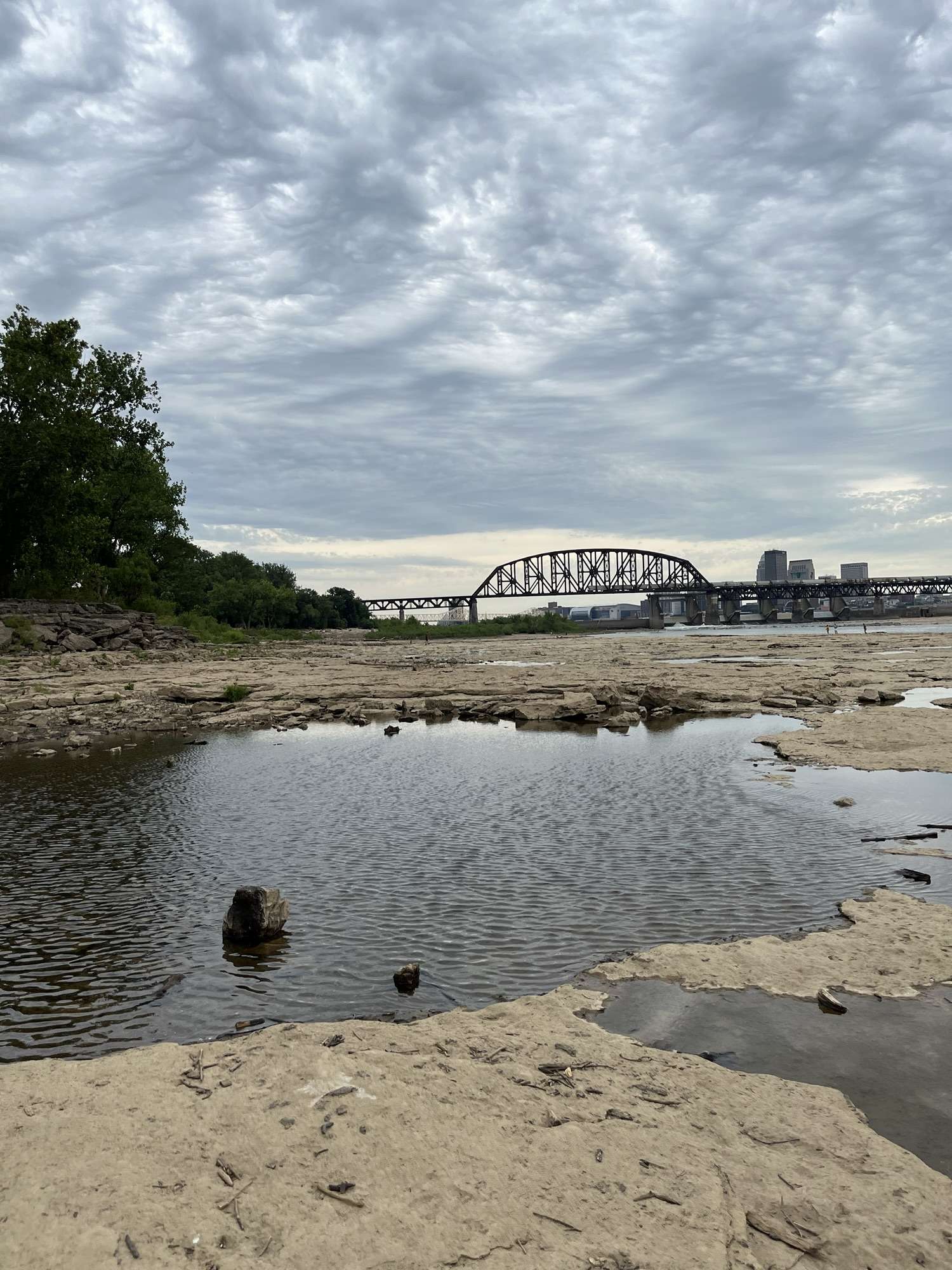
There are no waterfalls at this park, and it is not located in Ohio. That doesn’t make it any less appealing it just makes the name make way less sense. You will find an abundance of fossils here, as well as a dam that resembles multiple waterfalls, and a large train bridge.
The natural world often preserves its most ancient chapters in unexpected places, where the relentless flow of water carves away the modern veneer to reveal a prehistoric past. Along the borders of the Ohio River, ancient seabeds lie exposed to the open air, offering a rare portal into a forgotten geological epoch. Stepping into these landscapes changes the entire rhythm of an afternoon, shifting attention from the routine pace of daily life to the deep, silent timescale of fossils and ancient stone.

Woodland Paths & Sports-Mode Mishaps:
The afternoon started with a familiar battle of wills: trying to coax a seven-year-old out of the car. After some heavy convincing, he finally declared that his shoes were in “sports mode,” bolted out the door, and promptly took a tumble within the first five steps.
Once the initial wipeout was out of the way, however, there was no turning back. Getting him to slow down or chill while we tried to take photos became the new challenge.

The Trail:
Right off the trailhead, we spotted wild mushrooms tucked near the path, alongside a surprisingly interesting outdoor classroom area.
The trail quickly opened up into a landscape teeming with history. There are fossils scattered everywhere along the path, and stepping inside the interpretive center even revealed a woolly mammoth fossil exhibit.
The atmosphere of the trail had its own distinct local flavor, complete with a few local dogs on the walk and the unmistakable scent of weed drifting through the air.
By the time the clock hit five o’clock, we had cleared the few available trails here. To enter and leave the area that I would struggle to call a beach we had to scramble over massive piles of drift logs.
While walking along the beach we explored the exposed rock formations and looked into the small cave-like openings. This felt almost like stepping onto another planet, every inch of the stone under our feet were made of massive fossil plates.
The kid who threw a fit just to get out of the car ended up having the absolute time of his life, demanding to know where else we could explore next. That’s just how kids are, keeping the adventure alive right to the end.

The Ancient Architecture:
The Falls of the Ohio State Park is a unique geological and ecological sanctuary situated along the Ohio River in Clarksville, Indiana. Unlike typical waterfalls driven by vertical drops, the “falls” are actually a 2.5 mile series of rapids and cascading limestone ledges where the river drops about 26 feet over a relatively short distance.
This dramatic descent historically created the only major navigational hazard for early riverboat travelers, requiring flatboats and steamboats to navigate carefully or portage around the turbulent stretch. Today, the park serves as a protected National Wildlife Conservation Area and state park. The goal here is preserving one of the largest exposed Devonian fossil beds in the world.
When river levels drop during the late summer and autumn months, vast acres of limestone emerge from the water, allowing visitors to walk directly across an ancient seafloor that spans hundreds of millions of years of Earth’s history.

Coral Reefs & Devonian Seas:
The reason fossils are so overwhelmingly abundant here comes down to ancient geography. Approximately 390 million years ago, during the Devonian Period, the region that is now the American Midwest sat near the equator, completely submerged beneath a shallow, warm tropical inland sea.
This prehistoric ocean swarmed with marine life comparable to modern coral reefs. As ancient corals, brachiopods, bryozoans, crinoids, and stromatoporoids lived, died, and accumulated on the seafloor, their calcium carbonate skeletal structures were compressed and lithified into dense layers of limestone over millions of years.
Because the Ohio River continually scours away the overlying mud and sediment, these massive fossil plates are exposed in stunning preservation. Walking across the limestone shelves reveals intricate patterns of horn corals, honeycomb corals, and crinoid stems frozen directly into the bedrock. It is a living museum where stepping stones are literal fragments of an ancient tropical reef.

Industrial Horizons – Dams & Massive Rail Bridges:
While looking down reveals millions of years of natural history, looking up and across the landscape frames the heavy footprint of human engineering. Dominating the immediate view from the park are two monumental structures: the McAlpine Locks and Dam system and the sprawling, industrial spans of nearby railway bridges crossing the Ohio River.
The dam regulates the powerful river currents, drastically altering the natural water levels that once defined the wild, roaring rapids of the historic falls. Parallel to the water management structures, the massive steel lattice of the historic railroad bridges stretches across the horizon. These industrial iron giants frame the ancient riverbanks, creating a striking visual contrast between the heavy infrastructure of the 19th and 20th centuries and the 390-year-old fossil plates resting quietly beneath their shadows.

Feeling Small:
One of the main things that keeps me coming back to places like this in nature is the reoccurring realization just how small we are. Looking from the bridges, to the dam, to the fossils, and back to the massive Ohio River it is impossible not to feel almost microscopic here.
Leaving the riverbanks behind, the transition back to the everyday world comes with a lingering sense of perspective. A landscape built from ancient coral reefs, framed by steel bridges and modern currents, leaves a quiet mark on anyone willing to scramble across the logs and look down at the stone beneath their feet.

Read More:
Thistlethwaite Falls. Fossil Park.
AllTrails. Falls of Ohio State Park.


Leave a Reply