
Best for:
Solo backpackers seeking solitude, amateur geologists hunting for pyrite and fossils, thru–hikers looking to explore Ohio, & mindful trekkers wishing for an authentic vibe-shift in the Forest.
Trail Notes:
- Navigational Strategy: The long loop and short loop do not share the same trail; download offline maps on AllTrails+ before arrival as
cell service is non-existent. - Backcountry Amenities: A prime, accessible camping spot is located just .12 miles from the trailhead, featuring a pre-existing fire pit and curved tree landmarks.
- Geology & Rockhounding: The stream is a goldmine for shale ledges, hag stones, and pyrite. Casual surface collection is allowed up to 10 lbs, but artifacts and vertebrate fossils are strictly
prohibited. - Interconnected Flora: Look for Ghost Pipe (the translucent “spirit” plant) and massive root systems supporting multiple trees, for proof of the forest’s underground nutrient-sharing network.
- Trail Safety: Utilize the boot-brush stations to prevent invasive “hitchhikers” and keep an eye out for “UR LOVED” carved into a tree near the switchback.

The Offering:
The Wildcat Hollow Trail in Wayne National Forest, Ohio offers something real a living, interconnected ecosystem where the trees speak to each other.
The history here is written in layers of ancient shale. This post per-usual isn’t just your average trail guide; it’s an exploration the land’s history. That looks at why we head into the Forest to find things, how nature sends us signs from those we’ve lost, and the technical facts that make a trek truly feel out of this state.
While we walk on the industrial scars that eventually healed into this ethereal, enchanted landscape we see today.

This is the story of the Land Reborn from the Land Nobody Wanted and why experiencing it for yourself is the only way to truly see it.
The Tuesday Hike:
After two years of working practically every Tuesday and Friday as pick up days on-top of my Saturday-Monday night-shift routine schedule.
I just didn’t pick either day up. You know what it felt really good to be in the forest and not have a care in the world momentarily. Come with Luna and I through Wildcat Hollow at Wayne National Forest, Where I take the wrong loop, and realize it before it’s too late thankfully.
We parked the Civic in the rather small for the overnight parking side & thru-hike side both but.. alas also it’s good to mention these loops are not on the same trail.

The best practice is to use these brush your boots stations both before you start (to protect the trail you’re on) and after you finish (to make sure you don’t take any “hitchhikers” home or to other trails with you). It’s a small step that makes a massive difference in keeping the woods looking the way they should.
So, guess what I managed to do… I download the wrong trail by accident… Thank god for the offline navigation in AllTrails+. It’s a good reminder to always have those maps downloaded before you lose service.
April 21st 2026 at 10:20 am. I have snacks, we grabbed breakfast on the way here, and I have 4 SpongeBob Path Reusable bottles in my pack. I also have a large hydro flask, can’t be too cautious with hydration for two.
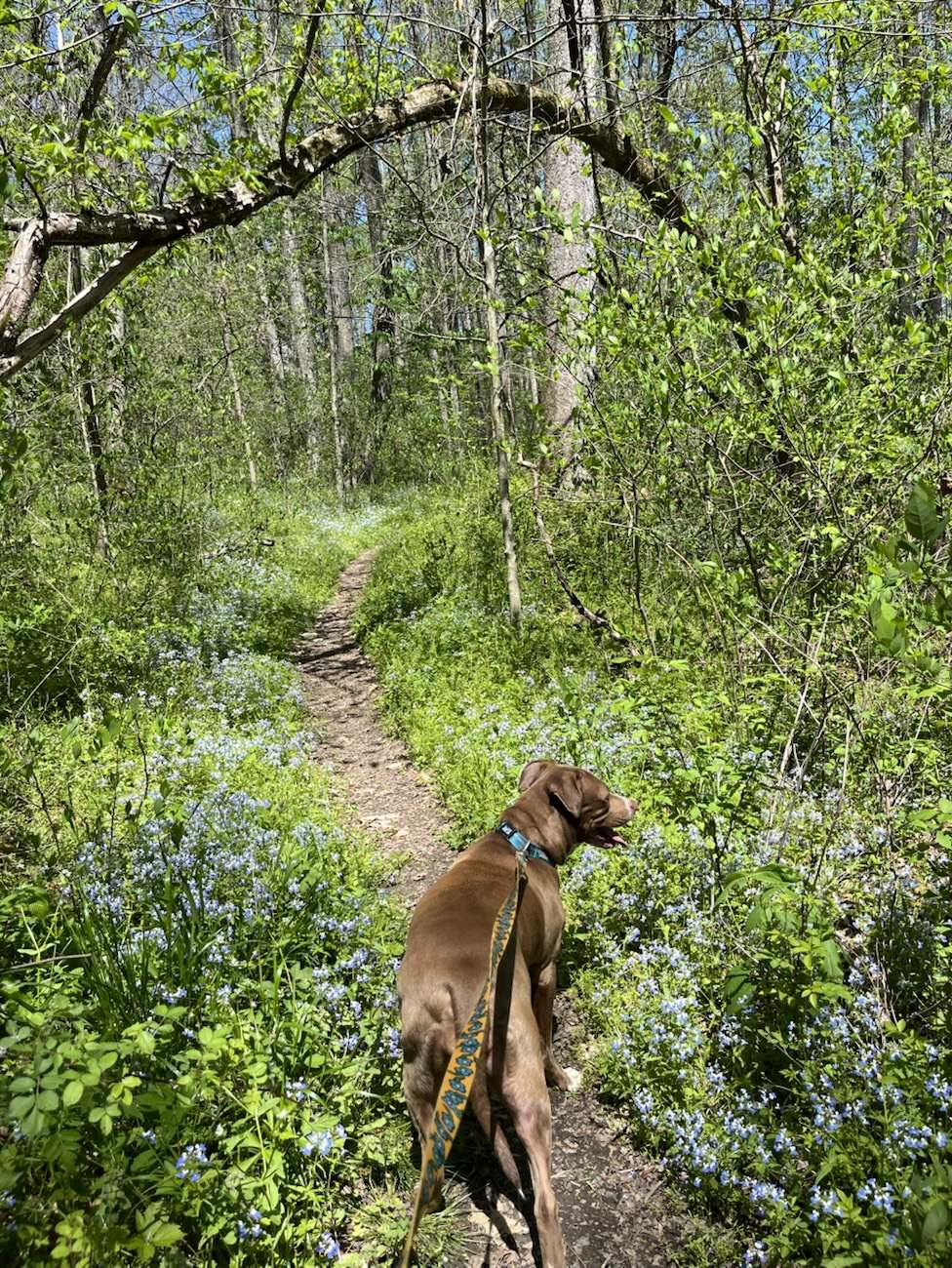
I’m so excited to start my extended weekend. I want to mention that there is one camping spot .12 miles into the trail very, accessible. There are many wildflowers of multiple colors lining the trail, as well as fell not cut moss covered trees.

Well come on let’s go, I know it’s chilly now, but we will heat up quick and so will the day.
The rocks, butterflies, and a surprise switch back await us with a hopeful omen, on this Ohio trail.
Wildcat Hollow is More Than a Hike:
There is a specific kind of magic that happens when you stop rushing through life and start walking through the loudest quiet place in Ohio. That’s an oxymoron, you won’t understand unless you’ve experienced it.
Most people treat the wilderness like a curated, manicured “nature-show experience.” The only thing worse I can think of are the places that feel more like crowded amusement parks, just in nature.
Don’t get me wrong I love a good rollercoaster, but I go out here to get away from all of that. Tourist traps for me are handled one of three ways in regards to the wilderness:

- A) I create an estimated plan for the least amount of people. I have been to Conkles Hollow, Brandywine Falls CNVP, and more with just my homies. You have to know when to go. Which let me tell you doesn’t always mean a shitty view.
- B.) I plan for the crowd. This for me is usually more mental and or self care related than anything. So that I don’t lose my absolute mind in the seas of humans.
- C.)
I don’t plan & risk losing my mind.
The Vicious Pitbull Trope;

Most of my videos from my trips have the sound replaced when Luna comes. You see… Luna spends a lot of the time we are trekking pretty much dragging me and then panting dramatically the second I make her stop walking so I can film or photograph something.
But I did catch two photos of her just leaning down to gently sniff the flowers. It’s funny people call them vicious, but she is more gentle than some people in the world.

- Pro Tip for Hiking with dogs:
If you’re out here with your dogs, in the heat knowing your dog and their breed can save your day and your dog’s life.
Allowing them the opportunity to lay in the water to cool off, always walking close to stream when it’s hot so they don’t run the risk of overheating, and bringing plenty water as well as a collapsing bowl. These are just some of the ways you should be preparing

Geology GeekSquad:
There are shale lines in the stream here that look like a mini-cliffs where the water flows peacefully. These are perfect spots to see that layered bedrock up close.
As well as many hag stones and half-baked hag stones which are typically on the stream line. A hag stone is a naturally occurring stone with a hole ruling through it. This was formed over thousands of years by the movement of water, sand, or the boring actions of small mollusks.
A half-baked hag stone is a stone with a deep, noticeable indentation that hasn’t formed a full hole. I just personally have an affinity for them.
What you can find:

- Pyrite (“fool’s gold”) and Quartz.
- Hematite, Gypsum, and Calcite.
- Ironstone and occasional flint in eastern sections.
- Upper Carboniferous (Pennsylvanian) and Permian bedrock, which means you are more likely to find ancient plant life and swamp-dwelling creatures than trilobites.
Rules for Collecting;

- casual use rockhounding, but strict prohibitions apply to historical & biological items.
- small quantities of unique rocks for typically up to 10 pounds
- Surface Collection: Most collecting must be from the surface. You should not disturb the earth or use mechanized equipment.
Prohibited Items:

- Artifacts: It is strictly illegal to remove arrowheads, pottery, or any man-made objects (even old bottles or farm equipment).
- Vertebrate Fossils: You cannot collect dinosaur bones, fish, or anything with a backbone.
- Protected Areas: Collecting is prohibited in designated wilderness areas or sensitive research sites.
- Gold Panning: Panning with a hand shovel and pan in streams is generally allowed without a permit, but using a sluice box or suction dredge requires official authorization.
Prehistoric Roots & the Shallow Sea:
Long before it was a hiking destination, this part of Ohio sat south of the equator. Over 350 million years ago, a prehistoric tropical shallow sea covered the region. This environment deposited the organic-rich mud that eventually hardened into the Ohio Shale and Cleveland Shale you see exposed in the ravines and mini-cliffs along the stream.

The specific rock layer here is often the Huron Shale member of the Ohio Shale, known for its large, round concretions.
While you might find pyrite (“fool’s gold”) and its less-hard twin marcasite, as well as flint, chert, and fossils of mainly ancient sponges and algae, not corals (which had already gone extinct).
The rock also holds a deeper economic story. These same shales were once a major source of oil and gas in Ohio.
The geological makeup here is often tied to glacial carving. In reality, the deep, dramatic ravines of the Appalachian Plateau that we scramble through today were cut primarily by streams and rivers over millions of years, long before the Ice Age.

However, when glacial meltwater floods did arrive from the north, they dumped massive amounts of sediment into the main river valleys, reshaping the landscape indirectly. The rock itself weathers from blue-gray to a chalky light gray or white, giving the cliffs their distinctive look.
So while glaciers never touched this ground directly, their meltwater played a supporting role.
The Fairy Gate Legend:
In British and Irish folklore, these natural arches are considered powerful liminal spaces, or places that are “neither here nor there.”

- The Threshold: Walking under a natural tree arch is believed to be a symbolic “passing through the veil“. In some legends, doing so at specific times (like dusk, dawn, or a full moon) could
accidentallytransport a person into the Otherworld. - The Rules of Passage: Tradition often dictates that if you walk under one, you should leave a small token of respect. You could leave anything a stone, piece of bread, or coin. This works to ensure the fairies don’t take offense at you “entering” their space.
- Healing Rituals: Some older folk traditions involved passing sick children or livestock through these natural arches (particularly those made of Ash or Oak) to “
strip away” the illness and leave it on the other side of the gate.

Industry History – The Land Nobody Wanted:
By the 1800s, the ethereal peace of this forest was consumed by the roar of Iron Furnaces and coal mining.
The hills were completely clear-cut to fuel the furnaces, and the soil was stripped for resources until the land was a devastated wasteland of erosion and acid runoff. By the early 1900s, it was known as “the land nobody wanted.” In 1935, the federal government began purchasing these exhausted acres to create the Wayne National Forest.

What you see today is a testament to the resilience of nature, a reforestation project that turned an industrial graveyard back into an enchanted sanctuary.
The Ethereal Shift: Understanding the Forest vs. the Woods:
Standing in Wildcat Hollow, I finally felt the shift from woods to forest. It is enchanted, ethereal, and busy in a way time doesn’t touch.
I walked about .22 miles further and found an even crazier sight: five trees growing out of a single, massive visible root system.
It really drives home those ethereal and enchanted feelings I’ve been chasing. After visiting National Forests in North Carolina and Kentucky over the last year, and now the only National Forrest in Ohio I finally get the. difference.

Don’t get me wrong I love walking in woodlands but it’s much different than frolicking in the forest. This is the loudest quiet place I’ve ever been. It’s a busy place where time doesn’t seem to exist. A natural concert that makes you realize life is always “rush, rush, do, do,” but out here, that’s not what it’s about.
It’s not about the trees; it’s the “loud quiet” and the sense that the land is busy in a way that time doesn’t touch.
This trek started with a fluke; it turned into a relaxed exploration.
Even when compared to Hocking Hills, the Ledges, and the waterfalls I have seen across Appalachia, this place is the most “how the fuck is this in Ohio” place I’ve been to yet. It proves that no matter how much people ignore it, the land here has Appalachia running through its veins just like we do.
Work smarter not harder:
I also spotted several peeling birch trees.
Pro-tip: The bark on these is easy to remove and acts as a world-class natural fire starter if you’re camping or backpacking. there’s no need to carry in synthetic or liquid based fire starters when you can use the world around you practically.

The Interconnected Underground:
The trees here are resilient as fuck. I saw three trees trunks growing from the same huge root system and, then four tree trunks, growing out of the and even larger massive root systems.
In Ohio, species like the American Beech (Fagus grandifolia) and Sugar Maple (Acer saccharum) are masters of this. They are interconnected underground, sharing nutrients and information through mycorrhizal fungi.
Ghost Pipe (Monotropa uniflora): This plant is the ultimate proof of the system. It’s white and translucent because it has no chlorophyll and doesn’t need photosynthesis.

It plugs in to the tree roots to survive. If you find it, don’t pull the root, simply snip the stem. This wonderful plant turns purple when picked, a sign of the energy it draws from the trees.
Here’s a fact you may not have known- Ghost Pipe, (Native American Pipe) cannot be lab-recreated because it needs that underground conversation with the trees roots system to survive.
Omens in the Brush: Butterflies & Spirits:
Nature speaks in signs if you’re patient enough to see them. Along Eels Run Creek, where I noticed the yellow butterflies first, my favorite color along with a sign from my mom. After hanging out with them for awhile if course one followed Luna and I for miles. At times they practically flew directly into my face.

Right there in the stream, where I had hung out with the butterflies awhile I found a heart-shaped rock, sent directly to me from my mom. The area where the butterflies were thickest was a goldmine of the things I love. I found two of those half-baked hag stones I use for my altar.
I also found some strange, light-grey rocks in the water…they looked solid, but if I squeezed them, they just smooshed. I’m still trying to ID those.
Before leaving the area I buried a blunt roach on the stream shore right there as an offering to my mom, my ancestral guides, and Mother Earth.

As I was leaving a black and white butterfly showed up, flying around with all the yellows.
The good omens didn’t stop: I found a double-trunk tree growing with two mushrooms, a poetic nod to alternate universes.

To add another layer to it there was a a tree carved with “UR LOVED” at the top of a switchback. Few a couple hikes now I’ve been telling my mom if this was he to send me a sign. I think I found mine.
Later on near where we turned around I spent a while down on the creek bank and found a crawdad. I was again reminded of my mom just in a different aspect. Nostalgia from our creek trips in the creeks back home in West Virginia. Another clear a sign from my mom.

Ohio as a Mirror: The Love-Hate Relationship:
It was here that I noticed Ohio is layered the same way I am. The Geography of our land is layered through sweeping gorge views, sandstone cliffs, hidden lush ravines, ledges overtop of cliffs. Ohio was once a prehistoric tropical sea, iron furnaces, coal scars, the land nobody wanted and now a forest that shouldn’t exist but does.
Our shared Appalachian bones, and the slow work of reforestation over old industry transitions the land here again and again. Ohio the place that reflects resilience, love, and damage at once: quiet hollows that have healed around scars left behind by those who were supposed to be trusted.

I love the views and the way the land surprises me; the mirror here is not a single image but a stacked one: the land is rugged and layered; I see the same laying when I dig into my own sandstone and shale bedrock layers .
Every time I hike somewhere like this, I am reminded of the same layered beautiful ruins in myself. It’s like someone turned on the lights.
Small Waterfalls & Big Jokes:
I found the tiniest waterfall I’ve ever seen and turned it into a running bit: “when you come out as trans and the waterfall says me too.” As a trans man, the joke is self-directed and celebratory.

It’s about finding yourself and nature in each other and begging about to laugh still. This was my own way to laugh at the little things… literally. Cis men get grower not shower jokes , and oh no it’s cold, trans men get the home run though, mines smaller for sure want to measure?
This wasn’t about anything other than seeing myself and other trans men in nature as humor. While owning the moment and turning a tiny, ridiculous thing into something that funny because it is true.
Wrapping Up the Trek:
Whether it’s my pitbull Luna dragging me while panting dramatically or the sound of a concert from nature, Wildcat Hollow reminds us that we need to experience life to see it and that “ UR LOVED” now and always.

We covered 4.8 miles in 3.5 hours, including a smoke session in the 71-degree sun and found a large hag stone along the way for my altar. If you’re hiking with dogs, pay attention to the signs.
I spent a while down on the creek bank and and was nostalgic for the creek in West Virginia.
Just as I was finishing up, my butterfly visitor came back one last time. I obviously don’t know if it was the same one, but it was definitely a sign from my mom.
This forest is the most “how the fuck is this Ohio” place I’ve ever been, and it’s a reminder that even the most damaged land can grow back into something sacred.

TLDR:
Wildcat Hollow at Wayne National Forest is the loudest “quiet place” I’ve been. My 4.8-mile exploration of land reborn from industrial scars.
Whether you’re hunting for hag stones in the shale-lined streams, navigating fairy-gate portals, or finding signs from lost loved ones in the flutter of yellow butterflies, this forest proves that even “the land nobody wanted” can heal into an enchanted sanctuary. Park the Civic, hydrate your dog, and prepare for a vibe-shift that feels more like the deep Appalachia of West Virginia than the Midwest.


Leave a Reply