
Best For:
Folk art enthusiasts, Ohio history buffs, budget-friendly day trips, and creatives seeking inspiration.

Springfield, Ohio- Hartman Rock Garden:
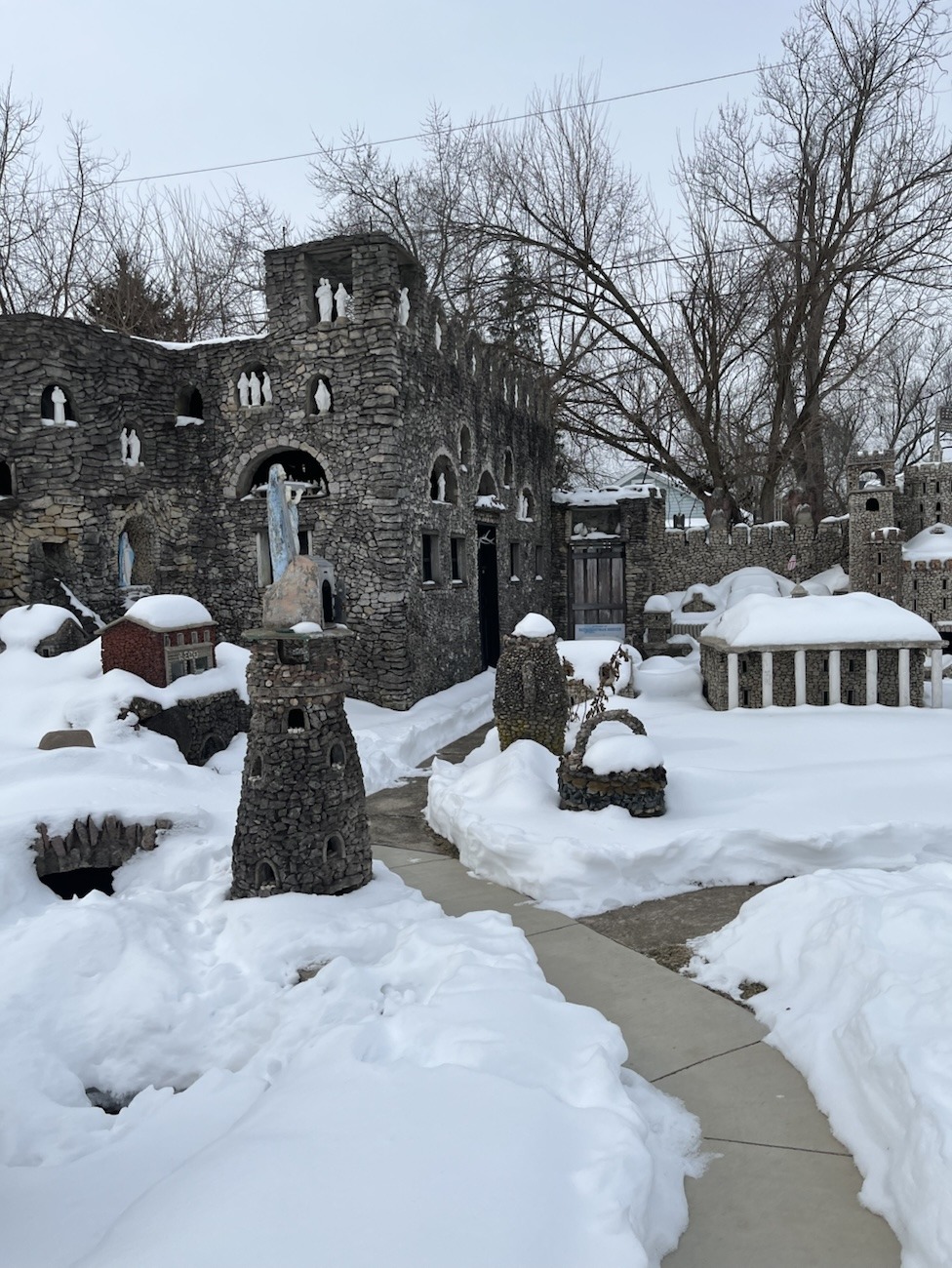
I was passing through Springfield, Ohio, on my way home from the troll exhibit in Dayton. So I decided to stop at the Hartman Rock Garden. Nearly a foot of snow buried much of the site. I did not want to pass up the experience of seeing this piece of living art.
I knew I would need to return in warmer months to see the full detail. There was still no way I was going to miss the chance to stand in front of a place built during the Great Depression. Even under snow, the garden still held presence, quiet, patient, waiting for discovery.

The Visit
The exhibit is in the yard of a cute home in a calm neighborhood. There was a dog loose on the street so I left Luna in the car.
Snow covered some of the sculptures, turning towers, miniature buildings, and stone pathways into partially hidden shapes. Some figures were not visible; others rose clearly above the drifts, hinting at how intricate the site must be once everything is uncovered.
When the snow falls, these stone sculptures don’t disappear…
they go into a deep, patient hibernation, waiting for the spring thaw to tell their story once more.
It felt less like visiting a tourist attraction and more like stepping into someone’s preserved imagination. Even in winter, the sense of scale was obvious. You could see how much labor had gone into the stonework, how many small details were layered into the larger structures. The snow did not erase the experience. It simply turned it into a preview, a promise to come back and see the full story when the ground clears.

History of the Hartman Rock Garden
The Hartman Rock Garden was created by self-taught artist Harry George “Ben” Hartman, a Springfield foundry worker who began building the garden in 1932 after being laid off during the Great Depression.
Using concrete, glass, metal, and hundreds of thousands of stones gathered locally, Hartman transformed his backyard into an elaborate folk-art environment filled with miniature buildings, patriotic scenes, religious imagery, and imaginative structures.
History isn’t always found in dusty textbooks; sometimes, it’s hidden in a quiet backyard, built stone by stone from the ashes of a depression-era dream.
Between 1932 and 1939 he constructed more than fifty detailed structures, including castles, historic landmarks, and symbolic sculptures representing education, religion, and American history.
After Hartman’s death in 1944, his family preserved the site for decades, and restoration efforts in 2008–2009 helped ensure the garden’s long-term survival as a recognized folk-art landmark maintained by a nonprofit organization.
Today the garden remains open to the public year-round, free to visit, standing as one of Ohio’s most unusual and personal art environments.

My Experience
Seeing the Hartman Rock Garden under snow felt like walking through a paused moment in time. The structures that rose above the snow allured at the complexity waiting beneath, reminding me that some places deserve more than a single visit.
Two of my favorites were the tea or coffee cup and the large schoolhouse structure.
It is a profound reminder that we are the architects of our own resilience, turning the broken pieces of a hard season into a permanent, public monument of hope.
Even partially buried in winter, the Hartman Rock Garden proves how powerful individual creativity can be. Built by one man during one of the hardest economic periods in American history, it continues to stand decades later, inviting travelers to pause, look closely, and remember that imagination leaves physical footprints.
Have you been to a rock garden like this? Or have you been to Hartman rock garden? Tell me in the comments your favorite folk art exhibit.
Thomas Dambo Trolls- Trip One
Be seen, celebrated, and connected! All Free! Submit to Poeaxtry Spotlights today. By form or email Poeaxtry@gmail.com


Leave a Reply