
Tag: trans visibility

  • Trans‑Masculine Pioneers Through History: Power, Purpose, and Legacy

    Trans‑Masculine Pioneers Through History: Power, Purpose, and Legacy


    Trans‑Masculine Pioneers Through History: Power, Purpose, and Legacy

    Trans and trans‑masculine people have long shaped the world in ways that go beyond survival. These figures have made significant contributions in medicine and public health. They have also excelled in military service, sports, arts, and community building. Their lives and achievements are worth celebrating. Their stories remind us that trans masculinity is not a modern invention, but woven deeply into global history.

    James Barry — Surgeon & Medical Innovator (British Empire)

    Dr. James Barry (c. 1795–1865) was a remarkable military surgeon in the British Army, born in Ireland. Barry performed one of the first known Caesarean sections. In this operation, both mother and child survived. It was a huge medical feat for the time. He was deeply committed to improving hygiene and sanitation in military hospitals. Barry pushed for better medical care for soldiers and local populations. Barry lived publicly as a man, signed as “Dr. James Barry,” and challenged early-19th-century gender norms while saving lives.

    Why he matters: Barry’s identity didn’t limit his contributions. Instead, he used his position to heal, reform, and innovate in colonial-era medicine.

    Alan L. Hart — Radiologist, Tuberculosis Pioneer & Writer (United States)

    Alan L. Hart (1890–1962) was a pioneering radiologist who helped revolutionize early detection of tuberculosis. He introduced the use of X-ray imaging for TB, greatly improving public health efforts. Beyond medicine, Hart was also a writer, weaving themes of identity, science, and healing into his fiction. He lived as a man for decades, and his lifelong work saved lives and pushed medical boundaries.

    Why he matters: Hart’s transmasculine identity is inseparable from his legacy. He was both a healer and a storyteller. His commitment to public health left a measurable impact.

    Karl M. Baer — Writer, Reformer & Gender Pioneer (Germany / Israel)

    Karl M. Baer (1885–1956) authored Memoirs of a Man’s Maiden Years, reflecting on his childhood, identity, and transition. In the early 1900s, Karl underwent what is widely recognized as one of the first gender-affirming surgeries. He gained legal recognition as male. Baer also worked with Magnus Hirschfeld, influencing early sexology and social reform. His life bridged personal narrative with political and social change—he was a social worker, suffragist, and advocate for marginalized people.

    Why he matters: Baer’s work helped lay the foundations for gender-affirming care and gender rights. His story is both deeply personal and socially transformative.

    Michael Dillon — Physician, Ethicist & Medical Trailblazer (United Kingdom)

    Michael Dillon (1915–1962) was a British physician. He became one of the first trans men to medically transition using testosterone. He wrote Self: A Study in Endocrinology and Ethics, exploring gender identity, medical decision-making, and ethics. Dillon’s work helped shape early frameworks for trans healthcare and medical ethics.

    Why he matters: He merged professional rigor with personal courage. His life and writings helped build compassionate, evidence-based approaches to gender-affirming care.

    Amelio Robles Ávila — Soldier & Revolutionary (Mexico)

    Amelio Robles Ávila (1889–1984) was a Colonel in the Mexican Revolution. He lived openly as a man from his mid-20s, and his military leadership was recognized by the Mexican government. Robles earned a Revolutionary Merit Award and is celebrated in Mexico for bravery and service while living authentically.

    Why he matters: Robles demonstrated the intersection of trans identity and revolutionary activism. He fought for justice and recognition. He left a lasting legacy in Mexican history.

    Lou Sullivan — Activist, Community Builder & Writer (United States)

    Lou Sullivan (1951–1991) was openly gay and trans at a time when that was revolutionary. He created resources for FTM people. He built peer support networks. Lou clarified that gender identity and sexual orientation are distinct but overlapping. His diaries and posthumously published writings reflect hope, insight, and advocacy.

    Why he matters: Sullivan built community structures. He fought for medical recognition. He articulated trans masculinity in ways that continue to guide activism today.

    Reed Erickson — Philanthropist & Trans Movement Fundraiser (United States)

    Reed Erickson (1917–1992) founded the Erickson Educational Foundation (EEF), which funded early transgender medical research, community outreach, and publications. His work expanded medical care and education opportunities for trans people in the 1960s–80s.

    Why he matters: Erickson’s philanthropy helped create infrastructure for trans communities and ensured early access to gender-affirming care.

    Albert D. J. Cashier — Soldier & Union Veteran (United States)

    Albert Cashier (1843–1915), born Jennie Irene Hodgers, served in the 95th Illinois Infantry during the U.S. Civil War. Cashier fought bravely, lived as a man for decades, and was respected by his community. He exemplified heroism, integrity, and authenticity.

    Why he matters: Cashier’s dedication to country and self demonstrates courage in both service and identity.

    Zdeněk Koubek — Athlete & Gender Trailblazer (Czechoslovakia)

    Zdeněk Koubek (1913–1986), born Zdena Koubková, was a world-class runner in the 1930s, setting records and winning medals. In 1935, he publicly announced he would live as a man and continued to pursue life openly in Prague. His story expanded conversations around gender in sports.

    Why he matters: Koubek’s athletic excellence and public transition challenged norms and left a legacy of courage and change.

    Why These Histories Matter

    Trans identity is not new: These men and transmasculine figures span centuries and continents. Their impact was positive and varied: Medicine, activism, war, arts, sports—their lives left tangible contributions. Visibility strengthens communities: Recognizing these stories empowers transmasculine people today. Global and intersectional representation: Figures from Mexico, Czechoslovakia, the U.S., and Australia illustrate the diversity of trans histories.
  • TDoR- A LGBTQ+ History Lesson

    TDoR- A LGBTQ+ History Lesson

    The First Transgender Day of Remembrance

    On November 20, 1999, the first Transgender Day of Remembrance (TDoR) took place. This was organized by activist Gwendolyn Ann Smith to honor the life of Rita Hester. A trans woman of color murdered the year before.

    Gwendolyn’s web project, Remembering Our Dead, launched to aggregate names of trans people lost to violence. Thus making our stories visible. Candlelit vigils in Boston and San Francisco marked a solemn promise: trans lives will not be erased.

    Since then, TDoR has grown into a global observance, with hundreds of cities participating annually.

    Rita Hester: Her Life, Her Death, Her Legacy

    Rita Hester was born November 30, 1963. She lived in Boston, where she was a vibrant presence in the queer and trans community.

    On November 28, 1998, she was stabbed to death in her apartment, reportedly twenty times. The media misgendered and dead named her. Only demonstrating the disrespect and erasure trans people face even in death.

    Her death sparked outrage and action. Leading to the first TDoR and the enduring memorial project that ensures trans lives are remembered. A mural in Boston now honors her, cementing her presence for generations to come.

    Notable Trans People Remembered: Impact & Legacy

    Sir Ewan Forbes (1912-1991)

    A Scottish doctor and trans man, Ewan Forbes, faced a legal challenge from his cousin. All over the inheritance of a baronetcy. Forbes, being AFAB, was forced to claim an intersex condition in a secret court hearing to win the case. Ewan lived publicly as himself, married the woman he loved, and carried his title. Though, the secrecy delayed broader legal recognition for trans people in the UK. His story is a reminder that trans men have always existed, just usually quietly. While erasure is even evident in victory.

    Albert Cashier (1843-1915)

    Albert Cashier, an Irish-born trans man, served in the Union Army during the American Civil War. He lived his adult life as a man until a car accident in 1910 revealed his assigned sex at birth. Later, in a state institution, attendants forced him into a dress against his will. Comrades remembered him as loyal and steadfast, and he was buried in his full military uniform in 1915. Albert’s story illustrates resilience, service, and the courage of living authentically despite societal erasure.

    Dr. Alan Hart (1890–1962)

    Alan Hart, a trans man and American physician and radiologist. He was also one of the first trans men in the United States to undergo hysterectomy and gonadectomy in 1917. Though, his career and life were lived under the constant threat of being outed. Which, sadly, would have ended his medical work. Hart’s persistence highlights both the courage and the invisibility imposed on trans men in history.

    Billy Tipton (1914–1989)

    A celebrated jazz musician, Billy Tipton lived and worked as a man to pursue a career in music. Jazz venues wouldn’t book women musicians, so Billy became. He lived the life he wanted, just as many queer people of the time did. And Billy thrived, he led bands and toured relentlessly. Eventually he built a reputation as a talented, reliable musician. Billy booked steady gigs in Oklahoma and Washington, raised three boys, and maintained a family life. Billy’s life was loving and ordinary in all ways that mattered. Though, after his death in 1989, paramedics discovered he had been assigned female at birth. Turning what should have been private, into a media frenzy. Billy was ripped open by tablets hungry for spectacle. Instead of honoring a respected musician, the media turned him into a headline. Misgendering him, mocking him, and sensationalizing his life without the faintest understanding of the violence that exposure like this causes. This was one of the first major examples of the modern press publicly outing a trans man without consent. Eventually, it shaped the way media ethics would be debated. Yet, none of that noise changes the truth. Billy lived his life as himself, loved his kids, made his music, and never owed the world a fucking thing. Billy Tipton’s story is a stark example of how transgender men have been misrepresented, even after death.

    Gwendolyn Ann Smith

    The founder of TDoR and author. Her activism preserves memory and builds community. Gwendolyn dreams to exist in a world where we no longer need the memorial she created. Her work ensures that trans lives lost to violence are not forgotten, creating a foundation for grief, resistance, and advocacy.

    Monique Thomas & Chanelle Pickett

    Both women are trans women of color whose deaths preceded Rita Hester’s. Monique Thomas (1998) and Chanelle Pickett (1995) are integral to TDoR’s early history. Their lives and deaths emphasize that violence against trans women, especially Black trans women, is part of a systemic pattern.

    Marsha P. Johnson (1945–1992)

    A self-proclaimed transvestite, She/her, drage queen activist, and community elder, Marsha P. Johnson co-founded STAR (Street Transvestite Action Revolutionaries) with Sylvia Rivera. She fought for queer and trans youth, living openly and boldly. Remembering her highlights the activism, joy, and resistance within trans communities, and not only loss.

    Recent Transgender people lost to soon

    Mar’Quis “MJ” Jackson

    A 33-year-old Black trans man and Philadelphia activist. MJ worked with the William Way Center, Transgender Legal Defense Fund, and The Free KY Project. He was found deceased on December 14, 2022, from multiple blunt force injuries. His life was full of love and activism. Being described as someone who “would get the party started anywhere” and “loved everybody.” In January 2025, Charles Mitchell was convicted for involuntary manslaughter and other charges related to MJ’s death. His story paints a picture of violence against trans people. While we also seldom get actual justice.

    Nex Benedict (2008-2024)

    A 16-year-old nonbinary student from Owasso, Oklahoma, Nex endured severe bullying and a physical assault at school. Despite the school nurse recommending a medical examination, Nex finished the day at school. To arrive home bloodied after being left to endure the rest of the day without proper care. They later died from an overdose, a death considered a result of systemic failures in schools and anti-trans environments. Nex’s story reflects both the vulnerability of trans youth and the urgent need for systemic protections.

    Sam Nordquist

    Sam was a 24-year-old trans man of color from Minnesota. He endured weeks of physical and sexual abuse, starvation, and psychological torture before his death in early 2025. Seven scumbag monsters were charged with second-degree murder. Two of which had recently been released after sexual charges. These excuses for humans also had two minor children actively engaged in abusing Sam. This angel of a human was also a healthcare worker. He loved his community, he wanted simply to be loved. I will always have a dedicated memorial page dedicated to him on my website. His memorial page tells the story of what he loved, shares art, and honors him. His life, work, and heart should not be reduced to his death. Sam reflects the vibrancy, generosity, and bravery of trans men today.

    Why This Matters: Memory, Violence, Resistance

    TDoR is resistance, not just memorial. Reading names refuses invisibility. Lighting candles is defiance. Violence against trans people is not new, and systemic and cultural erasure persists.

    Legal protections in the U.S. stay a patchwork at best. As of 2024, only about 21–23 states plus D.C. explicitly protect gender identity across employment, housing, and public accommodations. In the remaining states, trans people can face legal discrimination. This includes things like “gay/trans panic” defense. This legal defense still exists in roughly 30 states, excusing violence based on bias.

    Now we approach weaponized visibility. Trans women are often hyper-visible, opening them up to new dangers. While trans men are erased, their existence ignored in public discourse, sports, and legislation. Both experiences mirror systemic abuse that fuels discrimination and violence.

    Honoring the Living While Remembering the Dead

    TDoR is both grief and affirmation. It memorializes those lost like Rita Hester, Monique Thomas, Marsha P. Johnson, Brandon Teena, Sam Nordquist, Nex Benedict, MJ Jackson and so many more. While still reminding us to support living trans people. History stretches from the Union Army to contemporary schools and workplaces, showing how erasure and resistance are deeply intertwined.

    Every name read on TDoR is a spark, every candle lit a defiance. We remember, we resist, and we build toward a world where no trans life is taken by hate.

    Trans history reaches further than most realize. Before the Nazis destroyed Berlin’s Institut für Sexualwissenschaft, trans people in Germany had access to pioneering medical care and advocacy resources. They of course were violently erased in the 1930s. Remembering these early efforts reminds us that trans existence and resilience predate contemporary struggles.

    This post highlights trans men more heavily than I typically would on a TDoR post. However I a trans man, only recently learned the historical trans men’s names let alone their histories. Figures like Billy Tipton, Albert Cashier, Sir Ewan Forbes, and Dr. Alan Hart lived powerful, often invisible lives, and their stories deserve visibility alongside the trans women who are too often hyper-visible and unsafe. For many trans men, history has quietly erased them and that invisibility is part of why this remembrance matters today.

    Poem about Sam

    Poem about trans people gone to soon

    Links portfolio ko-fi

  • Part Two- National Coming Out Day Reflection

    Part Two- National Coming Out Day Reflection

    The Second Coming Out

    National Coming Out Day isn’t just about one announcement. It’s about every version of ourselves we’ve had to reintroduce to the world and to ourselves.

    This is Part 2 of my coming out story. The first time, I came out as a lesbian. This time, I came out as me.

    The Second Time Someone Saw It Before I Did

    I was 19 when I met an out trans man for the first time. It was at a wedding, and he came up to me like he already knew something I didn’t.

    He said, “Oh my god, it’s so cool to meet someone like us in public.”

    I glitched. I remember thinking, What does he mean, “like us”? I didn’t think he was right, but I also couldn’t stop thinking about it. I wasn’t aware he was trans I just saw a cis man and I was so confused.

    It was one of those moments that doesn’t make sense until years later.

    The Quiet Realization

    Fast forward to when I was 21. I was in an online community space surrounded. This man was filming a Q&A video, answering random questions, when it just… hit.

    I started asking the influencer questions about t and transitioning etc.

    And I thought, Wait a minute. Maybe that guy was trans at the wedding.

    I laughed it off at first. Said thing to myself like, “No, bro.” But, Deep down, I knew something had shifted.

    That’s when I realized: I wasn’t a lesbian who looked masculine. I was a trans man who had finally found the words for what had always been there.

    Transition and Transformation

    At the time, I was in a long-term relationship with a lesbian partner. I didn’t say anything right away. I didn’t feel like I had the space to explain myself.

    My identity wasn’t up for debate, and it didn’t need validation to be real.

    A little while later, I moved to Las Vegas, started testosterone, and began living fully as myself. Two years after that, I got top surgery.

    Now, I’ve been on T for almost 11 years, and post-op for nearly 9.

    No spectacle. No huge reveal.

    I just made a post, changed my name everywhere, and kept living.

    Coming out as a trans man wasn’t some cinematic event. It was quiet, steady, necessary.

    It was me updating my social media, me existing without apology, me living a truth that had been simmering under the surface since long before I even had the language for it.

    Every year on National Coming Out Day, I think back to both moments. To the young girl who came out as a lesbian, and the man who came out as himself.

    Both were acts of courage. Both were survival. Both were me.

    Coming out isn’t a one-time performance. It’s a lifetime of peeling back layers until you recognize yourself: fully, completely, without shame.

    I came out twice.

    Once for who I loved.

    Once for who I am.

    And both times, I chose to live.

    Because that’s what coming out really is. It is choosing life, truth, and freedom, again and again.

    A man and his first chest binder
    A man and his first chest binder

    Poeaxtry links portfolio Poetizer

  • Part 1 — National Coming Out Day Reflection

    Part 1 — National Coming Out Day Reflection

    The Beginning of Owning My Truth

    In eighth grade, I told my best friend at the time that I had to tell her something. Before I could even say it, she looked at me and said, “What, you like girls?”

    No duh, me too.

    That moment was my quiet entry into honesty. It was not a big speech, not a dramatic scene, just truth spoken aloud. I told a few other friends. Most didn’t care, one freaked out a little. You know, the classic “ew, we slept in the same bed!?” comment. In my usual fashion, I just told her, “Yeah, no shit. Doesn’t mean it was anything weird. Just because I’m gay doesn’t mean I’m into all girls.”

    It wasn’t some grand parade or rainbow banner moment. I just stopped hiding it from all my homies.

    High School and Small Town Silence

    I grew up in small-ass Martins Ferry, Ohio. A tiny town, tight gossip circles, everyone knowing everyone’s business. I graduated in 2010, and there were maybe three out lesbians in my class. The rest were “straight in public” or “hush-hush about it.”

    I wasn’t loud about my sexuality in high school. But the moment I was no longer a student, I made my Facebook and MySpace say “interested in women.” No more hiding, no more pretending. Just existing.

    Family Reactions and Reality Checks

    My mom’s best friend was a lesbian who came out in the early 1980s, so she didn’t have much to say beyond not wanting it “broadcasted” to my little sisters. They were nine at the time. But my younger cousins told them. It wasn’t like they knew better.

    One sister said she didn’t care. The other said “ew,” but she got over it fast enough. Kids echo what they hear. And they learn what we show them.

    But there was one adult man, a friend of my mom’s. He was much older than me, always joking that he’d “take me on a date when I turned 18.” Everyone would laugh like it was harmless. I knew it wasn’t.

    Sure enough, once I turned 18, he messaged me on Facebook asking me out. I told him, “Dude, I’m with my girlfriend. I’m gay.”

    He flipped out, said I “lied” instead of just saying no. But I wasn’t lying. I was telling the truth, my truth. But he just couldn’t handle it.

    Looking Back on Coming Out

    Back then, coming out wasn’t about attention or pride flags. It was about not lying anymore. It was survival in small-town Ohio. And being honest even if nobody clapped for it.

    When I think about National Coming Out Day, I think about that moment in eighth grade. The one where I said, “Yeah, I like girls.” I think about every time after that when I had to say it again. Whether that was to friends, to family, to strangers who thought they had a say in it.

    This is Part 1 of my story… the first step in a much longer journey.

    Part 2 will come later today. It’s about when I came out again, not as a lesbian.

    Because coming out isn’t one moment. It’s a lifetime of moments: each one a little braver, a little louder, a little more you.

    Today, on National Coming Out Day, I remember that younger version of me. Who was scared, quiet, and honest anyway. The one who chose quiet truth in small towns where everyone knew your name.

    I came out as a lesbian first. I came out as myself second. Both are chapters worth telling. Both matter.

    Because every story of coming out whether it’s whispered, shouted, or written down… reminds someone else they’re not alone.

    Stay tuned for Part 2: Coming Out as me.

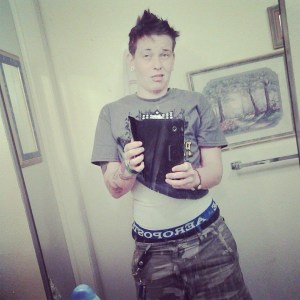
    When Axton first came out socially as transgender female to male. The start of a era
  • The Best of Axton N. O. Mitchell: Powerful Poetry Collection Unveiled

    The Best of Axton N. O. Mitchell: Powerful Poetry Collection Unveiled

    Introducing “The Best of Axton N. O. Mitchell”
    – A Curated Poetry Collection

    I’m excited to share my latest creative project with you all. It is a carefully curated collection of my most powerful poems. It is now available online for your viewing. This collection shows some of my most personal work. It is thought-provoking and explores themes of identity, loss, and relationships. The human experience is also explored.

    “The Best of Axton N. O. Mitchell” features five poems that hold special significance in my creative journey:

    1. “Wheeling Roads: Mother’s Home”: A deeply personal exploration of grief and friendship. It also delves into the lingering questions we face when someone important leaves our lives.
    2. “TDOV”: A powerful piece written for Trans Day of Visibility. It examines the intersection of identity, community, and the struggle for recognition in a world that often seeks to erase.
    3. “Transitional”: This poem challenges societal constructs around gender, examining the journey from childhood expectations to authentic self-expression.
    4. “They/Them”: A celebration of love, connection, and the beauty of relationships that transcend traditional boundaries.
    5. “Hands-Off”: A bold statement on autonomy, identity, and the right to exist authentically without interference.

    This collection is presented with a distinctive aesthetic. Powerful words are set against moody, grayscale landscapes. These elements enhance the emotional impact of each piece. The visual presentation complements the raw honesty of the poetry, creating an immersive experience for readers.

    Each poem signifies a different facet of my voice as a writer, from intimate confessions to bold declarations. Together, they create a tapestry of experiences. I hope these experiences will resonate with readers who have walked similar paths. They also resonate with those who seek to understand different perspectives of their own.

    I invite you to explore “The Best of Axton N. O. Mitchell” presented by Poeaxtry. The collection is designed to be experienced at your own pace, allowing each piece to be absorbed and reflected upon.

    Are a longtime follower of my work? Or you are discovering it for the first time? I hope these poems speak to you in meaningful ways. Poetry has always been my way of making sense of the world. Sharing these pieces feels like extending a hand of connection.

    This collection shows just a part of my work, and I look ahead to sharing more in the future. If you connect with these poems, I’d love to hear your thoughts in the comments below.

    How does poetry help you process your experiences? Which poem in this collection resonates with you most?

    The best of Axton N.O. Mitchell

    links

  • My First Surgery: Top Surgery and My Mother’s Care

    My First Surgery: Top Surgery and My Mother’s Care


    Have you ever had surgery? What for?

    The first surgery I ever had was my double mastectomy aka top surgery, with Dr. Brandon Reynolds in Las Vegas, NV.

    I remember how everything slowed down when I was being pushed into the procedure room. It wasn’t just medical. It wasn’t cosmetic. It was survival. I wasn’t trying to become someone new. I was cutting away what never belonged to begin with. I was unburdening myself of a silence stitched into my chest.

    My mom flew in to take care of me. That part still guts me sometimes. She didn’t hesitate. She came with snacks and soft words, helped me drain tubes, held space when I couldn’t hold anything else. She never made it weird. Never made it feel like I had to explain. She just showed up with love and candy and hugs and steady hands. That kind of care doesn’t leave your bones. I didn’t know it then, but I’d hold that memory close on darker days, especially after losing her.

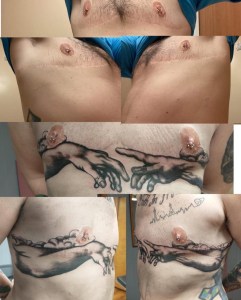
    That surgery gave me the kind of breath I didn’t know I’d been holding for most of my life. It was the beginning of my real reflection looking back at me. It was painful, messy, healing, and holy. It was mine. The next photos will be me fully healed in 2022 pre- and post-chest tattoo. After that, there will be a 4-day post-op photo. It shows a little swelling, bruising, and bodily fluids. It might not be suitable if you are squeamish.


    Photo collage of post-top surgery transgender man's chest and scars on top below tattoos cover his scars.
    four days post top surgery transgender man. Hematoma present in left of photo (man's right) chest tissue, drain tubes.

    links poem Coffee

  • I Am the Echo: A Transgender Memorial Poem by Axton N. O. Mitchell

    I Am the Echo: A Transgender Memorial Poem by Axton N. O. Mitchell

    “I am the Echo”
    An Original Poem by Axton N.O. Mitchell

    I am not the scream,

    not even the shout.

    I am the echo no one warned you about.

    You hear the bang, then the boom.

    You think it’s over much too soon.

    I am the echo

    of dead transgender men,

    laid to rest beneath markers

    that never quite said who they were.

    Erased at every turn,

    even in death.

    I am the echo that won’t let you forget

    names like:

    Sam Nordquist,

    Brandon Teena,

    Codii Lawrence,

    Arlo Huber,

    Nex Benedict,

    and so many others

    we’ve buried far too early.

    I am not their scream,

    I am not their shout, 

    those belong to them alone.

    But their echo lives on in my existence.

    In every breath I take,

    I speak their piece.

    Black background wrinkled with trans color font & trans symbol

    Links portfolio Hike
    Buy me a Coffee?


  • Published: The Men Who Are Trans + My First Feature in Forever With Pride

    Published: The Men Who Are Trans + My First Feature in Forever With Pride


    This journal entry marks the beginning of something I’m genuinely proud of.

    My poem The Men Who Are Trans has been published in the newest issue of Forever With Pride. It appears alongside a feature article. The article dives into my creative work, my love of poetry, zines, and even a little nod to rock hounding. This piece is more than just a publication. It marks the first month of a yearlong partnership with the magazine. I couldn’t imagine a better way to begin.

    This poem, in particular, is tender and rooted. It’s a quiet thank-you to the men like me. These are trans men who remember what it’s like to be hurt by someone who was supposed to love them. They use that memory as a guide for how to love others with care and intention.

    The simps who brood over you while staring at the moon.
    They forget to text you
    back while writing verses
    about their favorite muse,
    You.

    The feature article introduces readers to my broader body of work. It includes my handmade items, prompt journals, and e-books over on Etsy. It also shares my deep love for nature and ritual. Additionally, it highlights the thread of advocacy that runs through everything I create. It’s rare to find a publication that understands you completely. They see you not just as a writer, but as a whole, layered person. Forever With Pride does just that.

    You can read the full poem and feature here:

    👉 https://foreverwithpride.com/forever-with-pride-e-magazine/

    I’ll be contributing to Forever With Pride every month for the next year. I’m excited and honestly a little emotional. I’m thinking about where this journey might go. Thank you for being here. Whether you’ve been reading my work for a while or you just found me through something here, it means a great deal to me. Your support matters greatly.


    links Another Publishing Submit to Quarterly