Category: poetry

Solo launches, pre-launch drops, full poems, and announcements for traditional, solo, or indie publishing. Explore new works, behind-the-scenes updates, freebies, and more in the evolving world of Poeaxtry poetry.

  • No November Will Ever Be the Same, A Birthday Touched by Grief and Memory

    No November Will Ever Be the Same, A Birthday Touched by Grief and Memory

    November has its own temperature in my life now. A private weather pattern that settles into the days leading up to my birthday. Sometimes even the days after my birthday too. When grief meets a date that is supposed to feel bright, something shifts, something lingers, and something refuses to fade. This poem moves through that space, the place where candles and memories coexist. The place where a mother’s absence still shapes the month and every breath inside it. I wrote this to honor that truth…

    to let November speak the way it insists on speaking.

    “No November Will Ever Be the Same”

    November holds its own weather,
    a sky that remembers
    even when I try to forget.

    My birthday rises,
    a candle in a tiny room that
    never carries your scent
    four years later…
    I have grown to miss it.

    Four years without you,
    the month keeps its imprint,
    a bruise under the skin of another year,
    tender when I press it,
    tender when I don’t.
    I press it just to feel
    alive sometimes…

    November keeps the ledger open,
    ink still wet, pages turning
    with your scent hidden somewhere
    between the cold mornings
    and the early nights.

    People say time softens,
    but November disagrees.
    I walk through this month
    as if I am carrying two fires,
    one that celebrates my breathing
    one that flickers for the woman
    who taught me how to breathe at all.

    What does November mean now?
    A point between what was given,
    what was taken?
    A place where joy and loss sit
    at the same table…
    neither greeting the other?

    No November will ever be the same.

    I keep moving through it anyway,
    candle in one hand,
    memory in the other,
    hoping the light I carry
    is enough to keep them both lit.

    Poet’s Note

    This one carries the weight of four years. The very echo of that week and a day before my birthday that will forever lead me back to her. Writing it felt like holding two flames at once. The one that marks my birth and the one that marks her leaving. The poem flows with the tension, the ache, and the pull. They meet at the quiet acceptance that no November will ever return to what it used to be. If you are someone who walks through a month that changed you, I hope this piece sits with you in a way that feels steady.

    We all know grief never asks for permission to reshape a month, a date, or a ritual. It moves in and alters the light around everything that follows. Sharing this poem is part of learning how to keep moving. With my candle in one hand, and her memory in the other. I will continue trusting that honoring both is enough. November will never be the same, but it still holds space for growth, reflection and the kind of love that keeps shaping us long after loss has taken its form.

    Links

  • Colors in the Sky: A Poem of Memory, Loss & My Mother’s Sunset Light

    Colors in the Sky: A Poem of Memory, Loss & My Mother’s Sunset Light

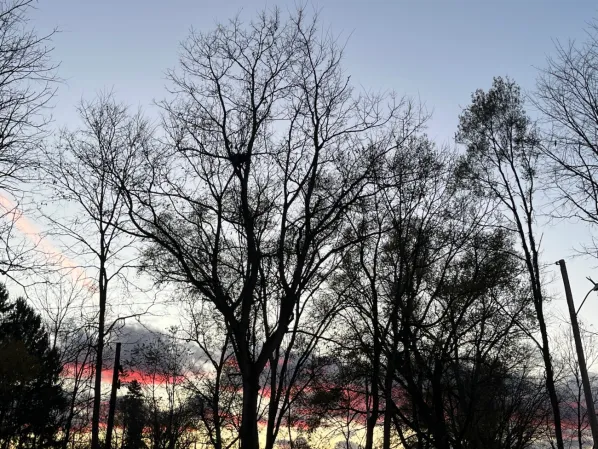
    I was inspired by the sky Monday evening… blue, pink, and purple. In that moment I realised how my mother learned to paint. Four years after she died, every sunrise and every slow‑burn sunset feels like her newly found brush‑stroke across the horizon. This poem invites you into the space where loss becomes colour and presence becomes visible light.

    The view that inspired this poem.

    “Four Years Later, She Paints”

    The sky’s been a little more beautiful since she left.

    Four years now,

    and she still finds her way back,

    not just in dreams,

    but also in color.

    Pink, blue, purple,

    the hue of the view she painted

    this evening

    the kind that makes you stop mid‑sentence,

    just to take another look.

    Never painted a day in her life,

    she paints now.

    Every sunrise, every slow‑burn sunset,

    she’s learned a language that allows her to share even when she’s no longer there

    Somehow I know she mixes those shades

    just to show she misses us too.

    And sometimes,

    I think it’s her way of saying

    I love you,

    now that her words

    don’t

    reach

    our

    ears.

    Poets Notes

    This poem came from noticing the sky and realising it carried messages from the one meant the most… My mother wasn’t the painter she is now, in her absence she became an artist in the sky. Seeing those colours reminded me she’s still at work… even when I can’t hear her voice. Writing this piece helped me feel her presence not as a memory trapped in time, but as light moving, transforming, still reaching out.

    Even when words fail us, love remains visible. This piece is a reminder to look up, to notice colour, and to feel the presence of those we’ve lost in the world around us. Let this poem and photo stand together as proof: what’s lost isn’t gone, it’s just changed form.

  • “Where her hands still are” a poem of loss

    “Where her hands still are” a poem of loss

    There are some loves that never leave the room, even when the person does.

    This poem is for anyone who has ever reached into an empty kitchen and still felt warmth. Who has caught themselves folding towels the same way, or found their heart beating to a rhythm that was first taught by love.

    Loss doesn’t silence that bond…

    it transforms it into echo, ritual, and the quiet kind of forever that hums through the smallest parts of life.

    “Where Her Hands Still Are”

    By: Axton N. O. Mitchell

    I still hear her in the quiet,
    her quiet giggle.
    A low hum the house learned from her,
    The lines around her mouth,
    soft percussion of spoons on porcelain,
    Her sigh as the curtains breath with the wind.

    She was the kind of gentle
    that never had to announce it existed;
    you just felt it.
    In the way light hit the kitchen table,
    Or how your shoulders settled
    when she walked into a room.

    She always swayed,
    and somehow, it made everything feel safe.

    Now every sound leans toward memory.
    The kettle whistles her name,
    the wind carries faint notes of her perfume,
    and every dawn feels a little more unsure
    how to begin without her.

    Her hands made warmth
    out of thin air and love.
    Even the dust knew her touch.
    I fold laundry the way she did,
    sleeves tucked in, corners neat
    a quiet ritual…
    to keep my world from unraveling.

    Grief doesn’t shout anymore;
    it lingers in the shadows,
    breathes through the walls,
    sits down beside me at dinner
    every single night,
    waiting for me to notice.

    I talk to her often…
    just not out loud.
    I
    I find her in the places silence but quiet best:
    the garden,
    the car,
    anywhere I know she lingers.

    Life goes on, yes,
    but oh so differently,
    like a song missing its first note.
    Yet her love hums underneath it all,
    steady, ancient,
    woven into everything I touch.

    Even gone,
    she’s everywhere.
    She is the steam of morning tea,
    the lilac scent after rain.
    I feel her in the echo of my own heartbeat,

    After all it learned its rhythm from hers.

    Her absence will always ache,

    but the ache itself is proof,

    she’s still here.

    She is woven into the pulse of every moment I’m still living.

    Love doesn’t end when the heartbeat stops;

    it just finds new ways to hum.

    Poet’s Note:

    I wrote Where Her Hands Still Are after realizing that grief isn’t always loud. Sometimes it’s patient. It waits, hums, and reminds you that love this deep doesn’t vanish. It simply reshapes itself. You don’t ever lose a mother completely; you just start learning to speak in her silence.

  • “Can You Read the Room?” A Poetic Exploration of Silence and Presence

    “Can You Read the Room?” A Poetic Exploration of Silence and Presence

    There are rooms that speak without words. Spaces where light, sound, and presence…or absence, tell stories the heart quietly knows. In “Can You Read the Room?”, this poem navigates the fragile space between life and stillness, showing how even the smallest elements, like the hum of a heater, the gaze of a pet, anchor us in a world of quiet reflection.

    Can You Read the Room?

    The lamp’s gone cold,

    its bulb a frostbitten moon.

    Light spills out wrong,

    pale and unconvincing,

    a blue hue.

    The air hums sterile,

    a clinic without purpose,

    a stillness once safe.

    Soft. Solace.

    The heater drones on,

    groaning through the night,

    spitting warm breath

    that never reaches cold hands.

    Blinds drawn tight,

    as if the outside could judge,

    or the sun might bite.

    Even the usually lit TV’s

    dark eye is closed.

    No flicker.

    No laugh. No light.

    A blanket rises…

    enough to prove life is here.

    The body beneath,

    neither dreaming

    nor sleeping.

    The dog watches quietly,

    devoted without demanding.

    The cat’s tail curls,

    a question mark still,

    but he’s stopped asking.

    A clock ticks,

    the only noise

    for nothing worth timing.

    Every second,

    a whisper saying:

    “Can you read the room?

    Can you taste the air gone flat,

    the hum of things pretending to function?”

    This is how a heart

    plays dead

    without truly dying.

    Life exists even in muted forms. The poem reminds us that presence is not always loud and that subtle signals, like the rise of a blanket, the loyal eyes of a pet, can speak louder than words. “Can You Read the Room?” challenges us to notice, to feel, and to recognize the understated pulse of being alive, even when everything else seems still.

    Poet’s Notes:

    This poem was inspired by quiet, personal observation and the way empty spaces reflect our emotional landscape. The imagery aims to balance the sterile with the intimate: a room devoid of action yet full of subtle life. I focused on sensory contrasts like cold and warmth, light and darkness, movement and stillness, to capture the tension between isolation and connection. The repetition of questions mirrors the mind’s own attempt to engage with emptiness, urging the reader to “read the room” both literally and metaphorically.

    So tell me can you read the room?

  • The World Burns, and We Scroll: Bearing Witness to Genocide, Greed, and the Price of Empires

    The World Burns, and We Scroll: Bearing Witness to Genocide, Greed, and the Price of Empires

    We live in a world that feels like it’s cracking under the weight of its own reflection.

    As of 2025, humanitarian crises and genocides continue across the globe, largely ignored or exploited by the same systems that profit from their pain. In Gaza, tens of thousands have been killed and displaced as infrastructure collapses and access to aid remains restricted. In the Democratic Republic of Congo, the cobalt and coltan mined by children still power the batteries of our phones, laptops, and electric cars. And in Sudan, an ongoing civil war has displaced millions, yet receives almost no media coverage compared to Western conflicts.

    Meanwhile, Americans scroll and spend, buried under debt, inflation, and propaganda. While, being told that freedom can be found in the checkout aisle or the next algorithmic distraction comes along.

    This poem was written as both confession and confrontation: a moment of truth-telling from within the belly of a capitalist empire that feeds on silence.

    Poem:

    “The World Burns, and We Scroll”

    I wake beneath the hum

    of screens,

    each one a sermon preaching more for sale,

    their glow a ghost of what we lost…

    to comfort,

    convenience,

    and compliance.

    The world burns,

    not metaphor,

    not news,

    she just burns.

    In Congo,

    in Sudan,

    in Palestine,

    children trade their breath for minerals.

    Their parents’ lives

    for borders drawn by hands

    that never had to bleed.

    Their cries travel

    through copper veins

    to light our phones, our news feeds,

    our many, many screens.

    The guilt, we share.

    We spend.

    We pretend.

    America,

    land of the barely living wage,

    where grief is taxed,

    and outrage costs extra.

    We chant freedom in discount aisles

    while bombs hum lullabies abroad,

    and children go to bed with dread

    fed by hunger.

    You’ve got to start to

    wonder.

    We are not free.

    We are stitched into these machines,

    screaming between algorithms.

    We need only to bear witness,

    to cradle a world that keeps unraveling,

    to tell everyone still fighting:

    we see you.

    Even if our country won’t.

    May every dollar dripped in blood

    rot back to dirt.

    May every empire collapse

    under its own reflection of depravity.

    May mercy outlive profit.

    May love…

    unfiltered, defiant, unbranded,

    outlast the hands that sell it.

    And may God hope He isn’t real

    after what He’s let these children

    feel.

    The violence unfolding in Palestine, Congo, and Sudan is not distant. It is wired directly into our daily lives. It is in our consumption, our comfort, our denial. Every tap, every scroll, every “neutral” stance allows empires to continue unchallenged. Bearing witness means refusing silence. It means calling it what it is: systemic greed, colonialism reborn, a global machine powered by both apathy and profit.

    But awareness can still become action. Sharing verified updates, supporting on-the-ground organizations like Doctors Without Borders, UNRWA, Refugees International, and Congo Relief Missions, or simply breaking the silence in our own communities. Each and every act chips away at the narrative that tells us we are helpless.

    Art alone cannot stop war, but it can refuse to let it vanish unseen.

    This poem stands as both lament and rebellion… against complicity, against erasure, and against the idea that humanity can be priced.

    Poet’s Note:

    I wrote this piece as an American who has grown exhausted by the repetition of history. We are watching the same injustices dressed in new slogans. We are taught to chase comfort while others are buried beneath it. This poem is not just grief; it’s a refusal to look away.

    If you read this and feel angry, good. That means you still have something the system hasn’t stolen, your empathy. Hold on to it. Use it. STAY WOKE!

    Because the world is burning, and still, somehow, we have the power to bear witness, to refuse to forget, and to keep telling the truth.

    Links. Portfolio. Poetizer

  • Racism and Fascism in America Protest as Poetry

    Racism and Fascism in America Protest as Poetry

    This poem confronts the realities of racism, fascism, and systemic oppression in the United States. Through vivid imagery and raw emotion, it exposes how fear, privilege, and institutional violence shape American life, while highlighting the resilience and voice of marginalized communities.

    “The State of the Dis-United”

    An original poem by: Axton N.O. Mitchell

    Rabid preacher,

    lying through perfect teeth

    straightened by the braces of minorities.

    Speaking of liberty and God,

    sitting there choking on both.

    You draped hate in Stars and Stripes,

    hung pride from every porch post,

    called it patriotism…

    it was merely your fear

    in a pretty JoJo bow.

    Your police hunt.

    Your politicians feed.

    And your children pledge allegiance

    to the god, and to the country,

    that never answered a single prayer

    from the lips of someone “different.”

    You see shelter

    where I see a cage.

    I scream bullets.

    You respond justice.

    Where white is “normal,”

    and everyone else…

    a “problem.”

    I’ve seen your suburbs

    built on

    brown

    and

    black

    bones,

    your schools still teaching how to forget

    by preaching white lies.

    You sell “unity”

    with a Confederate discount,

    while renaming oppression

    “freedom of speech.”

    Your anthem is a siren,

    and every verse

    bleeds red, white, and bruise.

    And still…

    we breathe.

    We march.

    We write.

    Turning every war-won wound

    into witness.

    No fascist flag

    can outshine

    the fire of the people

    they try to silence.

    This poem is born from my lived experience as a trans person navigating a country built on fear, exclusion, and hierarchy. I wrote it to call out the hypocrisy, the violence, and the ways systems crush those they deem “other.” But it’s also a testament to: resilience, survival, and the voices of all marginalized communities. This is me and I stand with you. Every line is a refusal to stay silent, every image a witness to injustice. I wrote it because poetry is my weapon, my witness, and my way of demanding that the world see us, hear us, and reckon with what we endure.

  • A Poetic Conversation Across Generations: My Stepdad’s Legacy

    A Poetic Conversation Across Generations: My Stepdad’s Legacy

    When Poetry Runs in the Family

    Sometimes poetry isn’t just something we stumble into, and it’s something that threads itself into our family history. My stepdad, as a teenager, had a poem published. That poem became one of his early milestones, a moment of recognition that showed him his words carried weight and resonance.

    For years, that story lived in our family as a point of pride. A reminder that poetry can reach beyond the page, that it can take a teenager’s thoughts and stamp them into the world for others to see.

    Carrying the Torch: My Poetic Response

    Recently, I found myself thinking about that poem again. But instead of just admiring it, I decided to step into the conversation myself. I wrote a response piece… no, not to his father, as his original poem had been written, but to him.

    In doing so, the poem became something multi-generational. His words reached back toward his father. Mine reached back, to him. The thread stretched, carrying a dialogue that spans decades, relationships, and grief, yet ties us together in the language of poetry.

    Here is that poem, my response to his legacy:

    “Dad One”

    From the son…

    To dad one with love
    Remember when you came into my life,
    stepped to the plate,
    and even taught me how to play ball?

    Dad, you never missed a game,
    a practice, or a play.

    You helped mold me into the man I am.
    I may not share your genes,
    but I carry all of you.

    I would give many things
    to have another conversation with you,
    to say what we have left unsaid.

    This is coming from the heart.
    Though we can never start again,
    every day I wake knowing
    you are proud of me.

    Why This Matters

    Poetry has a way of crossing boundaries. Whether it is between time, between people, or even between generations. My stepdad’s published poem and my response to it stand as proof that art doesn’t live in isolation. It echoes, it answers, and it evolves.

    This wasn’t just about writing a poem. It was about creating a bridge. His words to his father, and my words to him. That’s what makes poetry eternal. It has a way of inviting others into the conversation, long after the ink has dried.

    Family stories take many forms. Ours happened to take the shape of poetry, a legacy written in lines and verses. My stepdad’s published work planted a seed, and my response poem carries that seed into new ground.

    Maybe that’s the real beauty of poetry. It never really ends. It just keeps finding new voices to speak through.

    Links

    Portfolio

    Ko-fi

    Goodreads

  • Trannys &the ‘Tism: A Satirical Look at Society, Identity, and Misconceptions

    Trannys &the ‘Tism: A Satirical Look at Society, Identity, and Misconceptions

    In “Trannys &the ‘Tism,” the lines between satire, social critique, and personal identity blur. This poem challenges misinformation, conspiracy theories, and prejudice surrounding trans people and autism, delivering a raw, unapologetic perspective. With biting humor and lyrical cadence, it confronts societal biases while affirming that marginalized identities persist despite ignorance and fear.

    “Tranny’s &the ‘Tism”

    An original poem by: Axton N.O. Mitchell

    Tylenol made me a tranny.
    But, it…
    Didn’t make me a tyrant.

    If I had my way
    migrants wouldn’t need let in.

    Since borders are reliant
    On the color of your skin.

    Didn’t you hear?
    Chem trails turned the frogs gay!

    They want to destroy national parks.
    They don’t care
    about pollution or
    Corruption.

    Release the Epstein Files!

    Five mass shootings have been by people who are trans!

    How many from those like you?
    There are bad seeds everywhere!

    Does your wife know you
    Touch children
    down there?
    Down stairs?

    Autism isn’t from a pill
    or
    vaccine


    It is not a disease
    It is not
    something
    that can be
    eradicated

    Trannys and the ‘tism:
    Are here to stay!
    As long as people
    Like me have got
    A Say!

    “Trannys &the ‘Tism” leaves readers with a defiant affirmation: identities cannot be erased by misinformation, prejudice, or societal fear. Through sharp satire and fearless honesty, it demands recognition of trans and neurodiverse voices and reminds us that visibility, truth, and agency endure, no matter the resistance.

    Links

    Portfolio

    Ko-fi

  • The Best of Axton N. O. Mitchell: Powerful Poetry Collection Unveiled

    The Best of Axton N. O. Mitchell: Powerful Poetry Collection Unveiled

    Introducing “The Best of Axton N. O. Mitchell”
    – A Curated Poetry Collection

    I’m excited to share my latest creative project with you all. It is a carefully curated collection of my most powerful poems. It is now available online for your viewing. This collection shows some of my most personal work. It is thought-provoking and explores themes of identity, loss, and relationships. The human experience is also explored.

    “The Best of Axton N. O. Mitchell” features five poems that hold special significance in my creative journey:

    1. “Wheeling Roads: Mother’s Home”: A deeply personal exploration of grief and friendship. It also delves into the lingering questions we face when someone important leaves our lives.
    2. “TDOV”: A powerful piece written for Trans Day of Visibility. It examines the intersection of identity, community, and the struggle for recognition in a world that often seeks to erase.
    3. “Transitional”: This poem challenges societal constructs around gender, examining the journey from childhood expectations to authentic self-expression.
    4. “They/Them”: A celebration of love, connection, and the beauty of relationships that transcend traditional boundaries.
    5. “Hands-Off”: A bold statement on autonomy, identity, and the right to exist authentically without interference.

    This collection is presented with a distinctive aesthetic. Powerful words are set against moody, grayscale landscapes. These elements enhance the emotional impact of each piece. The visual presentation complements the raw honesty of the poetry, creating an immersive experience for readers.

    Each poem signifies a different facet of my voice as a writer, from intimate confessions to bold declarations. Together, they create a tapestry of experiences. I hope these experiences will resonate with readers who have walked similar paths. They also resonate with those who seek to understand different perspectives of their own.

    I invite you to explore “The Best of Axton N. O. Mitchell” presented by Poeaxtry. The collection is designed to be experienced at your own pace, allowing each piece to be absorbed and reflected upon.

    Are a longtime follower of my work? Or you are discovering it for the first time? I hope these poems speak to you in meaningful ways. Poetry has always been my way of making sense of the world. Sharing these pieces feels like extending a hand of connection.

    This collection shows just a part of my work, and I look ahead to sharing more in the future. If you connect with these poems, I’d love to hear your thoughts in the comments below.

    How does poetry help you process your experiences? Which poem in this collection resonates with you most?

    The best of Axton N.O. Mitchell

    links

  • A Thousand Times: A Poetic Reflection on Growth and Self-Discovery

    A Thousand Times: A Poetic Reflection on Growth and Self-Discovery

    This poem, “A Thousand Times,” is a heartfelt reflection on personal growth, identity, and the journey of self-discovery. It explores the desire to reach back in time to encourage your younger self while celebrating the resilience and courage it takes to embrace who you truly are.

    “A Thousand Times”

    Brave girl, you have a beautiful
    soul…
    brave little girl

    y
    o
    u

    are worth far more than you know
    and oh,
    the places you will go

    I have wished a thousand
    times
    for the ability to travel back in
    time

    to let you know

    that w
    e

    Made it.

    You just had to give life a try.

    Oh,

    And…

    Realize that you’re a guy.

    That,

    was always enough.

    A Thousand Times encourages readers to reflect on their own journeys of self-discovery and resilience. It’s a reminder that embracing identity, learning to trust oneself, and recognizing your worth are victories worth celebrating. This poem is both an homage to the past and a celebration of the present, highlighting the strength it takes to grow and accept oneself fully.

    Poeaxtry Links

    Another poem

    Poems