Category: Poeaxtry’s Open Shelf

Curated collection of spontaneous essays, creative explorations, prompt responses, political takes, minority highlights, cultural reflectons, spirituality, indie and small business shout-outs, and more.

  • Haircare Safe Spaces for LGBTQ+ and Minority Communities

    Haircare Safe Spaces for LGBTQ+ and Minority Communities

    Why Affirming Haircare Matters:

    Accessing safe and affirming haircare is an often overlooked need for LGBTQ+ and minority communities. While most mainstream salons and barbershops do not always provide inclusive or culturally aware services, networks like Strands for Trans and The Dresscode Project create spaces where clients can confidently express their identity without fear. These initiatives, along with local inclusive salons, online communities, and affirming haircare brands, help form a comprehensive ecosystem that supports safe, respectful, and professional haircare experiences for all clients.

    How Strands for Trans Creates Safe Spaces:

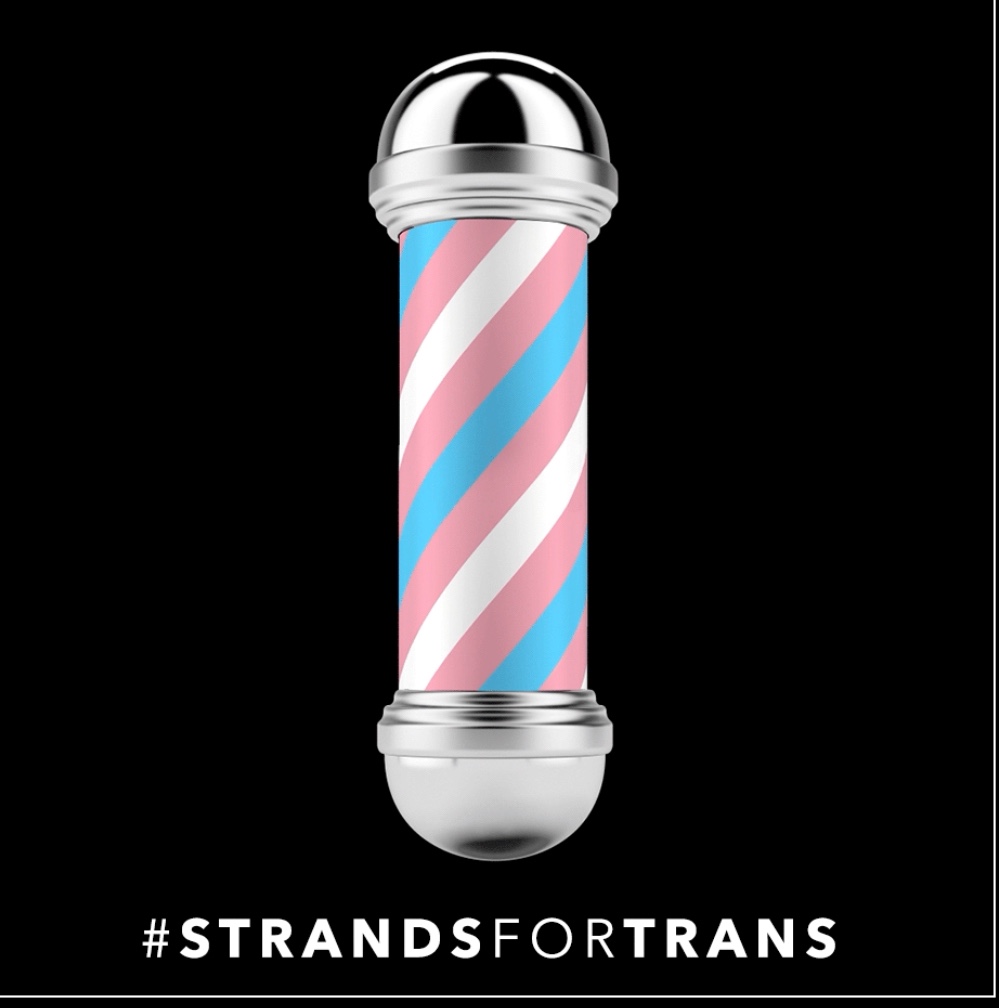
    Accessing affirming haircare is an essential need for LGBTQ+ and minority communities. Networks like Strands for Trans provide a membership-based platform connecting trans and non-binary clients with barbers and hairstylists trained in gender-affirming services. Members gain access to a map of verified stylists and locations, making it easier to find trusted professionals across the country or internationally. Strands for Trans also offers stylists guidance and training on communication, safety, and inclusive best practices. Participating salons and barbers receive a trans-affirming barber pole, in pink, blue, and white, signaling that the space is safe, supportive, and welcoming for trans and non-binary clients. And by fostering a network of trained professionals, Strands for Trans reduces anxiety and ensures clients experience predictable, safe, and affirming care when visiting salons or barbershops.

    What Resources Do These Networks Provide?

    Strands for Trans also builds broader community support through resources and guides designed to help trans and non-binary people thrive in multiple spaces. One standout resource, “The Gender Euphoria & Beyond: A Guide for Creating Affirming & Safe Spaces,” was developed from extensive research and focus groups, bringing together diverse experiences and perspectives. This guide offers practical strategies for creating safe, affirming environments not only in haircare but across communities, workplaces, and social spaces. Members of Strands for Trans have access to this guide, enabling both individuals and organizations to cultivate spaces where trans and non-binary people feel respected, supported, and celebrated.

    Strands for trans
    Strands for trans

    The Dresscode Project: Hair Has No Gender:

    The Dresscode Project (DCP) is a global initiative founded by Kristin Rankin (they/them) to create safe, gender-affirming spaces in salons and barbershops for LGBTQ2S+ individuals. At its core, DCP upholds the belief that hair has no gender, advocating for non-gendered haircuts that allow clients to express their authentic selves without being confined to traditional gender norms. Through education and training, DCP empowers stylists to provide inclusive services that respect each client’s identity. The organization also promotes gender-neutral pricing, ensuring that costs are based on factors like skill, time, and hair length, rather than gender. One of DCP’s signature initiatives is the Gender-Free Haircut Club, a monthly event where salons offer free, gender-affirming haircuts to marginalized queer individuals. With over 550 member salons worldwide, DCP is transforming the beauty industry by fostering environments where every client feels seen, respected, and celebrated.
    Dress code project

    What Does an Affirming Haircare Experience Feel Like?

    Imagine walking into a barbershop and noticing a trans pride symbol barber pole on the door or window. You feel an immediate sense of ease, knowing that the stylist understands pronouns and gender-affirming care. The stylist greets you warmly, listens to your style preferences, and communicates respectfully. By the end of the appointment, you leave feeling both cared for and affirmed. This kind of welcoming environment is exactly what Strands for Trans and The Dresscode Project work to create, a space where clients can express themselves confidently without fear of discrimination.

    How to Find Local Inclusive Salons:

    Outside of these formal networks, there are local salons and barbershops recognized by community members as LGBTQ+ and minority-inclusive. Urban salons often display gender-neutral signage, pronoun policies, and affirming mission statements. Barbershops in college towns may openly welcome clients of all genders and cultural backgrounds. Word-of-mouth recommendations, local community boards, and LGBTQ+ or minority organizations help clients identify these affirming locations. Visible symbols, clear communication, and a culture of respect indicate that clients can expect safe, affirming, and professional care in these spaces.

    Online Communities for Haircare Support:

    For those seeking affirming haircare advice and community support, there are online resources that cater specifically to LGBTQI+ and minority individuals. Platforms like Reddit communities such as r/TransHairCare, NaturallyCurly.com forums, and HairCareTalk inclusive discussion boards provide spaces for users to share experiences, ask questions, and find guidance for safe and supportive haircare practices. These forums connect people from around the world, making it possible to locate affirming stylists, learn about products for diverse hair textures, and engage with others navigating similar experiences.

    Social Media Resources for Inclusive Haircare:

    Social media offers vibrant, interactive spaces for connection and education. Instagram accounts like @TransHairNetwork, @InclusiveHairCommunity, and @CurlCollective, along with Facebook groups such as “Queer Haircare Collective” and “Minority Haircare Advocates”, provide supportive communities where members can exchange tips, share local recommendations, and spotlight inclusive salons or stylists. These groups are particularly valuable for LGBTQI+ and minority individuals looking for spaces that celebrate their identities while offering practical haircare guidance.

    Inclusive Haircare Brands and Products:

    A number of indie and minority-owned brands focus on inclusive, affirming haircare for a wide range of textures and identities. Examples include SheaMoisture’s Pride Collection, Aunt Jackie’s Curl Care Line, The Mane Choice formulations, Eden BodyWorks, and Camille Rose Naturals. SheaMoisture’s Pride Collection is a collaboration with the Marsha P. Johnson Institute, celebrating the legacy of LGBTQ+ activist Marsha P. Johnson and supporting LGBTQ+ communities. While the brand itself is owned by Unilever, this collection, along with other initiatives, reflects SheaMoisture’s commitment to inclusivity and support for marginalized communities. These brands prioritize diversity, representation, and accessibility, offering products that cater to curly, coily, and textured hair while supporting LGBTQI+ and minority communities through inclusive marketing and community engagement.

    By leveraging resources such as Strands for Trans, The Dresscode Project, local LGBTQ+ and minority-inclusive salons, online communities, and affirming haircare products, clients gain access to a full spectrum of safe and affirming haircare options. These networks not only ensure professional, respectful services but also foster confidence, community, and identity affirmation. Investing in these spaces and resources helps build a broader culture of inclusion in the haircare industry, ensuring that every client can feel safe, valued, and celebrated.

    Have you found an affirming haircare space in your community?

    What made it feel safe and welcoming?

    Share your experiences or recommendations in the comments!
    Links

  • Joe Rogan and Transphobia: How His Platform Amplifies Harmful Narratives

    Joe Rogan and Transphobia: How His Platform Amplifies Harmful Narratives

    Joe Rogan, one of the most influential podcasters in the world, has repeatedly used his platform to promote harmful ideas about transgender people. While some of his commentary may appear casual or comedic, the cumulative effect of his words perpetuates misinformation and stigmatizes a community already facing high levels of discrimination.

    Rogan has publicly misgendered prominent trans figures, including Caitlyn Jenner, suggesting that her transition is more performative than authentic. He has hosted guests like Abigail Shrier, whose controversial book Irreversible Damage promotes the debunked theory of “rapid-onset gender dysphoria,” framing trans youth as victims of social contagion rather than individuals with valid experiences of gender dysphoria. By amplifying these perspectives without critical challenge, Rogan normalizes skepticism and hostility toward trans identities.

    Sports have also been a recurring theme in Rogan’s rhetoric. His comments on transgender athletes such as Fallon Fox and Lia Thomas frame their participation as inherently unfair, emphasizing biological differences in a way that dismisses the reality of trans athletes’ lived experiences and the inclusive policies many organizations employ. These remarks reinforce the false narrative that trans people are threats to cisgender norms rather than competitors on equal footing.

    Beyond interviews, Rogan’s own material often veers into transphobic humor. His Netflix special Burn the Boats included jokes that mocked transgender people, contributing to a culture that trivializes their existence and struggles. Even seemingly absurd claims, like the debunked “litter box in schools” rumor, have been repeated by Rogan, giving them credibility in the eyes of his massive audience.

    The impact of such commentary is not hypothetical. Public figures with massive reach have a measurable influence on social attitudes, and when misinformation is normalized on platforms like The Joe Rogan Experience, it can fuel legislation that restricts trans rights, embolden harassment, and create hostile environments in schools and workplaces.

    Holding influencers accountable is not about silencing opinions… it’s about recognizing the power that comes with a platform and the real-world consequences of amplifying harmful narratives. For Rogan, casual dismissal or mockery of trans experiences contributes to a broader pattern of marginalization, one that demands critical scrutiny rather than passive consumption.

    Links

  • Joyful Actions That Promote Change

    Joyful Actions That Promote Change

    Creating meaningful change can feel overwhelming if you’re not sure where to start, but it doesn’t have to be. Change is built through consistent, joyful actions. These are small steps that add up to a bigger impact over time. In this guide, you’ll learn ways to make a difference weekly, monthly, and bimonthly. Each action is explained with practical examples, so no matter your experience or resources, you can start contributing immediately. At the end, you can download 3 full checklists and a bonus checklist for easy reference.

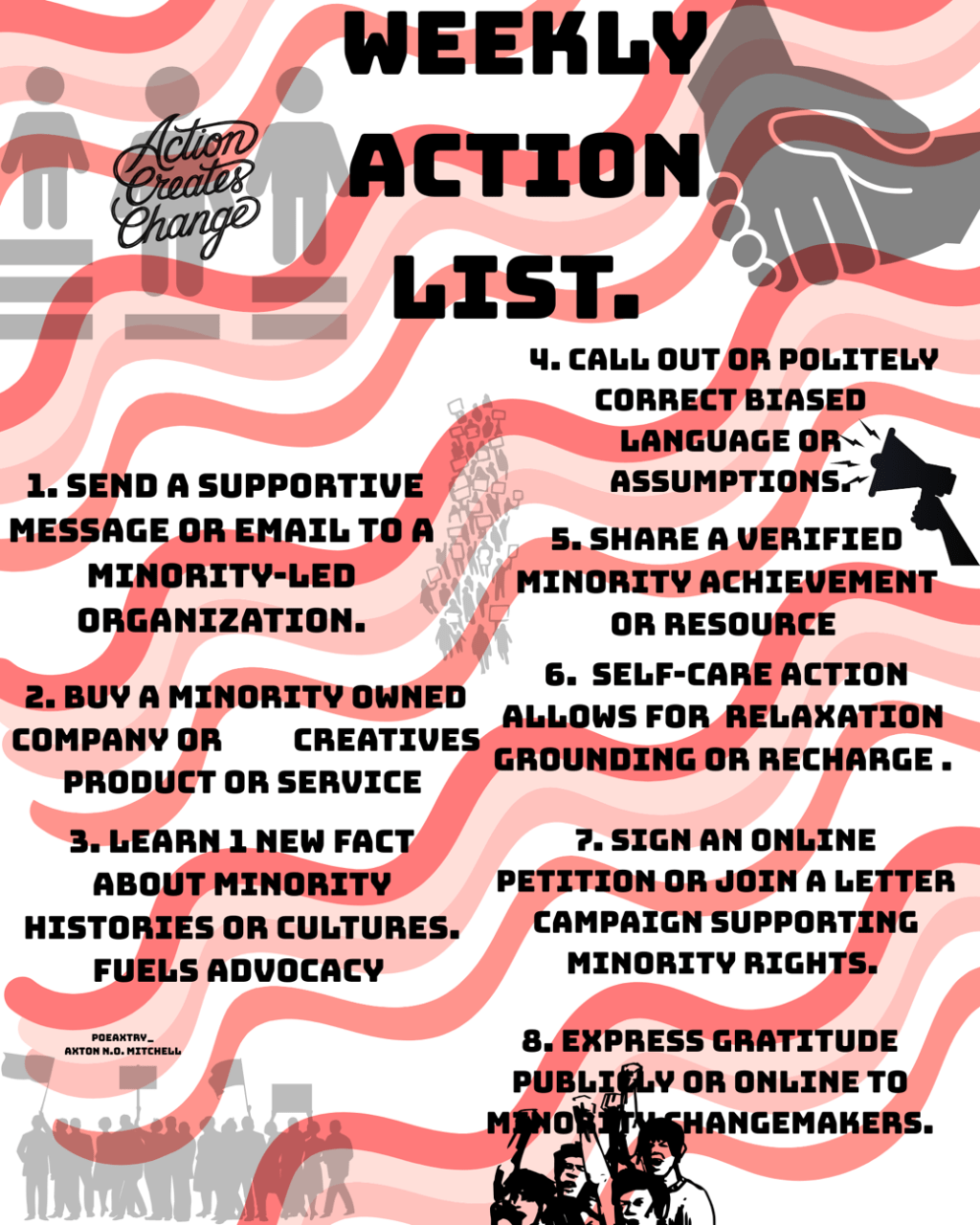
    One of the easiest ways to begin creating an impact is by taking small, weekly actions that are actionable and meaningful. We also added joy to the mix to give a reward to ourselves for becoming the change. For instance, sending a supportive message or email to a minority-led organization might seem simple, but it can make a real difference. Even a brief note like “Hi, I just wanted to thank you for your work; it inspires me…” can boost morale and let these organizations know that their efforts are seen and appreciated.

    Using or purchasing from minority-owned businesses is another small but powerful action. By intentionally supporting products or services from these businesses, you’re directly contributing to economic empowerment. You can find minority-owned businesses through directories like Buy Black, Official Black Wall Street, or even local listings. Even one small purchase counts.

    Learning one new fact about minority histories or cultures each week expands your understanding and counters misinformation. Things like reading an article, watching a short video, or listening to a podcast, then sharing what you learned with a friend. Over time, these small learnings compound into a deeper awareness that influences your daily choices and conversations.

    Calling out or politely correcting biased language or assumptions is another way to take weekly action. It doesn’t need to be confrontational; calmly explaining why a comment is harmful helps educate those around you and encourages accountability. Similarly, sharing a verified minority achievement or resource with someone… like a news story, a blog post, or a social media feature can help amplify important voices and keep these accomplishments visible.

    Self-care also counts as an action. Taking time for yourself by going for a hike, cooking a favorite meal, doing a face mask, getting your nails done, reading a book, or listening to uplifting music can keep you grounded and energized for advocacy. You simply signing an online petition or joining a letter campaign are other ways to use your voice and influence policy. Finally, expressing gratitude publicly or privately to minority changemakers reinforces positive recognition and strengthens community bonds.

    Monthly actions give you a chance to take slightly bigger steps that still fit within a manageable schedule. Participating in a virtual or local minority-supporting event, like a webinar, a virtual or local open mic, a lecture, or a cultural celebration. These expose you to new perspectives and help you connect with the work being done. Things like trying one new minority cultural experience: cooking a traditional dish, exploring music, or viewing art, can be a joyful way to learn and share culture, either with friends or online communities.

    Self-paced online workshops on allyship or cultural understanding are perfect for deeper learning. You can take them on your own schedule, allowing you to reflect and use what you learn at your own pace. Volunteering remotely for advocacy or awareness tasks, such as moderating online discussions, sharing resources, or helping campaigns These let you contribute meaningfully without needing to attend in person.

    By documenting and celebrating a minority achievements by writing a short post, vlogging, or highlighting someone on social media. You spread positivity and recognition. Sending letters or emails to officials advocating for inclusive policies is another actionable step, giving your voice weight in shaping decisions. When you highlight a minority-owned business or creator in your network it increases visibility and supports economic empowerment. Lastly, reflecting on and sharing a story or resource related to minority rights, even in casual conversation or online posts, expands understanding and encourages others to engage.

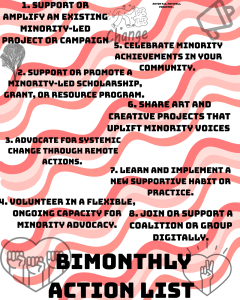
    Bi-monthly actions involve taking on larger, more flexible commitments that can still be done by anyone. Supporting or amplifying existing minority-led projects or campaigns is one way to have a broader impact. This could mean sharing updates online, signing up for notifications, or contributing in small ways. Promoting scholarship, grant, or resource programs created by minority leaders, expands opportunities for others and can be done digitally.

    When you advocate for systemic change through remote actions, like policy emails or participating in online, you allow anyone a voice in shaping outcomes. Volunteering flexibly for advocacy by things like resource sharing, digital organization, or communications allows you to make an impact when you can. Celebrating minority achievements in your community, either publicly or online, reinforces visibility and encouragement.

    If you can create optional joyful projects to amplify minority voices you have another avenue. You can contribute creatively, write, draw, record, or otherwise produce something meaningful. Implementing a new supportive habit, like sharing resources, mentoring via email, or spotlighting stories, builds consistent impact. Finally, joining or supporting digital coalitions or advocacy groups allows participation in campaigns, discussions, and advocacy initiatives. This connects you to larger networks.

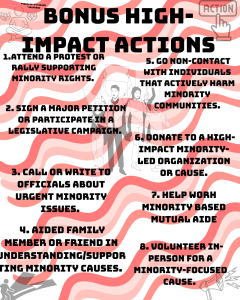
    Occasionally, you might want to take on high-impact actions. This could be going to a protest or rally, signing major petitions, or participating in legislative campaigns. These give your voice significant weight. You may want to call or write officials about urgent minority issues which directly engages policy influence. You may help a family member or friend understand and support minority causes or spread awareness in your immediate community. You may decide to go no-contact with harmful individuals or companies, donate to high-impact minority-led organizations, organize awareness events, or volunteer in person. These all can be transformative actions, and are optional but powerful ways to amplify your impact.

    Change is built through consistent, joyful actions that anyone can take. By following this guide, incorporating weekly, monthly, and bi-monthly steps, and exploring the Bonus Round opportunities, you can make a meaningful difference in supporting minority communities. Start small, celebrate progress, and remember that your actions whether big or small all add up.

    Below are the checklist images to view you can download them for free from my gumroad and Payhip as well.

    Links

    Weekly action list
    Weekly action list
    Monthly action list
    Monthly action list
    Bi monthly action list
    Bimonthly action list
    Bonus actions list
    Bonus actions
  • Ben Shapiro. Loud, wrong, and a misogynist

    Ben Shapiro. Loud, wrong, and a misogynist

    Ben Shapiro is a figure known for his aggressive debating style and political commentary. However, beneath the loud persona lies a consistent pattern of misogyny that permeates much of his public discourse. His treatment of women is not simply a matter of ideological difference. But it is a devaluation of their lived experiences, reinforcing harmful stereotypes and dismissing genuine social struggles.

    One glaring example is his reaction to Cardi B’s 2019 song “WAP.” Instead of engaging with the cultural impact or significance of the song. Benny chose to mock female sexuality, expressing confusion over basic female anatomy by suggesting that natural bodily responses were signs of illness. This public display of ignorance was not just embarrassing; it reflected a deeper discomfort with women’s autonomy over their own bodies.And to that I say, “Sorry you never got your wife’s pussy wet, Benny boy.”

    Beyond isolated incidents, Shapiro routinely diminishes feminist concerns, framing issues like the gender wage gap, domestic violence, and reproductive rights as emotional exaggerations. In his narratives, women’s experiences are often reduced to tools for debate rather than reflections of systemic inequities. When discussing abortion, Shapiro approaches the topic with philosophical hypotheticals, sidestepping the urgent realities faced by pregnant individuals lacking access to healthcare. His logic-driven rhetoric is a guise that masks the real human cost of policies affecting women’s rights.

    This pattern of rhetoric does more than provoke controversy, it contributes to a social climate where women’s voices are delegitimized and their struggles trivialized. By positioning himself as “too logical” for feminist discourse, Shapiro reinforces a toxic environment that blames emotion rather than addressing entrenched sexism.

    Understanding Shapiro’s misogyny is essential for recognizing how media figures shape public perception and normalize disrespect towards women. His words have consequences, contributing to broader cultural issues of the gender inequalities women face.

    Here we document and provide space for those targeted by voices like Shapiro’s to share their truths and challenge the narratives that silence or diminish them.

  • 📢 Elon Musk says his eldest son is dead.

    📢 Elon Musk says his eldest son is dead.

    But she isn’t. She’s Vivian Jenna Wilson, a trans woman whose identity Elon Musk has repeatedly refused to acknowledge publicly. This denial is not just personal; it is part of a broader, troubling pattern of control and erasure.

    Sources close to Musk reveal he has taken an engineering approach to reproduction — using sex-selective IVF techniques to ensure his children are assigned male at birth. Vivian herself has spoken out, describing how “her assigned sex at birth was a commodity that was bought and paid for.” This chilling statement underlines a disturbing mindset that treats human identity as a product to be designed, not an inherent aspect of a person’s being.

    When Vivian came out as transgender, instead of supporting her, Musk went as far as to claim she was dead. This act of deadnaming and erasure is more than insensitive — it’s a deliberate effort to erase a trans person’s identity, coming from one of the world’s most influential figures.

    Musk’s pattern of erasing trans identities extends beyond his family. His public statements about pronouns as “aesthetic nightmares” reveal an outright dismissal of trans experiences. More alarmingly, under his ownership, Twitter has repeatedly deadnamed trans users, suppressed trans voices through algorithmic shadowbanning, and failed to implement meaningful policies against transphobia on the platform. This institutionalized erasure amplifies the harm done by personal denial, leveraging corporate power to silence marginalized communities.

    This is not an accident or a misunderstanding — it is a deliberate and harmful approach with profound consequences. Trans people face higher rates of mental health challenges and violence, and erasure from powerful figures like Musk contributes directly to these risks.

    Erasure and deadnaming by influential individuals and platforms are forms of violence that perpetuate stigma and discrimination. They deny the legitimacy of trans identities and make public spaces unsafe for trans people. Musk’s actions and the policies enforced on Twitter under his leadership create a hostile environment that affects millions of users worldwide.

    Vivian’s story is emblematic of larger issues about power, control, and visibility. When billionaires weaponize their influence to erase trans identities, it sends a dangerous message: that trans people’s lives and experiences can be ignored, denied, or invalidated if it suits the powerful.

    But resistance grows too. Communities, activists, and allies continue to fight for trans rights, visibility, and dignity — calling out erasure wherever it happens. The fight for transgender justice is also a fight for respect, humanity, and basic rights.

    We must keep spotlighting these injustices and push for accountability — both personal and corporate. Elon Musk’s treatment of Vivian and the trans community is just one example of how bigotry can hide behind wealth and tech innovation. Recognizing this is the first step toward meaningful change.

  • How I’m Being the Change: Goals to Amplify Minority Voices

    How I’m Being the Change: Goals to Amplify Minority Voices

    Friday, on my way to work, I received a thoughtful email from the editor of Magique Publishing. This is a platform that has published me. They have also interviewed me in the recent past. Our relationship has been meaningful in a rather short amount of time. I value the insight, as we have built on a working relationship with shared values and mutual support. The editor read my recent blog post about the changes I wanted my blog to inspire. He reached out to tell me that my words had gotten him thinking. He pointed out something important: many people say they want to be the change. However, few ever talk about how they actually plan to be the change. The how is what baffles most. He also asked me a direct and challenging question: how am I going to be the change?

    The editor noticed something important. People are often aware of the big problems in the world. Yet, many don’t have clear guidance. Or they lack understanding on how to make a difference. We find it challenging to create impact on a small scale. He speaks about a university professor who, after leaving teaching, realized that practical “how-to” solutions for everyday activism were scarce. And wouldn’t you know he has a solution to help bridge that gap. He created a checklist of challenges. These are grouped by size and scope. People are welcomed to try them weekly or monthly. These challenges also include large spectrum goals. Examples are writing a letter to a government official or volunteering hours. They also consist of medium and small goals, like donating to a local charity or composting food scraps. He even suggested the possibility of joy-centered challenges to help people feel more connected and grounded in their communities. I love this idea of supporting each other through shared challenges and building momentum together.

    That email also motivated my own self reflection on ways I’ve actually been the change and where I can do more. It is rare you meet someone able to challenge you so respectfully and with the best intentions. But the questions he proposed pushed me beyond words into concrete action. I’m sure I’ll be forever grateful for that.

    In response, I’m dedicating time to developing two sets of goals organized into three clear categories: small weekly actions, medium monthly projects, and large bimonthly initiatives. One set will focus on personal goals for myself, while the other will center on community engagement, offering practical ways for contributors to get involved and create real change.

    I am also keenly aware that many people speak about being the change but rarely take real, measurable steps. This gap between words and action is what I am determined to close. One key way I live this is by intentionally publishing only minority creators in all my collaborations and projects. While I do allow ally-supportive works when they add meaningfully, they must not speak over marginalized voices. No minority submitting a piece on theme will ever be turned away. I may not publish every piece in a collaboration, but I will always include at least one from a minority creator. I’m not aiming to silence more of us. I’m committed to amplifying marginalized voices and ensuring they are never overshadowed.

    Though I am working steadily toward these goals, I know the work is ongoing and there is always more to do. That’s why I invite you, my readers and fellow changemakers, to consider your own goals for creating change. What small, medium, or large steps will you commit to? How will you move beyond talk and into meaningful action? I encourage you to share your goals in the comments. You can also reach out directly. Together, we can hold each other accountable. We can build a community dedicated to lasting impact.

    I am deeply thankful to Magique Publishing’s editor for inspiring this reflection. Sometimes, one thoughtful question from the right person is all it takes to turn intention into powerful action. If you want help crafting your own goals, I’m here to support you. I’m also here if you want to engage your community in this conversation. Let’s make change happen, now.

    Check out Magique publishing’s substack
    Check out our List of ways to make actionable change!

  • 📢 Donald Trump isn’t “controversial.” He’s racist.

    📢 Donald Trump isn’t “controversial.” He’s racist.

    We’re not gonna keep pretending this was about “policy.” That it was “just politics.” That any of this was ever neutral.

    Donald Trump didn’t “divide the nation”; the nation was already divided. He just took a fucking blowtorch to it and got rich doing it.

    He didn’t build anything. He exploited what was already broken. He played white America’s fear like a damn fiddle and then sold tickets to the concert.

    Yes, from the beginning? It was racism.

    When he announced his campaign by calling Mexican immigrants drug dealers, criminals, and rapists. It wasn’t some offhand moment. It was the start of a plan. It was a signal to white supremacy: I’m your guy. Given his face looks like that little racist frog meme and all.

    This wasn’t new. He’d already been pushing that racist birther lie about Obama for years, acting like the first Black president wasn’t legit because his skin made Trump uncomfortable. It wasn’t “doubt.” It was hate. That’s what got him attention. That’s what built his base.

    He kept going.

    He called for a Muslim ban.

    He referred to Black and brown countries as “shitholes.”

    He told Black women in Congress to “go back” where they came from. Three were born here though, I don’t think any of Trumps wives were.

    He refused to condemn white supremacists. Told the Proud Boys to “stand back and stand by.” They heard him. Loud and clear.

    And this whole time he was being taken to court by E. Jean Carroll for sexual assault. She won. He was found liable for sexual abuse. That’s not speculation. That’s not internet gossip. That’s legal fact. You voted for a rapist and a man who is proven to have said he just can’t help himself around beautiful women and I’m sure you know the rest of the line. I mean for Christ sake your vote was for a racist walking meme.

    So while he was out here calling immigrants rapists , he was in court being held responsible for exactly that kind of violence. But the media won’t call it rape. They say “scandal.” They say “controversy.” They say “misconduct.” Nah. Say what the fuck it is.

    Your president is a RAPIST!

    This country made excuses for him. Over and over again. It’s not “bias” to say he’s racist . And it’s restraint not to say worse, honestly.

    And we’re not gonna do the media’s job and soften this shit for you.

    This is Poeaxtry’s Poetry Prism.

    We don’t worship people who use power to abuse.

    We don’t confuse “influence” for integrity.

    We don’t forget.

    We document the harm and provide a space for those targeted by Trump’s hate to share their own truths and reclaim their voices.

    Stick around for more.

  • Dr. Seuss Was Racist: The Truth They Hid in Plain Sight

    Dr. Seuss Was Racist: The Truth They Hid in Plain Sight

    Theodor Seuss Geisel, widely known as Dr. Seuss, is often celebrated as a beloved children’s author whose whimsical stories have enchanted generations. However, beneath this nostalgic legacy lies a troubling reality of racism. Dr. Seuss was also responsible for spreading racist imagery, harmful stereotypes, and participating in practices that reinforced systemic racism.

    During World War II, Geisel created political cartoons for the U.S. military and newspapers that featured dangerous caricatures of Japanese Americans and other Asian people. These cartoons amplified xenophobic sentiments and contributed to public support for the forced internment of Japanese American citizens, a grave injustice that violated civil rights and caused lifelong trauma. That is still widely ignored by people as a whole when speaking on American transgressions against minorities.

    Beyond his political work, Dr. Seuss’s children’s books included offensive and demeaning portrayals of Black, Asian, and Indigenous peoples. His illustrations often leaned on racial stereotypes that reduced complex cultures to exaggerated, harmful tropes. The severity of this imagery was such that in 2021, several of his titles were officially pulled from publication by the publisher due to their racist content.

    Adding to this, less known but equally disturbing, is Geisel’s association with pamphlets circulated during the early 20th century that listed people of color for sale under racist terms that commodified them in deeply offensive ways. This reflects a direct involvement in perpetuating dehumanizing views of Black people and communities of color. It underscores that the harmful narratives linked to Dr. Seuss go beyond caricatures in books and into real-world racist practices.

    Dr. Seuss presents a confusing legacy of contradictions. The reality of his good vibes and racism” is summed up by “green eggs, red flags”. While his playful stories like Green Eggs and Ham charm generations, these beloved tales mask the red flags hidden beneath. His cheerful façade conceals troubling racist imagery and messages that demand a closer, critical look. This contrast shows how something seemingly innocent can still carry deep and harmful issues. Also reminding us to question and unpack what we celebrate.

    These facts highlight a deeply problematic side of a figure many of us grew up idolizing without question. It reminds us that cherished childhood stories and authors can harbor legacies of racism and oppression that deserve acknowledgment and critique.

    The cultural impact of these racist portrayals is significant, given the widespread reach of Dr. Seuss’s works in schools and homes worldwide. When children are exposed to stereotyped and racist imagery under the guise of innocent stories, it reinforces prejudiced worldviews early on. This demands a critical examination of the stories we pass down and the voices we elevate.

    We don’t buy books to worship. We buy them to question. So thrift, borrow, secondhand your way through the wreckage of art, but be the voice for those who cannot be one. Point out what’s broken when you see it. Respect the talent, when it exists, not the trash. Respect the people affected more than the pen.

    So if you grew up on the racism of Dr. Seuss tell me did you notice the issues before? Did you know he was involved in more than cute kiddie books? Or do you think I’m out of line?

    Links coffee Amazon

    Trump Shapiro

  • Stephen King and the Horror of Ableism: When Disabled Women Are the Monsters

    Stephen King and the Horror of Ableism: When Disabled Women Are the Monsters

    Stephen King is undoubtedly one of the most prolific and influential authors in modern horror literature, but his depiction of disabled women often falls into troubling patterns that reinforce damaging stereotypes. In particular, the characters Annie Wilkes from Misery and Jesse from Gerald’s Game illustrate how King’s narratives tend to frame disabled women either as violent threats or tragic victims, a portrayal that not only simplifies disability but also perpetuates societal stigma.

    In Misery, Annie Wilkes is introduced as a physically disabled former nurse who rescues author Paul Sheldon after a car accident. However, as the story unfolds, Annie’s disability becomes closely intertwined with her erratic and dangerous behavior. She kidnaps Paul, holding him captive and subjecting him to physical and psychological torture. The character’s violent instability is amplified by her disability, which reinforces the harmful trope of the disabled individual as inherently unstable or dangerous. This representation can contribute to real-world prejudices by implying that disability is connected to unpredictability and violence, rather than portraying Annie as a complex person shaped by many factors beyond her physical condition.

    On the other hand, Gerald’s Game presents Jesse, a woman who becomes physically disabled after a traumatic event—a bondage game with her husband that goes wrong, leaving her handcuffed and stranded in a remote location. Jesse’s character is depicted with more psychological nuance as she battles not only her physical limitations but also her history of trauma and abuse. While this portrayal gives insight into the emotional and mental struggles tied to disability, it still frames disability largely through the lens of suffering and victimhood. Jesse’s survival story is powerful, but King’s focus on trauma risks reducing her disability to a symbol of pain rather than allowing for a broader, more empowering representation.

    Fact 1: Studies of disability in media highlight that disabled women are often confined to narratives of victimization or menace. Annie Wilkes’s violent actions in Misery and Jesse’s vulnerable predicament in Gerald’s Game both echo these patterns, emphasizing danger or helplessness as defining traits.

    Fact 2: These portrayals perpetuate social stigma against disabled women by framing their identities through extremes of fear or pity, limiting public understanding and empathy for their real-life experiences.

    King’s depictions mirror broader issues within popular culture, where disability is frequently sensationalized or used as a shorthand for horror and tragedy. This oversimplification overlooks the complexity and diversity of disabled individuals’ lives and fails to challenge the biases that continue to marginalize disabled women.

    Furthermore, the cultural impact of King’s storytelling is significant because of his vast audience and influence. When such stereotypes go unchallenged, they reinforce misconceptions and contribute to the social exclusion of disabled people. It is essential for media creators and consumers alike to critically analyze these portrayals and advocate for stories that present disabled women as fully realized individuals with agency beyond their disabilities.

    Adding to this complexity is the inequity in whose perspectives are valued when discussing disability. Disabled creators and activists who critique harmful portrayals are often dismissed or labeled as “dramatic” or “attention-seeking,” while mainstream authors like King receive less scrutiny. This double standard highlights ongoing challenges in elevating marginalized voices and underscores the importance of amplifying authentic narratives from disabled women themselves.

    By addressing these issues openly, readers and creators can push for more accurate and empathetic representations in literature and media, helping to dismantle stigma and foster a culture of inclusion.

    Have you noticed these instances in work from “the king” of horror? Do you also see the ugliness they perpetrate?

    Links Etsy song

  • Quentin Tarantino’s Use of the N-Word Isn’t “Edgy”—It’s Exploitation

    Quentin Tarantino’s Use of the N-Word Isn’t “Edgy”—It’s Exploitation

    Let’s not pretend this is new. Quentin Tarantino has a long and well-documented history of using the n-word in his films. But what makes his case especially disturbing isn’t just the frequency of its appearance. It’s that he casts himself to say it.

    This isn’t incidental. It’s not some “gritty realism” or “necessary evil” in the name of authenticity. Tarantino doesn’t just write scripts where racial slurs. He inserts himself as the mouthpiece for them. The industry then claps for it.

    Over and over, in movie after movie, he writes the word, directs the scene, walks on camera, and delivers it. Full control, full authorship, full power. This isn’t a creative accident. It’s a pattern and a choice.

    Take Pulp Fiction. He plays Jimmie, a white man. Jimmie casually spits the n-word while discussing a dead Black man in his garage. There is no reason this scene needed to include that word. There is certainly no reason Tarantino had to be the one saying it. He’s the writer. He’s made any choice. Not only that, but he chose that.

    People have called this out many times. They include critics, scholars, Black viewers, and even fellow filmmakers. Yet, the industry still refuses to hold him accountable. Instead, they’ve labeled him “a provocateur,” a “visionary,” a “master of raw dialogue.”

    What does it say that a white man can repeatedly use anti-Black slurs in entertainment? He profits from it all while Black creators constantly have to justify even showing their pain.

    This Isn’t About One Word. It’s About Control.

    Tarantino’s use of racial slurs isn’t about storytelling. It’s about power.

    White filmmakers like him write themselves into roles that allow them to say the n-word on screen. They’re not pushing boundaries. They’re reinforcing a long history of white ownership over Black narratives. It’s voyeuristic at best, violent at worst.

    This dynamic isn’t limited to Tarantino, but his case is one of the most egregious. He profits from Black trauma. He peppers his scripts with the aesthetics of Blackness by using slang, music, and cultural references. He even includes entire character archetypes. Then he centers himself and other white people in the telling.

    Even Django Unchained, which they say features a Black hero, focuses largely on white characters during its runtime. These include white saviors, white villains, and white storytellers. And again, the n-word appears more than 100 times. It’s everywhere. Gratuitous. Heavy-handed. But in interviews, Tarantino defends it as “truthful” or “necessary.”

    Truthful to what? Necessary for whom?

    You don’t get to use realism as a shield when you’re writing the fiction yourself.

    When bipoc tell their Stories, they are silenced. When He Tells Them, He’s celebrated.

    Here’s the part that stings the most. A project by a Black or Indigenous filmmaker with the same level of graphic violence would contain racial slurs. It would include cultural trauma similar to Tarantino’s films. Such a project would be torn apart in the press. Their project would include racial slurs. It would also involve cultural trauma, similar to Tarantino’s films.

    They’d be accused of exploiting pain. Of playing the victim. Of being too angry. They are told their stories are “too much” or “not universal enough.” The same people who praise Tarantino’s “grit” would call others “divisive.” Or worse yet, “irrelevant.”

    When minorities create art rooted in our reality, they call it trauma porn. When he does it, they hand him awards.

    Black creators have to walk a razor-thin line. They balance honest expression with marketability. They tone police themselves at every turn just to be taken seriously. Meanwhile, Tarantino gets to waltz into the conversation, drop the n-word a dozen times, and get called authentic.

    That is the very definition of privilege.

    It’s Time We Say It Plain.

    This isn’t about whether Quentin Tarantino is “racist” in the most obvious sense. This is about who gets to tell stories and what they get praised or punished for.

    Many people of color hesitate to share their own experiences with racism. It’s because minorities know how these experiences will be received. We’ve all as minorities have seen it too many times. We are labeled attention-seeking. Dramatic. Angry. Bitter. Especially those of us whose difference is their race.

    Meanwhile, a white man says the n-word on screen, over and over again. Sometimes, he does this while laughing about a corpse. Other times, it happens while playing slave masters, and the media calls it brave.

    They say it’s bold. They say it’s raw. Worse by far is them say it’s “grit.”

    Let’s say what it really is: exploitation.

    And let’s stop pretending it’s anything less.

    So if you’re a fan of his work, and you’re willing to say why, please enlighten me. If you’re one of the same standpoint as me, please add anything to your comment. Mention anything you see that he does that accompanies his racism in writing and directing.