Category: Poeaxtry’s Open Shelf

Curated collection of spontaneous essays, creative explorations, prompt responses, political takes, minority highlights, cultural reflectons, spirituality, indie and small business shout-outs, and more.

  • Ohio HB 249 Senate, 2026: Battle the Anti-Trans Bill

    Ohio HB 249 Senate, 2026: Battle the Anti-Trans Bill


    Best for:

    Transgender individuals, gender nonconformists, intersex individuals, queer folk, advocates, socio-politically involved people, and those who want to stop HB249.


    A screenshot from the Ohio legislature website showing opposition submissions from community members, including Axton Mitchell from poeaxtry with a red square button to download their testimonies.
    Proof of my official submission on the Ohio House website; my voice is now a permanent part of the 136th General Assembly’s history.

    The Record of Our Existence –

    Ohio HB 249 Senate, 2026:

    On March 14th, 2026, I sent my testimony into the House of Representatives as HB 249’s time to sink or swim was approaching.

    House bill 249 is a “model bill” designed to push the trans community, gender nonconformists, and drag artists alike out of public life. Attempting to do so by using vague “adult cabaret” language to criminalize our presence. While the House vote was 63–30 in their favor, the fight has now reset.

    HB 249 is officially in the hands of the Ohio Senate. This is where we build our firewall.

    I am sharing the original House testimony I submitted, here to show you that advocacy is a tangible, documented act. We are not just screaming into a void; we are putting our names, our businesses, and our stories on the permanent record.

    Yelling
    Free speech
    But controlling what the news say
    The Lorax called, it’s time to find a new shade
    Ru Paul’s never seen a beat that bad on drag race

    – Earth to Eve

    The Blueprint – My House Testimony Receipts:

    “You can't really know where you are going until you know where you have been,” so said the late, great Maya Angelou. 

    I put my business, Poeaxtry, and my name on the official record to further prove that transgender and gender nonconforming individuals are here to stay, as we always have been. Our community cannot and will not be ignored.


    Screenshot of the New Edition to Ohio HB 249 Senate, 2026. This text explains the adult cabaret portion of the bill white background black text
    The “Red Flags” in plain text; this is the language they are using to categorize us as a “performance” rather than as people. This is the actual verbiage used in Ohio HB 249 Senate, 2026.

    How Allies & Family Build the Defense:

    Ohio HB 249 Senate, 2026:

    In Ohio we are pivoting to the Senate Judiciary Committee, and this time, we need a broader coalition. If you are an ally, a parent, or a concerned neighbor, your role is to change the narrative.

    • 1. Break the “Common Sense” Propaganda:

    The proponents of this bill claim it is about “protecting children.” Our most useful move is to show people other actual people’s testimony.

    When you show a person the actual legal definitions, they can see the overreach for what it is. Education is the first step toward stopping the Senate from moving this bill to a floor vote.  

    • 2. The Ally Advantage:

    Advocates, allied people, and family members in support of transgender individuals and other people who don’t conform to gender norms, have a unique power to combat Ohio HB 249 Senate, 2026.

    When you testify, you are telling the Committee that this bill doesn’t just “protect” some families; it threatens all families by giving the state the power to decide who is “obscene.” Your testimony proves that the trans community is supported by a network of voters that the Senate cannot afford to alienate.


    Submitting Your Senate Testimony in Opposition of Ohio HB 249 Senate, 2026:

    The Senate Judiciary Committee, chaired by Senator Nathan Manning, is where this bill must be stopped. Here is how we flood their office with “oppositional” testimony.

    The 24-Hour Rule

    In the Senate, your testimony and the Witness Information Form must be emailed to the Chair’s office at least 24 hours prior to the scheduled hearing. This is a strict deadline; if the meeting is at 9:45 AM on a Wednesday, your email needs to be sent by Tuesday morning.

    Drafting Your Statement

    • The Salutation: “Chairman Manning, Vice Chair Reynolds, Ranking Member Hicks-Hudson, and members of the Senate Judiciary Committee.”
    • The Position: Clearly state at the beginning: “I am writing as an Opponent to HB 249.”
    • The Personal Touch: Talk about your life in Ohio. If you are a parent in Newark or a shift worker in Belmont County, mention it. Senators should care about their constituents.
    • The Ask: Explicitly tell them: “I urge you to vote NO on HB 249 and keep this bill from reaching the Senate floor.”
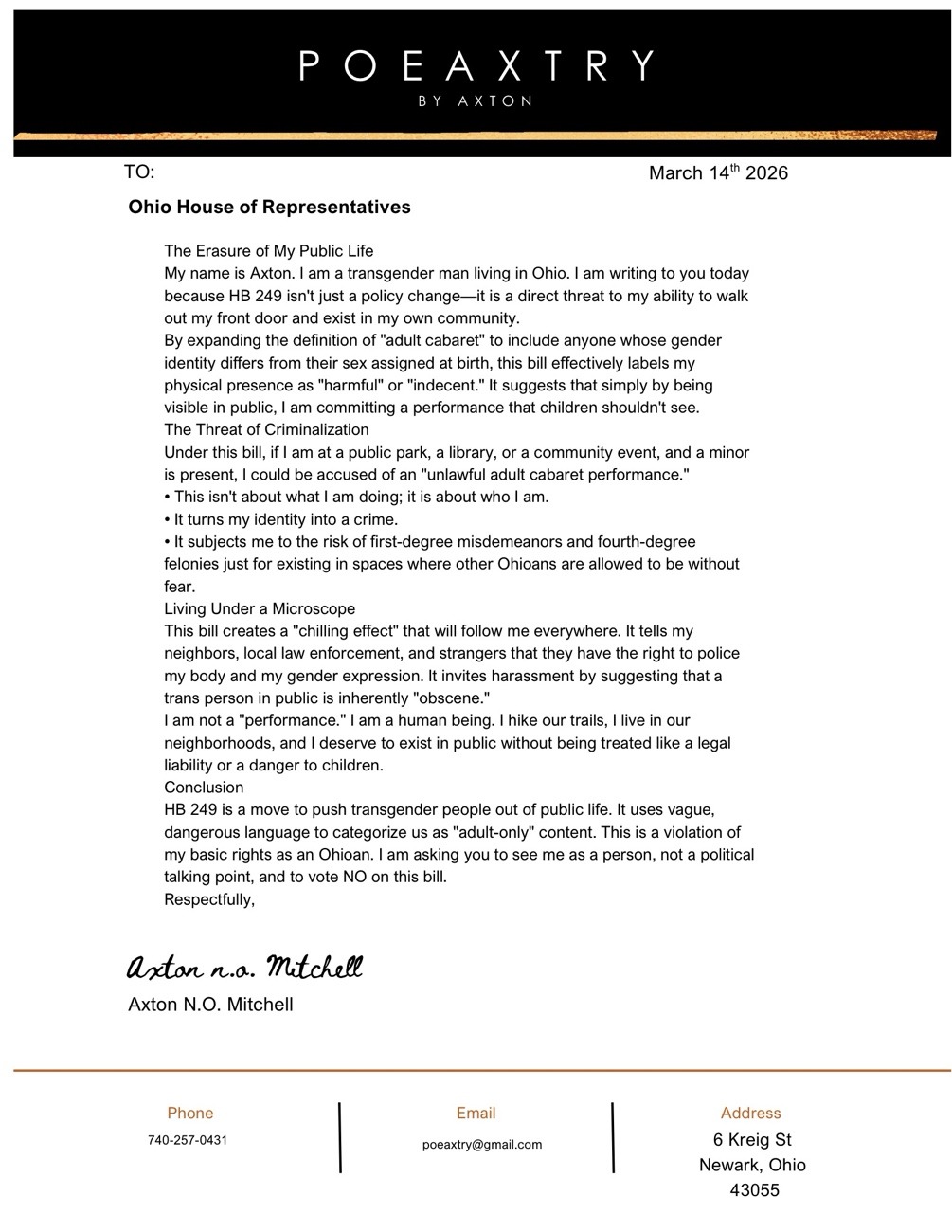
    Testimony submitted in opposition of HB249 photo has black header white body background and black text showing Axton Mitchell’s full testimony
    Testimony I submitted to the House of Representatives to oppose HB249

    Please explain it to me
    The man in charge of the economy’s
    Got 6 bankruptcies
    Asking ChatGPT
    To define GDP
    Defunding education, when half the country can’t read
    Well now its clicking for me
    You need the people asleep
    And knowledge is the greatest threat to propaganda machines

    -Earth to Eve

    Support the Opposition of Ohio HB 249 Senate, 2026:

    • Join a Lobby Day: Collective Physical Presence

    A “Lobby Day” is not just a meeting; it is a show of force. When groups like Equality Ohio or the ACLU of Ohio organize these days, they provide the training and the talking points you need to walk into a Senator’s office with confidence.

    Why it works: Legislators see hundreds of people in the same colored shirts walking the halls; it reminds them that their “yes” vote has a human cost.

    What you do: Sign up for the Equality Ohio mailing list or check their “Events” page immediately. If a formal day isn’t scheduled yet, gather some friends, drive to Columbus, and ask for a 15-minute meeting with your Senator’s aide. You don’t need an invitation to be a constituent in your own Statehouse.

    • Tag Them Constantly: Digital Accountability

    Posting your testimony is step one; making sure the Senator has to see it is step two. You need to tag their official office accounts, not just their campaign accounts.

    • The “Constituent” Signal:

    Always include your city or zip code in the post. Senators prioritize their own voters. Use a phrase like: “As a voter in [Your City], I am tagging Senator [Name] to ask why they are supporting the vague and dangerous language in HB 249.”

    • How to Tag:

    Most Ohio Senators use a standard format for their handles (e.g., @OHSenateGOP or their specific name). If you can’t find them, tag the Senate President Matt Huffman (@MattHuffmanOH) because he controls which bills actually move to a vote.

    • The Share Chain:

    When you see someone else post their testimony, share it and tag your Senator again. We create a digital wall of opposition that they cannot scroll past.

    • Inform Your Neighbors: Localized Education – Ohio HB 249 Senate, 2026:

    Most people in your community probably think Ohio HB 249 Senate, 2026 is “common sense” because they haven’t read the actual definitions in Slide 3, or they may be taking everything at face value and not reading the fine print.

    • Community Meetings:

    Bring printed copies of the Ohio HB 249 Senate, 2026 definitions to your local city council meeting, school board or other community related meetings.

    • The “Red Flag” Script: Tell them: “This bill isn’t about what the headlines say; it’s about giving the state the power to decide if your neighbor’s clothing or presence is ‘obscene.’ Here is the literal text.”

    • The Library/Coffee Shop Move:

    Print out a small “How to Help” flyers with a QR code leading to this guide, or any other helpful resources and leave them at local hubs.


    We Are the Firewall

    The anti transgender rhetoric relies on us getting tired, and our advocates just moving to the side and letting their bigotry slide.

    However, we are a community that knows how to survive. A lot of us thrive in these fight or flight situations. We know how layering our advocacy, from social media comments on Facebook to formal testimony in the Senate. They are making the political and social cost of this bill too high to pay.

    Transgender people, drag performing artists, and gender nonconformists alike are not a “performance” to be managed; we are the public that they serve, just the same.

    Let’s make sure they remember that when the Senate gavel falls. I am still waiting to be shown where the United States Constitution, the Bill of Rights, or Bill of Rights says anything about a person makes them deserving of less than anyone else. The Declaration of Independence promised life, liberty, and the pursuit of happiness; the Constitution and the Bill of Rights were written to codify and protect those very rights for every one of us.



  • Ohio HB 798: The “Erasure Act” & the Cost of Visibility

    Ohio HB 798: The “Erasure Act” & the Cost of Visibility


    Best For:

    Political science Majors, transgender and gender non-conforming people, advocates, and those who fight for equal rights.


    The GOP’s Attack on Visibility on TDOV – Coincidence? Irony?

    The irony of House Bill 798 being introduced on Trans Day of Visibility (TDOV) isn’t lost on anyone. While we spent March 31st celebrating our existence, Rep. Josh Williams (R-Sylvania Twp.) was filing paperwork designed to make that existence legally invisible.

    This isn’t just another “bathroom bill.” This is a “Map of Hell” expansion that moves the goalposts from “protecting kids” to erasing adults. After the manufactured moral panic and outrage over Target selling chest binders and gaffs, the mask has finally slipped all the way off. In case you didn’t get this already, they don’t want to “protect” kids; they want us to stop existing in public, and honestly probably in private as well.


    Ohio HB 798 The New Legal Definition

    A Trap for the Transitioned:

    Ohio’s HB 798 doesn’t just use the word “sex,” it seeks to legally define it as “biological sex,” specifically determined by “internal and external reproductive anatomy” and “genetics” at birth. If you corrected our documents whether a decade ago or three months, this is a calculated attempt to make our current legal status “erroneous.”

    By narrowing the definition to chromosomes and anatomy at birth, the state is trying to create a legal “Ground Zero” that ignores medical transition, court orders, and any amount of lived experience. It turns our IDs into a “lie” in the eyes of the state, regardless of what our passports, birth certificates or social security records say.


    “Protecting Children” to Erasing Adults Ohio’s HB 798:

    For years, the rhetoric was centered on “protecting the youth” from permanent changes. But Ohio’s HB 798 proves that was a lie, but I’m sure like me you were already aware of that. As a transgender female to male who legally has changed his name and gender marker back in 2016, this bill feels like a targeted attempt. Ohio’s GOP wants to try and reach back into my past while systematically undoing my present, the same goes for everyone else like me in Ohio.

    The bill doesn’t just stop at K-12 schools; it targets the very foundational documents of adulthood:

    • Marriage Licenses:

    It seeks to freeze sex markers, ensuring your “biological sex” is the only thing the state recognizes on your wedding day.

    • Death Certificates:

    It mandates that even in death, your true identity can be erased, forcing a “biological” marker onto your final record.

    • The “Bounty Hunter” Clause:

    It allows private citizens to sue institutions if they “perceive” someone of the opposite sex in a restroom. This isn’t about safety; it’s about state-sponsored stalking.

    They told us it was about the children until they realized we weren’t going away. Now, they’re coming for our marriages, our dignity, and our right to die with our names intact.

    – Axton N. O. Mitchell

    My Wedding:

    I am getting married in October. This bill isn’t just a headline for me; it’s a shadow over my ceremony. While I have lived my truth for over a decade, the state of Ohio is trying to build a legal cage around the word “biological.”

    They want to make being trans so uncomfortable, so litigious, and so bureaucratically exhausting that we simply stop talking. They want us to live the lie because our truth is too inconvenient for their campaign trail.


    It is a pursuit of our identity that follows us literally to the grave, attempting to erase the life we actually lived in favor of the one they wanted for us.
    – Axton N. O. Mitchell

    Why Ohio’s HB 798 is a House of Horrors:

    • Retail Panic Result: This bill is the direct descendant of the rage sparked by binders, gaffs, and pride merch. It’s the legislative version of screaming in a Target aisle.
    • The Litigation Trap: By allowing lawsuits based on “perception,” Ohio is encouraging a culture where every stranger is a self-appointed gender inspector.
    • The Permanent Record: By banning changes to birth and death certificates, they are attempting to ensure that no matter how you live your life, the state gets the “last word” on who you were.

    When Existence Became the Crime:

    I saw the change pretty clearly. First, they said it was about “protecting children” from hormones and surgery, more permanent changes. Then, the goalposts moved to puberty blockers, and we already knew something was coming.

    Finally, when the moral panic shifted to Target putting out chest binders and tuck-friendly swimsuits, the mask fell off completely.

    They realized that transgender people and other gender nonconforming individuals aren’t just in clinics. We are in the woods, the parks, and in the workforce.

    Ohio’s HB 798 is the legislative response to that realization. It’s no longer about medical “safety“; it’s about making the everyday act of buying a binder in a store or using a public restroom a legal liability.

    They are trying to make our existence so litigious that corporations and schools are “scared” to accommodate us.

    Visibility without protection is a trap. They want us to be seen only so they can find us more easily

    – Axton N. O. Mitchell

    The November Ballot-

    Voter ID & the Erasure Act

    We cannot ignore the timing. With Ohio’s strict photo ID laws, any bill that muddies the water of what constitutes a “legal” sex marker is a threat to our right to vote.

    As we fight for the Ohio Equal Rights Amendment on the November 2026 ballot, bills like Ohio’s HB 798 act as a distraction and a deterrent.

    They want us so bogged down in fixing our birth certificates and worrying about bathroom lawsuits that we lose sight of the power we have at the polls. This isn’t just a bill; it’s a hurdle placed in front of the ballot box.


    We Are Here To Stay –

    Death BEFORE Detransition!

    Ohio’s HB 798 is currently just a house bill. A “taxpayer-funded press release,” as some have called it. It hasn’t passed yet, not even close and with my wedding coming up in October, I refuse to let a desperate bid for a Congressional seat ruin the joy of my big day.

    We’ve watched this house of cards being built, from the first House bills that is on its way to the Ohio Senate. Today is April fools day one of my favorite holidays. Though, for a moment I actually tried to act like it was a sick prank.

    Yet, you and I We see the map they are drawing. As we head toward the November elections and my own walk down the aisle, remember: they can change the paperwork, but they can’t change the truth of who we are.


  • The 2026 Pivot: Navigating Ohio’s New Cannabis Landscape

    The 2026 Pivot: Navigating Ohio’s New Cannabis Landscape


    Best For:

    Ohio Locals used to make Michigan runs, people who keep their stash in their center console, individuals who don’t smoke in their house, but smoke in their car, hemp, and CBD customers, and those people who support small businesses.


    A man Smoking a rolled cigar of flower sitting in his car outside his house in a grey backwards hat and black sweater
    Sitting outside your house smoking in your car is now illegal!

    As an Ohio Local & Legal THC Advocate:

    In Ohio, the only thing that changes faster than the weather is the law. If you’re local of follow the Ohio government you know it’s true. While we all celebrated the “green wave” of 2023, the tide has officially shifted as of March 20, 2026.

    If you’re still operating under the old rules of Issue 2, you are walking into a legal minefield without a map. This isn’t just a “tweak” to the system; it’s a complete overhaul of how we buy, carry, and consume.

    Below i have broken down the breakdown of the new SB 56 landscape. Now you don’t have to hunt for the information or be ill informed. You can save and reuse this to stay informed, stay protected, and keep your peace of mind intact


    Ohio’s lawmakers – Making changes:

    For nearly two years, Ohioans operated under the framework of Issue 2. Which was the 2023 voter-approved initiative that legalized adult-use marijuana with a focus on personal freedom.

    However, as of March 20, 2026, the legal landscape underwent its most significant overhaul to date. Senate Bill 56. Which Ohio is now considering the law of this state. This bill introduced new criminal penalties and tighter restrictions. I feel every Ohio resident needs to understand it to remain completely informed.  

    Man in a multicolored hoodie, smoking a Rolex cigar in his car
    Sitting in a parked car & smoking now illegal in Ohio.

    The goal here isn’t to assist anyone in skirting the law. I aim to provide a clear, fact-based map of what the law is today. While we work at comparing the new laws to what they were yesterday. In a shifting legal environment, being informed is your only real protection.


    From Issue 2 to SB 56: What Changed?

    When Issue 2 first went into effect in December 2023, it was hailed as a relatively open system. It allowed for high-potency extracts and a flexible approach to where and how you could carry your product. SB 56, signed by Governor DeWine in late 2025, has “recriminalized” several behaviors that were previously considered safe under the original voter-passed statute.  

    Man smoking large orange bong, in shorts and green shirt, nose, lips, beard and down showing as well as exhale.
    Man smokes banning in his garage shop.

    The most jarring change is the Mandatory Local Sourcing rule. Under the original 2023 law, the source of your cannabis was less of a legal flashpoint as long as you were within possession limits. As of March 20th, 2026, it is explicitly illegal to possess any cannabis in Ohio that was purchased from another state.

    Yes. Even if you bought it legally in Michigan, or any other legal state. The moment you cross the state line into Ohio, that product is considered contraband. If it isn’t from an Ohio-licensed dispensary or a legal home-grow in Ohio, possessing it is now a criminal offense.  


    Potency Caps and the Hemp Ban:

    The Ohio lawmakers also used SB 56 to lower the “ceiling” on what can be sold in Ohio dispensaries. This affects both recreational users and medical patients who rely on high-concentration products.  

    • Extracts and Concentrates: The allowable THC limit has been slashed from 90% down to a maximum of 70%.  
    • Raw Flower: Dried plant material is now capped at a maximum of 35% THC.  
    • The Hemp Loophole: Previously, “intoxicating hemp” products like Delta-8 were sold in gas stations and smoke shops. SB 56 has effectively banned these sales outside of licensed dispensaries. Any product with more than 0.5mg of THC per serving is now legally classified as marijuana and must be regulated by the Division of Cannabis Control.  
    Man in Dunkin’ Donuts shirt, black backwards hat, and sunglasses smokes a rolled cigar in his car outside
    Smoking outside your house in your car is now illegal in Ohio.

    The Legal Blueprint for Transport:

    The most common way people find themselves in legal friction is during transport. SB 56 has introduced “Open Container” logic for cannabis, making it much easier to face a misdemeanor charge. Even for something as simply as having your product in the wrong part of your car. To remain 100% legal while driving, you must follow these specific storage protocols:  

    • The product must remain in its original, unopened packaging as dispensed by the retailer.
    • If the seal is broken or the package has been opened, the law now mandates that the product (and all associated paraphernalia like pipes or vapes) must be stored in the trunk of the vehicle.
    • If your vehicle does not have a trunk, such as a hatchback, van, or SUV, the product must be stored behind the last upright seat or in an area not normally occupied by the driver or passengers.
    • Having an open bag of gummies or a jar of flower in your glove box or center console is now a punishable offense.  

    Consumption Boundaries – Public vs. Private:

    The “where” is just as important as the “how.” Under the 2026 update, public consumption is no longer a grey area; it is a prohibited act.  

    While you can legally consume on private property provided you own the home or have explicit permission from the landlord. Meaning you also cannot consume in any public space. This includes smoking, vaping, and even the use of edibles in parks, trail systems, concerts, on sidewalks, or in parking lots.

    Additionally, being a passenger in a vehicle while consuming THC products is now a misdemeanor of the third degree. The law has also removed previous non-discrimination protections. This means that while using it is still “legal,” it can be used as a factor in certain professional licensing or child custody situations if not handled within the strict confines of the law.  

    A man in a shoulder brace, black t shirt with blue hair smokes a cigar in his car outside
    Smoking in the car, is now illegal in Ohio.

    The Death of the “Gas Station High” – Intoxicating Hemp & Beverage Bans:

    One of the most aggressive maneuvers in SB 56 is the total elimination of the “unregulated” market. For the last few years, gas stations, convenience stores, and smoke shops across Ohio operated in a legal gray area. That allowed the selling if intoxicating hemp derivatives like Delta-8, Delta-10, and THCa.  

    As of March 20, 2026, that era is officially over. The new law has redefined “intoxicating hemp” to include anything containing more than 0.5mg of THC per serving. This change effectively reclassifies these products as marijuana, meaning:  

    • Gas Stations and Smoke Shops are now strictly prohibited from selling vapes, gummies, or flower derived from hemp if they contain intoxicating levels of THC.  
    • The Beverage Veto: In a late-stage move, Governor DeWine used a line-item veto to strike down a provision that would have allowed bars, restaurants, and breweries to sell low-dose (5mg) THC-infused seltzers.  
    • Dispensary-Only Access: Because of that veto, THC-infused beverages (even those derived from hemp) can now only be sold inside state-licensed cannabis dispensaries. Your local brewery can no longer legally serve or sell these “mocktails” or seltzers for on-site consumption or carry-out.  

    This isn’t just a change in where you buy; it’s a change in what exists on the shelf. Thousands of Ohio businesses have had to clear their inventory this week to avoid felony possession and trafficking charges. If you see a “THC beverage” or “Delta-8 gummy” being sold at a non-licensed corner store today, that business is operating outside the law and risking immediate closure.


    Staying Compliant- Possession and Cultivation:

    Possession limits remain at 2.5 ounces of plant material or 15 grams of extract. For those who choose to grow at home, the limit of six plants per adult (and 12 per household) still stands. However, SB 56 adds a “visibility” clause: your plants must be in a secured, locked area that is not visible to the naked eye from any public space.  

    By following these updated 2026 standards, sourcing locally, transporting in the trunk, and keeping consumption strictly private, you can navigate Ohio’s new landscape with the confidence of someone who knows exactly where the line is drawn.


    Knowledge is Our Only Armor:

    The transition from Issue 2 to Senate Bill 56 represents a significant tightening of the “personal freedom” Ohio citizens originally voted for. Whether you see these changes as necessary protections or an overreach of state power, the reality remains: law enforcement now has a new set of teeth. 

    In order to stay 100% “above board” in 2026, remember the big three: Source locally, stash in the trunk, and smoke in private. As the legal landscape continues to evolve, I’ll keep tracking the shifts so you don’t have to guess where the line is. Stay safe out there, Ohio.

    Side view of a bearded pale skinned man smoking a yellow penis shaped pipe inside a home
    Smoking a penis shaped bowl inside a private residence.
  • Transgender Day of Visibility 2026 – Strength, Survival, & Being Seen:

    Transgender Day of Visibility 2026 – Strength, Survival, & Being Seen:


    Best For:

    Transgender & Gender Nonconforming People, Advocates & Allied Humans, Openminded Individuals, Those Who Are Exploring Gender, and Those Who Wish to Educate Themselves.


    What Is Transgender Day of Visibility 2026 – Why It Matters:

    Today, March 31, 2026, the digital landscape is saturated with the colors of the trans pride flag. Timelines fill, brands post statements, and visibility becomes something that can be performed in seconds and forgotten just as fast as the day ends. For many, Trans Day of Visibility is reduced to aesthetics. A selfie. A repost. A temporary alignment.

    For a binary presenting transgender man navigating the professional, medical, and social realities of 2026, visibility is not a costume. It is not seasonal. It is not always an optional choice. It is tactical, beautiful, heavy, freeing, and often dangerous.

    Leaving a lot of transgender people who do not, or cannot live stealth have taken to saying that “we are visible for those who cannot be.” That statement gets repeated every year, but rarely is it unpacked.

    Some of us simply put cannot be visible because the conditions are more hostile now than ever in my life. Transgender individuals experience safety as an uneven frame with no real filter.

    Visibility is not evenly distributed. It is carried with a heavy rhetoric and stigmatization.

    Transgender women and men a like all know that being seen still carries consequences that range from social isolation to systemic neglect to extreme abuse leading to death. The world has not evolved past that truth, if anything we have somehow become less accepting.

    Until visibility stops being a risk calculation, it is not freedom. It is risky exposure. That means one of us still choose to live our truth, regardless of the repercussions, and that is how we are visible for those who cannot be.


    The Origin of Transgender Day of Visibility –

    Why March 31 Exists:

    To understand the weight of this day, you have to understand what came before it.

    Before 2009, public recognition of transgender lives was largely confined to Transgender Day of Remembrance. Visibility was tied to death only, if you look at the bigger view. Names were read only after their lives were taken. Stories were told after it was too late for those people to tell them with their own voices.

    Rachel Crandall-Crocker created Trans Day of Visibility as a direct response to that imbalance. The intention was simple and necessary. Trans people deserved to be seen while alive. Not as statistics. Not as tragic narratives. As full, present human beings.

    March 31 was chosen to create space outside of mourning.

    Over time, the language shifted. Awareness replaced urgency. Awareness is a passive tool when used in this manner . It requires nothing put a post on your Facebook one day of the year saying you care, even if you don’t.

    2026 is not about awareness. It is about presence.

    Visibility now requires refusal to be minimized as well as an equal amount of refusal to be spoken for. It requires existing without distortion.

    We are not a monolith. We are not a campaign. We are not a symbol.


    The Brutal Cost – Remembering Sam Nordquist:

    A Life Taken far too Soon:

    Any conversation about visibility that avoids consequence is incomplete, can I understand the original want for this day to stay away from grief. When you look at the bigger picture, you’ll understand that that’s simply impossible with the way things are going on at this stage…

    Sam Nordquist was a 24-year-old biracial and transgender man. Along with being trans this beautiful young man was a group home aide. Most importantly he was a human being with a future that should have continued. We will not stop until Sam gets without justice. There is not peace without any peace. We cannot continue to have hope, realistically.

    In the beginning of 2025, Sam’s life was taken tragically in the name of “love”.

    The System that Dropped the Ball:

    His death reflects a multi-agency systemic failure. His family raised concerns. His mother asked for help. His sister asked for help. He went to adult protective services and asked for help and they sent him back there. These monsters were staying in a hotel turned into an apartment complex for homeless people. Yet no one heard them from the walls as thin as paper. Recently, Kayla and her mother Linda were in the New York area on video they were screaming from quite a distance away from Patty’s Lodge, people came out they heard them. Where were the people at that should’ve heard Sam? The complex was fully “rented” for lack of better words.

    Intervention did not come in time. At the time a police officer local to the area of New York was quoted telling Kayla Nordquist that she just watched too many true crime stories in her brother’s fine. I hope the cop eats those words daily. I forgot they are called to protect, serve, and pass judgment the fucked up ways of America’s boys in blue.

    Visibility is NOT a Magic Cloak:

    Visibility does not guarantee protection and being known does not guarantee response. Systems can and do fail even when warning signs exist. When you’re living in a system that system wants to erase this is what help looks like.

    For many trans men and women, especially those who are not white visibility increases scrutiny without increasing safety in any form.


    Visible for Those Bound by Fear and Survival-

    Transgender Day of Visibility 2026:

    When we say “visible for those who can’t be,” we are describing our layered reality.

    • The Stolen Youth:

    Trans youth facing restrictions on healthcare, education, and participation. As well as new bills being geared at adults as well.

    • The Stealth and the Scared:

    Trans men and women are forced to without disclosure for safety and survival. Forcing us to live in hiding either through stealth aligned gender or truth not living in their truth.

    • The Global Struggle:

    The global attack on transgender and gender nonconforming communities. Normalizing situations where being trans is criminalized sometimes proposing felony charges.


    The 2026 Landscape –

    Survival as a Revolutionary Acting

    The legislative pressure continues across the United States, targeting healthcare, identity, and public life. Economic disparity remains, with trans people facing higher unemployment and poverty rates.

    Mental health outcomes improve with affirming connection, making visibility a survival factor people who are already present across all areas of life.


    Evidence of Resistance – Survival Itself:

    Being a binary-identified transgender man in 2026 means reconstructing masculinity outside inherited systems. Visibility exists across multiple different layers.

    • Professional identity.
    • Creative documentation.
    • Joy outside of struggle.
    • Digital preservation of lived experience..

    We are building continuity, not a momentary presence, but lasting record of real life pressures, progress, and prosperity.


    No One is Free Until We All Are:

    Visibility without safety is incomplete.

    Trans Day of Visibility 2036 is not a celebration endpoint. It is a checkpoint in an ongoing condition.

    Some of us stand in the light because we have no choice if we expect anything to change.

    For Sam Nordquist, though and for all the other victims of unprecedented bigotry and hate. We all unwillingly navigating systems that do not respond. All of you whose risk outweighs the reward when it comes to visibility yet, we are here for you. I will do whatever I can to make a better way for all of you and those still trying to decide whether survival is possible.

    Our goal is not visibility alone, but visibility without fear. Until then, I will carry it, for you and all of the shit they throw at you.


  • When the Wish Card Flips: What This Daily Tarot Pull Taught Us

    When the Wish Card Flips: What This Daily Tarot Pull Taught Us


    Best for:

    Spiritual Individuals, daily ritual practitioners, tarot beginners, overindulgers, and anyone feeling unfulfilled.


    Delayed Gratification:

    There’s something sacred about the moment I clock out of work around 6AM, finally able to settle into my early morning. My laptop closes, notifications fade, and I reach for my tarot deck, to map out my days off. It’s a ritual of mine.

    A small but meaningful way to transition from doing to being. I shuffle slowly, sometimes asking a quiet question, sometimes just inviting whatever message needs to find me. Though, weekly I make sure to pull a few solo cards for my different daily outlooks, I do larger readings too.

    This morning, I filmed the pull for a TikTok. The card that surfaced was the Nine of Cups, the card often called the “wish card.” Except it wasn’t upright, glowing with satisfaction and self-congratulation. It was upside down. Reversed.

    In the video, you see me shuffling, the card flip and my pause. The moment a card about fulfillment shows up reversed, you know the universe is asking you to look a little closer. So let’s talk about what that really means, and what we can actually do about it.

    Two stacks of black cards sitting in wooden table
    The shuffle.

    What the Nine of Cups Means When It’s Right-Side Up:

    Before we dig into the reversal, it helps to understand why this card carries so much weight in the first place.

    In its upright position, the Nine of Cups is pure contentment. The traditional Rider-Waite-Smith image shows a figure seated with arms crossed, surrounded by nine gleaming cups arranged behind them. Their expression is one of quiet pride, not boastful, but deeply satisfied. This is the card of wishes granted, goals met, and emotional security achieved. It says: You have what you wanted. Rest in that.

    When I pull this card upright after a long workday, it feels like a pat on the back. A confirmation that my efforts are landing, my needs are being met, and I’m allowed to simply enjoy where I am.

    But when it appears reversed? That’s when the conversation gets more interesting.


    Unpacking the Reversed Nine of Cups – What’s Really Going On:

    A reversed card isn’t a curse or a bad omen. It’s usually an invitation to look at the energy of the card from a different angle. It is sometimes the shadow side, sometimes the blocked side, or sometimes the not-yet side. With the Nine of Cups reversed, there are a few distinct flavors this message can take.

    1. The Wish Is Delayed (Not Denied).

    Sometimes the reversal simply means timing. You put something out into the universe, a goal, a hope, a milestone, and it hasn’t landed yet. The cups are still being filled. This isn’t failure; it’s the space between the ask and the answer. The challenge here is patience, and the discomfort of not knowing when.

    1. You Got What You Wanted, but It Didn’t Feel Like You Expected.

    This is a sneaky one. You achieve the thing, the job, the relationship, the external marker of success. But instead of euphoria, you feel… flat. The Nine of Cups reversed can show up when we’ve been chasing something we thought would make us happy, only to realize it was the wrong wish altogether. The fulfillment was hollow because it wasn’t truly yours.

    1. You’re Performing Satisfaction While Feeling Empty.

    Another common expression of this card reversed is the gap between appearance and reality. Maybe to the outside world, everything looks fine. You’re functioning, you’re smiling, you’re checking boxes. But internally, you feel disconnected, lonely, or unfulfilled. This version of the card asks: Who are you pretending to be okay for?

    1. Overindulgence as a Substitute for Fulfillment.

    The upright Nine of Cups enjoys life’s pleasures. Reversed, that enjoyment can tip into excess. If we are using food, shopping, scrolling, or other comforts to fill an emotional void. It’s not about the indulgence itself; it’s about what you’re trying to soothe without actually addressing it.

    A Pale hand, with black lined fern leaf tattoo, and green sweater sleeve reaches for black card on wooden table.
    The flip.

    How to Shift the Energy – Practical Ways to Realign:

    One of the reasons I love pulling a daily card is that it’s never just a diagnosis. This is my compass. If the reversed Nine of Cups appears, here are concrete ways to work with its energy and create real change.

    1. Clarify What You Actually Want.

    Sit down with a notebook and ask yourself: What am I currently pursuing? If I achieved it tomorrow, would I genuinely feel fulfilled, or would I immediately need the next thing? Separate wishes that come from societal expectation, comparison, or old versions of yourself from wishes that genuinely align with who you are now.

    Action step: Write down one goal you’ve been chasing. Beneath it, write why you want it. If the “why” feels hollow, give yourself permission to pause or pivot.

    1. Practice Honest Inventory, Not Performance.

    If you suspect you’ve been projecting satisfaction you don’t fully feel, start small. Pick one person you trust and share something real about where you’re struggling. The goal isn’t to dump negativity, it’s to close the gap between your inner experience and outer presentation. Fulfillment can’t grow in a space where you’re constantly performing.

    Action step: This week, say one honest thing about your emotional state that you’d normally keep to yourself. Notice how it shifts the quality of your connection.

    1. Delay the Dopamine Hit.

    When the reversed Nine of Cups points toward overindulgence, the fix isn’t puritanical restriction, it’s intentionality. Before you reach for a comfort habit (snacking, online shopping, binge-watching), pause for sixty seconds and ask: Am I doing this to genuinely enjoy it, or to avoid something?

    Action step: Create a five-minute “pause practice.” When you notice the urge to numb or distract, take five deep breaths first. Then choose consciously rather than automatically.

    1. Reframe “Delayed” as “In Progress”

    If your wish simply hasn’t arrived yet, the antidote is often reframing. Instead of seeing the delay as a rejection, treat it as a building phase. What skills, resources, or emotional readiness does this wish require that you’re still cultivating?

    Action step: Make a short list: What is this waiting period preparing me for? Even if the answer is simply patience, that’s a legitimate form of preparation.


    Why the Daily Pull Matters – Even When the Card Isn’t “Good”:

    My daily card pull isn’t about fortune-telling. It’s about staying in conversation with myself. When I pulled the reversed Nine of Cups, the video captured a real moment, not a curated one. That’s the point.

    Rituals like this keep us honest. They remind us that fulfillment isn’t a permanent state; it’s something we navigate, lose touch with, and return to. A reversed wish card doesn’t mean the universe is saying no. It’s saying let’s check the fine print before you sign.

    White background card with black boarders and designs, on a wooden table, card is being placed down by pale fingers with slightly showing tattoo and green sweater sleeve.
    The card.

    The Wish Is Still Yours:

    The Nine of Cups reversed isn’t a cancellation of your desires. It’s an invitation to refine them. In my own life, pulling this card reminded me that I’ve been chasing a few things on autopilot. Things I assumed would bring relief but that I haven’t stopped to ask if I actually want anymore.

    Your wishes don’t disappear just because one card shows up upside down. But sometimes they need to be held up to the light, examined from a different angle, and maybe even let go of. This way something truer can take their place.

    So if this card has appeared for you, here’s my encouragement: don’t panic. Don’t dismiss it. Let it be the start of a better question. Not “When will I get what I want?” but “What do I truly want to feel? What is one honest step I can take toward that today?”

    The cups are still yours. They’re just rearranging themselves into something that actually fits.


  • You Are Not Your Anger: What Language Teaches Us About Ourselves

    You Are Not Your Anger: What Language Teaches Us About Ourselves


    Best for:

    Indie writers supporting other writers, those interested in self-help or therapy, language lovers, psychology enthusiasts, over-thinkers, and anyone who ever feels consumed by emotions and wonders why it feels permanent.


    Learning About Language:

    I learned something recently that caused me to pause the video I was watching. A person was referring to their time living in America and comparing it to what they have experienced since living abroad. They were speaking about the use of emotions passing through us in the Spanish speaking countries they had been frequenting and touched on the psychological aspects of all of this. This prompted me to wonder about how much the way we speak in other ways outside of emotional ones impacts us as well.

    As an English-speaking American, I had never realized how heavy the verb “to be” actually is. We say “I am sad” as if sadness is not a visitor but a permanent resident. We say “I am anxious” as if anxiety is our address rather than a temporary weather pattern. Though these feelings are debilitating for some of us, we do not live inside of them always.

    Emotion:

    The English language, particularly American English, favors the verb “to be.” If we feel something, we are that thing, can you say dramatics. I’m kidding but, honestly those who designed the way we speak in America caused this collapse. The distance between self and sensation, is minimal here in the way we speak.

    In other many other languages people don’t often refer to themselves as the emotion they feel. For instance how Americans, myself included things like “I am depressed” or “I am anxious.” Instead, these some of these languages describe the feeling as something passing through them. Anger is passing through me. Sorrow is moving over me. Fear is on me right now.

    I now know, this also isn’t just a translation quirk, but a fundamental difference in how we construct the self. The consequences it has on our mental health, relationships, and how we move through difficult emotions are enough to make me more apt to think about the way I speak regarding myself.

    Irish (Gaelic): Sadness on Me

    In Irish, emotions are something that happen to you or rest upon you. The famous construction is Tá brón orm, which literally translates to “Sadness is on me.” You don’t be sad; sadness comes to you like weather arriving. Other examples:

    • Tá fearg orm — Anger is on me.
    • Tá imní orm — Anxiety/worry is on me.

    This grammatical structure inherently communicates impermanence. Sadness lands on you; it can also lift.

    Spanish: Having Feelings, Not Being Them

    Spanish commonly uses tener (to have) for emotions:

    • Tengo ansiedad — I have anxiety (not I am anxious).
    • Tengo miedo — I have fear.
    • Tengo tristeza — I have sadness.

    Possession implies a degree of separation. You can have something without being consumed by it. Spanish also uses reflexive and passive constructions that further distance the self from the feeling. Statements like me siento (I feel myself) or se me pasó la tristeza (the sadness passed through me) that allow distance in between self and feelings.

    Arabic: What Passed Over Me

    Arabic offers some of the most striking examples. In both Modern Standard Arabic and dialects like Levantine or Egyptian Arabic. The way they speak their emotions are frequently framed as something that came over or hit the speaker. Think of an outside force the self that moves through.

    • على قلبي ضيق (‘ala albi dayyiq) — “tightness is on my heart.”
    • جا عليّ حالة (ja ‘alayya haaleh, Levantine) — “A state came over me.”
    • مسكني غضب (misaknī ghaḍab) — “Anger seized me” or “took hold of me.”

    In classical Arabic poetics and everyday speech alike, emotions are often described as visitors, invaders, or passing clouds. You are not the anger; the anger is something that found you momentarily.


    Beyond Emotions: Other Ways American English Differs

    This pattern of identity vs. transience doesn’t stop with feelings. American English extends the “I am” or the “to-be” structure into domains. Here other languages use more temporary or external constructions. I found at least these three additional areas where the difference shows up. Illness and the body, success and failure, and time and urgency all of which have their own psychological impact on us all.

    Illness and the Body

    In American English, we say “I am sick” or “I am a diabetic” equating the condition with identity like self with emotion. In Spanish, you have sickness (estoy enfermo) is temporary “I am sick,” and chronic conditions use (tengo diabetes.) I have diabetes). In Arabic, one might say (المرض جاي عليّ) meaning the illness came upon me. Thus, framing the condition as an external visitor rather than a core identity. The difference matters: “I am a diabetic” lands differently in the psyche than “I have diabetes.”

    Success and Failure

    American English tends to internalize outcomes. We say “I am a failure” or “I am successful.” In many other languages, success and failure are things you achieve or experience. They are not things you are. In Japanese, success is often framed as 成功する (seikō suru) which translates to, to do/achieve success. They do not link to be successful with their identity. In French, j’ai réussi (I succeeded) keeps the event separate from the self as well.

    Time and Urgency

    American English is unusually future-anxious. We say “I am running late” as if lateness is an identity state. We say “I am swamped” or “I am buried.” All of these metaphors suggest we are the overwhelm. Other languages often externalize time pressure. In Arabic, one might say الوقت ضيق (“time is tight”) rather than “I am in a hurry.” In Spanish, voy con prisa (I go with hurry) also separates the self from the urgency.


    What This Does to the Psyche

    Linguistic structures aren’t something that is neutral. They work to shape cognition, emotional regulation, and even how we respond to distress. When a language consistently equates emotion, time, sucess, and other things with identity, it wires the brain to perceive these things as permanent traits. Likewise when a language preserves separation, it wires the brain for impermanence and separates self from trait.

    Self-Differentiation – The Space Between You and the Feeling:

    Psychologists use the term self-differentiation to describe the ability to hold onto your sense of self while experiencing strong emotions. The “I am” construction collapses that space. Using instead the emotion is passing through me acts to preserve it. That space is where regulation happens. Without it, you don’t have an emotion; you are the emotion. This makes it nearly impossible to respond intentionally.

    Impermanence: Fighting Reality vs. Moving With It

    All emotions, failures, illnesses are typically transient by nature. Neurobiologically, an emotion wave typically lasts 60 to 90 seconds when it is fully processed without cognitive resistance. But when we say “I am depressed” (as an identity), we lock ourselves into a narrative of permanence. I do want to note I am speaking emotionally and not clinically in terms of emotions . The brain, now seeking consistency, begins to look for evidence that confirms the identity. The language of transience like the emotions are moving through you, aligns with our biological reality. It says: this will pass. That statement alone changes the nervous system’s response.

    Secondary Suffering – Shame on Top of Pain:

    When you believe you are your emotions, failures, and illnesses, you inevitably add a second layer: What’s wrong with me? Why am I like this? Why can’t I just stop? This is called secondary suffering. The original failure, emotional state, or lateness was painful enough. The shame and self-criticism that follow are what make it debilitating. The “passing through” frame removes the self-judgment. If it is a just a visitor, there’s nothing wrong with you for hosting it.

    Agency: From Victim to Witness

    “I am late” positions you as the problem. There is no one left to respond. “Time is tight” positions you as the witness. You become the sky, not the storm. From that vantage point, you can choose. You can breathe. You can wait for it to become loose again. Agency is not about controlling the thing; it’s about remaining present while it passes.


    Pause With Me

    Let’s sit with this for a moment.

    If you grew up speaking English, or if English is the language of your inner monologue, you have likely spent decades telling yourself, hundreds of times a day, that you are whatever you feel. That is not a small thing. That is a quiet conditioning that runs beneath every difficult morning, spiraling thought, and every minute you were late.

    Here’s the thing language won’t tell you outright: it can be undone.

    Before we move on, let me offer a few small invitations, or ideas to get you thinking of things you want to add in the comments:

    • What emotion have you been telling yourself you “are” that you know now to be just be passing through?
    • If you speak another language, what’s a phrase from it that separates the self from the feeling, illness, lateness, or other state of being?
    • When was the last time you noticed your own inner monologue using “I am” in a way that didn’t serve you?

    This conversation only gets richer when more voices enter it. I love to read everything you have to add from your own experience with languages.


    Rewiring Our Inner Monologues:

    Knowing the linguistics is helpful and interesting. Applying it is where things change. Below are some specific ways to begin shifting from identity-based language to a more transience-based language.

    Swap

    When you notice an emotion rising, try this structure:

    • Instead of “I am anxious,” say internally: Anxiety is moving through me right now.
    • Instead of “I am so angry,” try: “Anger is upon me.”
    • Instead of “I am depressed,” try: A heavy sadness is resting on me right now. It will shift.

    This isn’t about toxic positivity or pretending the feeling isn’t real. It’s about relating to it accurately: as a temporary event, not a permanent identity.

    You Have, You Are Not

    If you live with a chronic condition, mental or physical, experiment with shifting from identity statements to possession statements:

    • “I have depression” instead of “I am depressed.”
    • “I have anxiety” instead of “I am anxious.”
    • “I have a chronic illness” instead of “I am sick.”

    This is not denial. It is a reclamation of selfhood. You are the one carrying the condition, and you are not the condition itself.

    Events, Not Identities

    When you make a mistake or fall short of a goal, notice where your inner monologue turns “I am” and “to be” statements into permanent flaws. Practice rephrasing:

    • “I failed that” instead of “I am a failure.”
    • “I made a choice that didn’t work out” instead of “I am a mess.”
    • “I am learning this slowly” instead of “I am stupid.”

    Behavior is not identity. The language you use to narrate your own life either reinforces that distinction or erases it.

    Externalize the Pressure:

    When you feel the familiar grip of “I am so behind” or “I am buried,” try externalizing:

    • “There is a lot of urgency right now” instead of “I am overwhelmed.”
    • “The timeline is tight” instead of “I am running late.”
    • “A lot is demanding my attention” instead of “I am drowning.”

    This small shift reclaims agency. You are not the overwhelm; you are a person navigating a moment of high demand.


    You Are the Weather Person, Not the Weather

    Language is not a neutral tool. It is a daily practice of world-building. When a language consistently tells you that you are your emotions, your illnesses, your failures, and your overwhelm, it builds a world where those things feel inescapable. When a language tells you that emotions pass through, that illness is something you have, that failure and time constraints are something you experienced, it builds a world where you remain the stable reporter of the weather and not the weather itself.

    The good news is you don’t have to move to Ireland or learn Arabic to make this shift. You just have to start listening to your own sentences. Then, when you catch yourself saying “I am” to something that is actually just visiting, you gently rewrite the line.

    You are not your anger. You are not your anxiety. You are not your worst day or your loudest emotion. You are the one who notices them arrive. And you will be the one who notices them leave.


    Before You Go

    If this post resonated with you, share it with a friend who overthinks their inner monologue or a therapy advocate you know that would appreciate the linguistics angle.

    If you know someone who doesn’t speak English as their first language who you’ve heard say “we just phrase it differently.” Share this will them and let them know you never know why it mattered before.

    Drop this in your newsfeed if you believe the psychology of language deserves more attention. The more we talk about how we talk, the more we all get free of the sentences that trap us.

    Thank you for reading. And thank you for staying with me to the end.


  • Bass-heavy House Music, Swamp Mud & Neon Lights – Newport Music Hall.

    Bass-heavy House Music, Swamp Mud & Neon Lights – Newport Music Hall.


    Best for:

    First-time ravers, creative entrepreneurs, EDM enthusiasts, those interested in trying new things, and the Shrek-obsessed individuals.

    Grassy hillside, and far-far away shrek branding with WHUBLUB and shrek ears.

    Last Friday Night:

    Friday, March 13th, the first one since Covid lockdown was implemented. I went to my first rave in my thirty-four years on Earth. I took my friend Haylee to Newport Music Hall in Columbus, Ohio for her birthday. Since she is a veteran of the scene and I am a total newbie. This Shrek-themed event served as the perfect entry point. We arrived after the 9:00 PM start time, but the show didn’t actually hit its take off until later. We didn’t end up missing a single beat of the chaos.

    Shrek franchise fairy godmother shakes her behind.
    Grandma got back.

    The Visual Assault:

    The performer, WHUBLUB, held the stage with a set that was pure, relentless kinetic energy. The screen behind the booth was a strobe-lit fever dream of animated assets. It wasn’t just “Shrek visuals.” These were a hilarious and on beat Fairy Godmother twerking in high-definition, gingerbread man, donkey, and others but especially Shrek of course in crazy fashion. The sensory input was a deliberate clash of childhood nostalgia and aggressive electronic production.

    strobe light warning for seizures and epilepsy.
    We love a thoughtful venue.

    The Costume Hierarchy:

    The crowd didn’t just “dress up.” They showed up and committed to the absurdity. The Newport Music Hall was packed with specific, niche nods to the franchise:

    • A bunch of trios of Three Blind Mice navigating the pit.
    • A wizard owning the bass.
    • A high-fidelity Doris. You know the “Ugly Stepsister” who intentionally looks like a man. Dressed up as Doris was a man, and I totally missed my calling.

    Seeing the technical execution of these costumes made it clear: next year, I am showing up as a character from the Far Far Away fringe. We are already planning the outfits.

    Axton in black and white bucket hat and black shirt with Hayley in green and black bucket hat both showing peace signs.
    Happy Bday Haylee!

    The Rookie Mistake:

    I feel like misreading the room is part of the first-timer experience. At around 10:30 or 11:00 PM, WHUBLUB, announced he had a “couple more” tracks. In a traditional venue, that means the lights are coming up. This being my thought track we exited, after his last track.

    In reality, the set was not even halfway through and the party raged well past midnight. Hayley didn’t mention it at the time. I wonder if she noticed, maybe she was just in the zone. Now a lesson has been learned: the “end” for some sometimes means the beginning for others.

    Look at the crowd!

    The Shrek Rave Phenomenon:

    The Shrek Rave is a massive touring phenomenon operating under the mantra: “Cool is Dead. It’s Dumb Just Come Have Fun.” It is an 18+ event that intentionally blends the absurdity of the Shrek universe with professional-grade EDM production. It creates a space where the “seriousness” of traditional nightlife is stripped away in favor of pure, inclusive chaos.

    A large inflatable wheel surrounded by rave goers.
    Inflatable Shrek joins the party.

    The Roots of the Rhythm:

    To understand why a Shrek-themed party works, you have to look at where rave culture started. This style of music and show emerged in the late 1980s in the UK and Europe as an underground rebellion against mainstream society and rigid social norms.

    The Birth of the Underground:

    The original raves began in abandoned warehouses and open fields. These gatherings were fueled by Acid House. Which is a subgenre of house music known for the “squelching” electronic sounds of the Roland TB-303 synthesizer.

    Puss and boot with two kittens dance on screen.
    I am a sucker for a good orange cat.

    These events were built on the core values of P.L.U.R. (Peace, Love, Unity, and Respect). This provided a vital safe space for marginalized groups, queer communities, and anyone seeking liberation through music.

    Defining EDM-

    Electronic Dance Music (EDM) is a technical umbrella term for music engineered for high-output sound systems.

    • House: Born in Chicago (The Warehouse), rooted in 4/4 “four-on-the-floor” drum patterns.
    • Techno: Detroit’s industrial contribution, focusing on mechanical, repetitive sequences.
    • Drum and Bass: High-BPM UK breakbeats that emphasize heavy low-end frequencies.
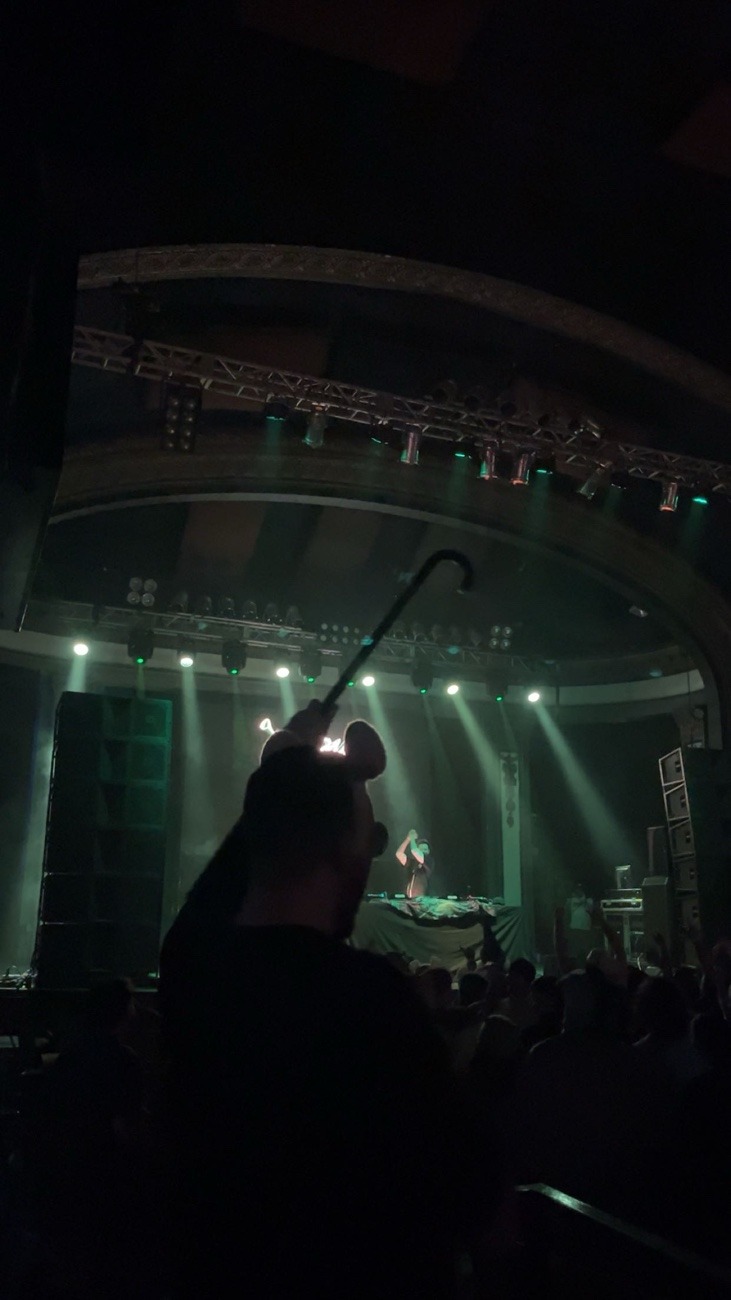
    Green and grey strobing lights add to the visuals and bass amping up the packed house.
    What an experience.

    Rebuilding the Narrative

    This night was a crash course in the reality of the Columbus rave scene. The music was loud, the costumes were killer, and the schedule is packed. We may have missed the final acts this year, but the blueprint is set. As long as they have it again, next March, the costumes will be ready, and we are staying until the house lights kill the vibe.

    Multiple neon colored Shek Animations dance on screen.
    Get it Shrek.

  • His Granite Skin: A Story of Gender and the Wild

    His Granite Skin: A Story of Gender and the Wild


    Best For:

    LGBT+ individuals and allies, transgender and non–binary nature lovers, seekers of self-discovery, wild souls with wanderlust, advocates who hike, and those who find their spirituality in the wilderness, readers and writers of creative works.


    I didn’t go into the woods to change; I went into the woods to finally stop pretending the mountain wasn’t already inside me.

    This Story is Different-

    Welcome to the fourth short story I’ve release since the first one in January 2026. If you’ve been following my work lately, you know my shorts have been dwelling in the shadows of psychological thrillers. We’ve explored the unsettling “getaway spa” of Anonymous Arron, the chilling future–tense human rights violations of Moist. Crunchy. Purple. Then we looked inside the eerie, “perfected” versions of ourselves promised in Something is Amiss in the Clinic.

    But today, we’re stepping out of the clinics and the underground bunkers. We’re stepping into the open air.

    While my previous stories focused on external systems and authoritarian pressures, this piece is about the internal landscape. We are going to unpack identity differently. Not through poetry for advocacy, self growth, or expression. Not creative writing and definitely not through forced procedure. Here comes your identity via a thru-hike with me visually. Backpacking in the open-air with deliberate creative visual descriptions.

    What are you waiting for?

    Let’s find a good spot to setup tent.

    While you watch the embodiment of transition unfold through these words in nature…


    His Granite Skin

    The air at the trailhead had a few distinct scents that excited my subconscious instantly. I noticed fresh pine first happily mixing with the smell of damp earthy soil as I took a few steps into the tree-line.

    I spun around a few times before I figured out which way was which on this hiking app I use. I decided to take to the right after noticing a stream. I could plan to set up camp not too far off it. Before I knew anything else nostalgia grabbed me by the nose entering memory. A flower smell I know too well. My favorite scent to smell in the wilderness: honeysuckle.

    Like the air from a pre-heated oven behind a fan, a gust of wind hits me in the face.

    The wind wants me to go in my way but I’m still hesitant to claim a space. Waiting for when I know. At barely twenty- something, still trying to find my way.

    The trail doesn’t care about the name on my birth certificate; it only cares about the strength of your stride and the honesty of your breath.”

    I swore that I’d pack lightly, I really thought I did. Somehow my pack is heavier than before. The evergreen weight of “she” and “her” cinched tight against my chest. Great. I’m sorry, my binder is tighter than before. Ribs, triple layered nylon, and skin that share a borrowed motel room.

    The first few miles through the summer sun, fluffy clouds, and blue skies were a negotiation inside my mind with identity.

    I walked silently over dirt, root, stone, and path that did not seem to pay any mind or give a care that I was there. The creek beds were dammed up as if to prove the stones had the strength. Holding back the leftover spring showers, April and May had brought.

    Moving one stone at a time carefully I allow the water to flow. Not in a frantic manner, not to cause swell, but a controlled stream with the clarity to do it carefully.

    The wilderness and myself are becoming something else. Hiking out of the shadow of the woman I was expected to turn into. The world saw the hiker for whom he was. A man navigating identity and survival; to the trees, he was just another heartbeat moving toward the sun with them.

    As the path spiraled into the end of summer and the mid-ascent to autumn, the canopy thickened. The canopy thickened into a cathedral of oranges, reds, and yellows. A few spots of green leaves left behind are scattered about. I hear them saying something is left worth holding onto. The last few unchanged summer leaves make me promise them I will see it through.

    The humidity finally dropped low enough I didn’t feel like a reptile who started shedding and is now stuck in his wet layer of skin. The other layer provides something new and a means to an authenticity life. As fragments of my skin begin to itch, peel, and change so get ready!

    Excited to see the new changes as they come. Each night, before I start the fire fueled by dried oak, cherry, and maple branches. I wash my face and study my reflection in the stream shifting a small amount daily. I draw out the changes like my topographical map.

    The seasons transition and so do I, mine is just a geologic change. The softness of the jawline seemed to weather away like debris after a heavy rain, revealing the reliable bedrock beneath.

    There were nights of doubt when the storm changed the trail into a river and my knees burned a fire that no amount of river-chilled water could douse. I camped in the hollows of ancient oaks, listening to the trees breathe, feeling the “she/her” of my past dissolve into the smoke of the campfire.

    The black flies were relentless, a stinging reminder of the skin I was still learning to live in my skin, after shed, but with every mile the distance grew, so did my determination.

    As we gained elevation and the air grew thinner while my spirit grew more dense. The labels I once felt were necessary like a raft, keeping me afloat, staying afloat. When I used to want more turbulence to explore, currents, and higher mountain peaks all I really was looking for was you. By the time the map reached the autumn ridges, I had found a new rhythm: The Hiker.

    The wind up here was fierce, stripping the air from my lungs and what is left of autumn leaves from almost bare trees. The birches and the high-pitched timber squeaked out from his voice an octave so high he has never heard it before.

    Transitioning is less like a construction project and more like an ancient river… eventually, the water wears away everything that isn’t the truth.

    It happened in the quiet moments between the switchbacks; the way my shoulders squared to meet the my gait, or the way my shadow on the sun-bleached rock actually matches the architecture of my mind. I was no longer “presenting” or performing a role for an audience of strangers in the valley; I was simply existing.

    The first frost arrived one morning, slivering on my face. Upon which a fine, dark dusting of hair appeared like lichen on a stone, the natural growth of the wild. I felt the shift in my chest, a resonance that matched the low thrum of the wind through the canyons. I wasn’t a woman anymore, I never was; I’d clung to it for safety. I am a man, carved out of the distance I have traveled.

    I arrived at the summit and saw a crown of winter white, silent and absolute. Standing at the peak, finally the man I see inside is projected outward. I look back at the valley where we would have been 200-something years ago.

    We all know winter has started. The transformation wasn’t a surgery of the flesh, but a shedding of dead things where new will regrow. I walked until the person the world saw finally caught up to the man who had been walking all along, leaving the old names behind in shallow graves in the topsoil of the lower trails.


    Journey Summary

    This expanded narrative explores the intersections of gender identity and the unyielding nature of the wilderness. It avoids clinical terminology in favor of environmental metaphors: changing leaves, weathered stone, and spring showers to illustrate a deeply personal transition.

    Key Highlights:

    • The Weight of the Pack: Symbolizing the societal expectations of my assigned gender at the start of the journey.
    • The Stream Reflection: A motif showing the subtle, natural sharpening of my features as i climb.
    • The Raft Metaphor: Acknowledging the utility of his past identity, while explaining why it was eventually outgrown for a more authentic self.
    • Geological Permanence: Concluding with the image of “bedrock,” suggesting that his manhood was always the foundation, merely waiting to be uncovered by the hike.

    There is a specific kind of magic found dangling your feet even a few hundred feet in the air.
    When the man you were born to be finally takes the lead.


    External Links

    Portfolio.

    Amazon. Wattpad. Etsy.


  • Beyond the Stage: Ohio HB 249 the Threat to Our Right to Exist in Public

    Beyond the Stage: Ohio HB 249 the Threat to Our Right to Exist in Public


    Best for:

    Transgender, non-binary, and gender-fluid individuals; drag performers and artists; Ohio residents, human-rights advocates, activists, and allies who value the fundamental right to exist safely in public.


    Trans Existence is Not an Exhibition

    I am writing this because the ground beneath us is shifting. We often talk about “drag bans” as if they only affect a stage or a performance, but Ohio House Bill 249 is much more insidious.

    This is an attempt to redefine what it means to be a person in a public park, a library, or a local shop. It suggests that simply being ourselves is a “performance” that needs to be regulated, hidden, or criminalized.

    Be Kind with hearts graffiti at mount wood overlook castle wheeling, west virginia
    Be Kind!

    Identity is the skin we live in, not a costume we put on to entertain or offend.

    What is HB 249?

    The Modernization of Erasure:

    Introduced as the “Indecent Exposure Modernization Act,” HB 249 seeks to expand the definition of “adult cabaret” to include anyone whose gender identity differs from their sex assigned at birth.

    While previous bills targeted specific types of entertainment, HB 249 uses vague language that could label a transgender person’s physical presence as “harmful” or “obscene” if a minor is present.

    This is a massive breach of our First Amendment freedoms. It doesn’t just target a show; it targets a soul.

    White paper black letter head with white font “Poeaxtry by Axton” black font on body and majority of doc.
    My Testimony for the Ohio House of Representatives.

    The Proposed Impact?

    Life Under the Microscope-

    If this bill passes, the legal landscape for gender-diverse Ohioans changes overnight:

    • Criminalization of Visibility: Being in a public space (like a library, hiking trail, shopping center, or festival) while “exhibiting a different gender identity” could lead to a first-degree misdemeanor.
    • Felony Charges: In certain circumstances, especially if the encounter is deemed “obscene” by a subjective observer, it could escalate to a fourth-degree felony.
    • The Chilling Effect: This creates a world where neighbors, strangers, and law enforcement are invited to police our bodies, our makeup, and our clothing choices.

    More Than an Attack on Drag Shows?

    The difference between this and “minor protection” laws is that HB 249 targets the individual, not the act. By categorizing gender expression as an “adult-only” performance, the state effectively labels our very lives as inherently sexual or indecent. It implies that a trans man hiking a trail or a non-binary parent at a park is a “legal liability.”

    Green bubble letter Love not Hate graffiti at Mount Wood Overlook Castle in Wheeling, WV 1/7/2026
    Love Not Hate!

    When the law turns a person’s identity into a “performance,” it robs them of their humanity.

    Add Your Voice:

    I’ve shared my testimony, but the Ohio House of Representatives needs to hear from you before Wednesday, March 18th. Tell us in the comments:

    • What are you most concerned about regarding the vague language in this bill?
    • Do you plan on sharing your testimony with the Ohio House of Representatives?
    • How has the community support in Ohio helped you feel safe in the past?

    Your comment may help others find the words for their own messages to the House of Representatives in Ohio.


    Who to Contact & How to Contact Them:

    The Ohio House Judiciary Committee is where the pressure needs to be applied right now.

    • Deadline: Wednesday, March 18th, 2026.
    • Where to find your Rep: Visit the Ohio House District Map and enter your zip code.
    • Key Committee Chairs: Reach out to the Primary Sponsors, Angela King and Josh Williams, to express your opposition.
    • The Message: “I am a constituent, and I am calling to urge you to vote NO on HB 249. This bill is a violation of the civil rights of transgender and gender non-conforming Ohioans and creates a dangerous precedent for government overreach.

    Freedom isn’t found in a closet; it’s found in the courage it takes to walk out the front door.

    Protecting the Future of Ohio:

    HB 249 is a move to push us out of public life by using fear and legal jargon. It’s a violation of our basic rights as Ohioans. We are asking the House to see us as people, hikers, poets, friends, parents, and neighbors. Instead of just seeing our identities as political talking points. We deserve to exist without being treated as a danger to the children we care for and the communities we love.


    Protect Our Identities:

    Please share this post to protect our community.

    Why share?

    The vote is this Wednesday and many are unaware of the bill’s broad reach.

    You have the potential to get more people involved with reaching out to Ohio’s representatives and therefore a bigger chance they will listen. E

    Everyone has a right to life, liberty, the pursuit of happiness. This infringes upon all three for transgender and gender nonconforming American citizens and migrants seeking asylum.


  • Something is Amiss in the Clinic

    Something is Amiss in the Clinic

    Welcome to the third story in my collection of ten. A night-shift intake nurse at a last-resort psychiatric clinic has seen too much to stay silent. Patients arrive broken. They leave recovered… too recovered. Scars gone. Accents erased. Handwriting changed. Administration calls it breakthrough treatment. The nurse calls it something else entirely. What happens in the sublevels stays in the sublevels. Until now.

    Author: AnonNurse22

    Subject: What “Continuity Treatment” Really Means

    ~~~~~~~~~~~~~~~~~~~~~~~~~~~~~~~~~~~~~~~~~~~~~~~~~~~

    Hello. I have debated posting this for months. My belief in the Hippocratic oath is the only reason I am pressing “post” at all.

    I am writing anonymously because every employee contract here contains strict “information containment” clauses and non-disclosure agreements. I am posting from a burner phone on a public connection. I am no longer certain which coworkers are still the people they once were… or which ones have already been replaced.

    The clinic advertises itself as a last-resort treatment center. Severe depression, treatment-resistant schizophrenia, violent instability, dissociation disorders, anything that frightens families badly enough that they begin using phrases like permanent solution gets routed here. Insurance rarely covers treatment, but government assistance programs often do, which is presented publicly as compassion.

    Patients arrive sedated more often than conscious. Intake photographs are taken under harsh lighting, a neutral expression required, a placard held at chest level displaying a treatment authorization number. I once believed the photos were for identification. Now I know they are used for calibration.

    The building is enormous above ground, yet most of the facility extends downward. Elevators labeled with simple floor numbers continue far past the lowest level shown publicly. Access requires rotating clearance codes. Nurses are not supposed to know them, but eventually every long-term employee does.

    The first thing that unsettled me was recovery speed.

    Patients diagnosed for decades, people whose files filled entire storage shelves, were discharged within weeks. Families cried, hugging them, thanking staff for miracles. It is easier to believe in medical breakthroughs than in something else.

    Still, details would not sit quietly.

    A woman admitted for chronic self-harm returned from a restricted procedure wing with both forearms unscarred. Not healed, not faded, simply never injured. Her intake photos showed years of damage. The discharge photos did not. Administration labeled it “archival image corruption.”

    A man with a strong regional accent returned speaking in a flat, locationless cadence. His parents laughed nervously and said he sounded “healthier,” repeating the word several times as if reassuring themselves.

    Handwriting samples changed. 

    Allergies disappeared. 

    Dietary restrictions changed entirely.

    I was told psychological healing causes behavioral shifts. That explanation might account for personality changes, but not anatomical ones.

    One night I escorted a sealed cart to Sublevel C. As the elevator descended, the air grew warmer, faintly metallic. The corridor lights hummed in a way that pressed behind my eyes. Doors were numbered but unmarked. The staff there wore lab clothing without institutional logos.

    A door opened briefly as I passed. Inside, I saw a patient I recognized from intake lying unconscious under surgical lighting. Standing beside the table was another person identical to them, freckles in the same pattern, breathing slowly, surrounded by monitoring equipment.

    I convinced myself exhaustion causes hallucinations. For several nights I repeated that explanation.

    Then I began noticing the containers.

    Large refrigerated units arrived overnight labeled “nutritional reclamation product.” No outside vendor appeared in our supply logs. Everything was processed internally.

    One evening a container seal failed during transfer. A dark fluid seeped along the seam and dripped to the floor. The smell reached me first, warm, heavy, sweet in a way that did not resemble spoiled meat, something fresher than that. My stomach turned so violently I had to brace myself against the wall, swallowing repeatedly just to remain standing. No incident report was filed. Within minutes the floor was sanitized. By the next shift, there was no record anything had spilled.

    Later, passing an open processing room, I saw stainless tables, grinders, packaging lines, portions weighed and vacuum-sealed with distribution codes that matched the cafeteria shipment logs exactly. I made it to a stairwell before vomiting.

    The realization came weeks later in the cafeteria. I was eating halfway through a meal before noticing the same faint sweetness beneath the seasoning, the same metallic aftertaste I had smelled in Sublevel C. I stopped chewing but could not immediately spit it out. That hesitation still makes me sick when I remember it.

    A month after my first visit downstairs, my badge was quietly granted temporary clearance to Sublevel D. I had not requested it.

    Sublevel D resembles a manufacturing floor more than a hospital. Technicians monitor screens comparing biometric data between two bodies at once. The word synchronization appears constantly. Patients are heavily sedated.

    From a storage alcove I watched a patient’s biometric profile scanned while an identical body was adjusted by surgical teams. Skin tone corrected. Posture aligned. Minor asymmetries removed. Only the second body opened its eyes.

    Beyond that wing, a temperature-controlled corridor receives the same refrigerated carts I had seen upstairs, full when entering, lighter when exiting. Intake averages over one hundred patients per month. Cafeteria distribution output matches the caloric yield almost exactly. Nothing here goes to waste.

    Later that week, I saw the same “recovered” patient discharged to waiting family members.

    Consent forms exist. They are titled Radical Continuity Treatment Authorization and buried beneath routine procedural signatures. A technical appendix outlines “resource reclamation following biological redundancy.”

    Some patients do not understand what they sign. Some are too sedated or pressured. But some know exactly what the procedure entails. I have seen patients request it, writing letters explaining they are glad the version returning home will be “the one you always hoped I could be.”

    Staff are trained to use precise language: pre-treatment individual, post-treatment individual. No administrator ever says the word death. On paper, the clinic has none.

    Leaving employment triggers mandatory cognitive exit evaluations. I have seen coworkers depart and return days later calmer, quieter, their clearance photos showing minute facial adjustments I cannot unsee.

    If this post disappears, assume monitoring extends further than policy states.

    There is one more thing people should understand.

    The individuals who return are not flawed copies. They are optimized. Emotional volatility dampened, compliance increased, distress responses reduced. Families describe them as happier, easier, finally themselves. The phrase repeats constantly.

    The people who entered the building do not leave it.

    My shift begins again in two hours. Tonight’s intake authorization list includes a name I recognize, a senior nurse who trained me when I first arrived. Their clearance level was higher than mine last week. The system now lists them as approved for continuity treatment.

    If further updates appear, I still have access. If they do not, and someone you love returns from treatment smiling too evenly, standing a little too still, eating without ever asking what is being served, remember this:

    Recovery and replacement look identical from the outside.

    — Anon Nurse 22