The holidays have a strange way of resurfacing old versions of ourselves. The child who waited. The belief that good things arrived simply because we hoped hard enough. For many of us, that version feels distant now, replaced by a quieter, more guarded endurance.
This poem is not about celebration. It’s about survival during a season that insists on cheer, even when hope feels rationed. Day two of writing and posting one poem a day is about naming that shift honestly, without pretending it doesn’t exist.
Hopeless Holiday
This year’s “holiday cheer”
is nostalgic in a way I’ve come to
fear.
Though,
I used to wait for Santa,
sitting still, filled with untamable
hope.
Now it seems the hope he brings
is more about having at least one thing
left to hope for at all.
Being hopeless on Christmas
would have to be worse than this.
Poet’s Note
This poem isn’t about Santa, and it isn’t about religion or tradition. Santa exists here as a symbol of effortless hope, the kind we’re given as children without conditions, without proof, without fear of disappointment.
As adults, hope changes. It becomes smaller, more deliberate. Sometimes it’s not about joy at all, but about refusing to let everything go dark at once. This piece lives in that space, where hope hasn’t vanished, but it no longer arrives freely.
Hope doesn’t always look like joy. Sometimes it looks like refusal. Sometimes it looks like staying present through a season that hurts, instead of opting out completely.
This poem holds that tension without resolving it, because not everything needs to be resolved to be honest. Day two is about acknowledging that hope can shrink and still matter, especially during the holidays.
Alexander Limarev, multidisciplinary artist, mail art artist, poet, visual poet and curator from Russia/Siberia. Participated in more than 1000 international projects and exhibitions. His artworks are part of private and museum collections of 78 countries.
His artworks as well as poetry have been featured in various online and print publications including BUKOWSKI ERASURE POETRY ANTHOLOGY (Silver Birch Press), SUPERPRESENT: A MAGAZINE OF THE ARTS, FLORA FICTION LITERARY MAGAZINE, HOME PLANET NEWS, NEW FEATHERS ANTHOLOGY, ANTI-HEROIN CHIC, ROUTE 7 REVIEW, UNLOST: journal of found poetry & art, #RANGER MAGAZINE, MAINTENANT etc.
Alexander Limarev is the 2024 Creatives Flash Nonfiction Contest winner in the visual art category at the Fort William Mountain Festival – Scotland; 2026 Best of the Net Anthology Nomination in the visual art category – USA.
How art is viewed
Artwork as viewed by Alexander Limarev is the way to speculate upon and explain to yourself such universal existential problems as a person’s life, double standards and their influence on individuals, public loneliness, social impotence, search of God, resistance to Evil. He thinks of his artwork as inner monologues developing over a particular thought or event and thus resembling nonsense, stream of consciousness in visual art, based on paradox, absurd, broken causative-consecutive and chronological connections, reflecting discrepancy, injustice of the outer reality. However, decorative artworks are a happy exception.
Becoming an artist
Becoming a visual artist came naturally, as creative process was an integral part of my life. It was not just a desire for self-expression, but also an attempt to understand how the world around me was structured. I sought the hidden essence of things. Art became my resistance to conventions and the dull, relentless pressure of society, which emphasized the importance of “practical and useful” professions. My desire to exist outside the system intensified as I learned about the fates of Soviet dissident artists who fought for the right to free expression. I began to understand that art is not just about creating artistic objects, but a powerful tool for exploring the human soul, society, and life itself, and that visual art is my personal form of protest against the constraints imposed by an indifferent and aggressive majority.
I chose this path to create a space where I could freely explore and transform the surrounding reality. My creativity became a way to delve into phenomena that are difficult to grasp through rational thought. I instinctively felt that creativity was a way to understand myself and the world around me.
Thus, I formed as a visual artist, not because of circumstances, but in spite of them. Art became an existential escape from false reality and an opportunity to glimpse into the depths of the human soul. I chose this path to dissolve the boundaries of perception and to show that even under strict censorship and limitations, one can find freedom in creativity
Links
It is very easy to find information about me on the Internet. Just type “Alexander Limarev” into any browser or search engine. Since 2012, my work is represented quite extensively, and there may be some earlier pieces as well. I currently do not have full access to this information.
Email poeaxtry@gmail.com for your own creative spotlight! And check back for a more in depth creative look into Alexander Limarev!
Every so often, a simple idea creates a creative avalanche. I’m hoping that this will be that.
Write a poem a day.
But do it for one hundred days.
Then share it publicly.
No paywall, no panel of judges, no polished submission packets, no gatekeeping. Just writers showing up where they are, writing through whatever weather they’re standing in.
I’m joining in.
Not because I want more pressure, or because I think productivity equals worth, but because poetry thrives on repetition, attention, and witness. A poem a day doesn’t have to be perfect. It has to exist. It has to respond. It has to mark time. It is practice, which we all have been told makes perfect!
For indie poets, marginalized writers, and creatives working outside institutional publishing, challenges like this matter. They create visible momentum. They pull poetry out of private notes apps and put it back into conversation. They remind us that poetry isn’t precious, it’s necessary.
This post documents my entry into the challenge, and it begins with day one, where else?
Day One of One Hundred
“Ice”
It’s cold outside,
my desire is on fire,
something more just out of
r
e
a
c
h.
The plows came through these
Appalachian city streets,
though the ice stayed
Immigrant mothers pray
for their brothers,
others try to feed their
families.
No matter the kind,
crushed ice
is my favorite.
Poet’s Note
This poem lives in the overlap between weather and policy.
Between what freezes naturally and what is enforced.
Ice shows up twice here. Once as winter, salt trucks, plows, and streets that look cleared but still aren’t safe. The other time as ICE, immigration enforcement, the quiet terror that doesn’t melt when the roads do.
Crushed ice is impact. It’s aftermath. It’s what happens when something large and heavy moves through a place and leaves fragments behind.
I didn’t want to explain the metaphor inside the poem. I wanted it to sit unresolved, because that’s how it exists in real life. Some people experience winter. Others experience surveillance. Sometimes it’s both, at the same time, in the same city.
Why This Challenge Matters to Me
Writing a poem every day for one hundred days isn’t about proving discipline. It’s about practicing attention. About letting the world interrupt me and answering back in language.
As an indie publisher, poet, and community builder through Poeaxtry and The Prism, I care deeply about visibility for small voices, especially voices that don’t get invited into traditional literary rooms. A public challenge hosted on a platform like Threads lowers the barrier to entry. It lets poets write in public without asking permission.
This is also about sustainability. One poem a day is manageable. It fits between work shifts, hikes, grief, anger, and ordinary survival. Over time, those daily poems become a record, not just of craft, but of living through a specific stretch of history.
If you’re participating too, or considering it, this is your nudge. You don’t need permission. You don’t need an audience. You just need to start.
What is something others do that sparks your admiration?
Admire What Matters
There are people who make you stop, just a little, because of the way they move through the world. They are the ones whose actions are impossible not to notice, even if they’re subtle. I’ve spent time thinking about what sparks my admiration. Not romantically. Not something to flex for show. All that will fade .
Artistic talent
I admire artistic talent, especially when it looks to come effortlessly to them. I can barely draw a stick figure, and my doughnuts barely hold their sprinkles, yet I watch people wielding brushes, pencils, or clay and feel a quiet awe. There’s something about creation, the courage to put something out there, that’s magnetic.
The knight in tin foil
I admire people who stand up for others, especially those who can’t or won’t defend themselves. When someone is being targeted for things beyond their control, the courage it takes to speak or act on their behalf is something that stays with me. It’s messy, it’s human, but it is real bravery in action.
Patient People
I admire patience, even if it’s just a performance, a practiced calm in the middle of chaos. There’s a rhythm to waiting, to tolerating, to letting things unfold. I will never understand how some people make it look effortless. I know it isn’t for me for sure.
idgaf
I admire those who don’t care what anyone else thinks. No not the kind that says it repeatedly but still hesitates. We hate a broadway wanna be. People who actually move through life free of that weight, making choices for themselves. It’s not easy for everyone. But it is a quiet rebellion that inspires without needing to shout.
Kind Souls
I admire quiet kindness, the kind not everyone will notice. It is given to injured wild animals, stray dogs or cats, and even the people society pushes to the side. There’s an authenticity in those moments, in lifting up the “underdog,” that leaves a mark longer than any grand gesture ever could.
Indie
I can’t forget the admiration I hold for indie creatives, the people who wake up, make, and try. And not for instant fake fame or clout. People who just feel they have to. The ones who experiment, who fail, who rise again, and who light the way for others in the process.
These traits, these actions, these quiet strength. They remind me for one that admiration isn’t about perfection. It is witnessing integrity, courage, creativity, and generosity in motion. And the more we notice, the more we can embody them in our own lives.
What are your favorite physical activities or exercises?
Finding Joy in Movement: Why Physical Activity Matters
Staying active doesn’t have to mean being uncomfortable in a crowded gym. Especially if you’re like me and they make you feel like everyone is staring right at you. For me, the joy of movement comes from freedom, fresh air, and the quiet satisfaction of feeling my body work in ways that make sense. Some days, that means exploring the wilderness, gliding across water, or feeling the burn from resistance bands at home. Each activity has its own rhythm, its own kind of therapy, and its own reason I keep coming back.
Hiking: Walking Into Calm and Clarity
Hiking has always been my escape and my reset. The perfect blend of adventure, exercise, and self care. Trails lined with autumn leaves, the crunch of snow beneath my boots, or the earthy smell of the forest after rain. It ismore than just cardio. This is meditation in motion. Every incline challenges my endurance, every rocky path tests my balance, and reaching the summit gives a sense of accomplishment that no treadmill can replicate.
Hiking connects me with the outdoors in a way a gym never could. The open air, the sun on my face, the sound of water running or birds calling. The ability to collect rocks too! It really is a full-body experience that nurtures mind, body, and soul.
Swimming: Strength and Mindful Movements
Water has a magic of its own. Swimming isn’t just exercise; it’s a rhythm, a flow that eases tension and strengthens muscles without pounding joints. I love the quiet isolation of a pool or a calm lake. Letting your body feel the water engulf it. It’s a workout that also clears the mind, letting thoughts drift as easily as my body through water.
Plus, swimming teaches patience, timing, and breath control. It’s a meditative discipline, one that makes me feel strong, centered, and refreshed all at once.
Kayaking: Power, Peace, and Perspective
Kayaking combines strength, coordination, and a little bit of adventure. Paddling through calm waters or along river bends is meditative, but it also gives a satisfying upper-body and core workout. I love the tactile feedback of the paddle slicing water. The rhythm of each stroke, engaging my entire upper body in unison.
Being out on the water is also a perspective shift. There’s nothing like seeing a familiar landscape reflected in a river or lake to remind you that exercise can be about more than calories. It’s also about wonder, movement, and presence.
Home Workouts: Resistance Bands and Freedom from Gym Anxiety
I’ll admit it gyms aren’t my favorite. There’s something about the feeling of everyone watching, or that subtle pressure to “perform,” that drains the fun out of working out. That’s where my full-body resistance band set comes in. You can anchored to doors, a bar, or different hand/ ankle straps. Providing me a total-body workout at home, in private, and at less money than a gym membership for just two months .
Bands aren’t just convenient they’re versatile. From squats to rows to chest presses, every muscle gets attention without the intimidation of a crowded gym. It’s empowering to feel strong and capable while keeping my workouts entirely my own.
Moving Forward: Finding Your Flow
The truth is, the best exercise is the one that makes you want to keep moving. Whatever one you enjoy. Hiking, swimming, kayaking, and resistance band workouts are my favorites because they blend physical challenge, mental clarity, and a sense of freedom.
If you’ve been hesitant to try something new, think about what excites you outside the gym walls. Maybe it’s a trail you’ve never walked, a lake you’ve never paddled, or a quiet corner at home with bands ready to stretch and strengthen you. Movement is personal, and your perfect routine might surprise you.
Ready to Move With Me?
Poeaxtry_ isn’t just about poems and crafts. We are also about living fully, creatively, and intentionally! With that in mind, we’d like to extend an artist, author, or creator spotlight offer, as well as a second spotlight to showcase your work. Submit this form or email poeaxtry@gmail.com and ask for more information on Indie Spotlights. Free!
On December 4, 2025, I dramatically layered up. I’m saying multiple layers, coveralls, a heated jacket, hiking shoes, 3 pairs of socks, multiple sweaters, and more! Then I headed out the lower gorge of Conkle’s Hollow State Nature Preserve. Of course I had to have friends with me so Skylar, the baby, strapped in. We found something rare… peace. No chatter, no other hikers, just the hush of winter slowing everything down. Literally not one other car at Conkles hollow beside a forest employee is UNHEARD OF!
We followed the path up to the first waterfall, just past where the concrete path ends. From there the trail becomes rougher. A little too uneven, icy, and rocky. Totally not ideal when you’re carrying or walking with a little one. So we paused the adventure there, grateful for what we saw, and turned back. Safety first, always.
The Grotto
The gorge in winter has a ghostly hush to it. Frozen trickles, patches of ice along the creek, stones dusted with snow, frost clinging to moss and rock. And we just got a nice bit of snow. To me it felt like walking inside a memory, or a dream. The cliffs loomed high, silent sentinels watching over the narrow floor beneath.
Even with the smaller hike (1.2 miles), coupled with the 29 degrees Fahrenheit the baby didn’t seem to mind. I felt the weight of quiet, with the kind of calm that demands you slow your breath, and your thoughts. That alone the silence, the cold, the hush, honestly made the hike worth it.
Even if you account the 5+ feral and ethereal gut wrenching screams I let out. I got the baby to join but Sky wouldn’t even try.
Frost Flowers
I only just learned about “frost flowers” earlier in the morning the day of this hike! These are surreal little winter magic flowers. What you’re seeing isn’t a true bloom, but thin ribbons of ice exiled from plant stems. This happens when cold air hits sap‑rich plants while the ground is still warm. Water gets drawn up from the roots, freezes in the stem, cracks it open, and then slowly seeps out and crystallizes in delicate, sheets of ice… fragile and fleeting, often gone by mid‑morning once sun or warmth touches them.
A Month Ago Rim Trail,
11/8/2025
A few weeks earlier, on November 8 my momma’s death anniversary, and a day I dedicate to celebrating her. Kylie and I walked the rim trail on the top of the rock walls at Conkles Hollow. The contrast between that high, exposed cliff line covered in early Autumn bliss and the now frozen ravine beneath struck hard.
I remember sitting on a sandstone edge, dangling my legs over the drop, taking in the leaves changing colors for mile in the forest, valley. Up there the wind carried memories, grief, quiet gratitude. Down below the gorge held silence and survival. And I now got to see just how high my seat really was. I basically had to do a backbend to see the top of the cliff from the gorge trail!
Walking the rim gave me perspective… on loss, on smallness, on beauty. Walking the gorge later with Skylar gave me gratitude… for warmth, life, safety, and the chance to bring new memory into old stone.
Why Conkle’s Hollow Means Something
Deeper
Conkle’s Hollow lies carved into the ancient bed of Black Hand Sandstone. These formed roughly 350 million years ago when this land was under a shallow sea. Over time, sands and silts compressed and hardened. Later Earth’s shifting gave rise to uplift, and water carved deep gullies and gorges into this sandstone. And that erosion sculpted the cliffs and narrow ravines you see today.
Cliffs of nearly 200 feet tower above a gorge so tight in places it’s only 100 feet across. Inside the gorge the micro‑climate supports ferns, hemlocks, hardwood trees, mosses and wildflowers. Deep shade, cool air, damp rock, and sometimes timelessness.
The preserve was purchased by the state in 1925, and dedicated as a protected area in 1977. This means these ancient cliffs and narrow depths are preserved, free for folks to walk through and reflect on age and time.
What to Know: Tips + Safety for a Winter Baby Hike
Lower Gorge trail: mostly paved or flat at first, but rougher after the concrete ends. Icy snow and uneven footing make anything past the first waterfall risky when carrying a baby or holding their hand. Dress in warm layers! I had three sweaters, three pants, and coveralls. Under a heated jacket. Hiking shoes with grip are essential when snow or ice coat stones or wood. Stay on marked trails. Cliffs rise high up to 200 feet and rims above the gorge are beautiful but dangerous when wet or icy. In winter the gorge is almost silent. So no crowds, no summer moisture but, that also means less water from the falls, and colder, steeper, slick-er terrain.
The “waterfall” pp
Nearby Trails & Bonus Stops Continue the Hocking Hills Journey
If you liked Conkle’s and want to wander more in the region, check these spots:
Cantwell Cliffs State Nature Preserve about 7 miles from Conkle’s Hollow on S.R. 374. Deep gorge, rugged terrain, canyon-like passageways and spring wildflowers. A great “next time” option for us since we had planned to go there before I became starved!
Rock House State Nature Preserve a “cave” cut into Black Hand Sandstone cliffs. Tunnel‑like, dramatic, offers a contrast to open gorge and rim walks.
Good for slow days, clear skies, or scratching your itch for hidden magic.
Reflection Loss, Life, Little Feet on Old Stone
Walking those cliffs and that gorge reminded me just how small I am… how fleeting we all are. Rock 350 million years young, carved slow over eons by water and time?! Well now compared to that, my grief and memories feel small.
Walking with the baby and my buddy down that gorge, past icy stones and silent walls, I felt something bigger. A bridge between the ancient, the lost, and the living. A chance to carve a new memory in the old stones of the world.
That’s the power of this land. It is timeless but alive. Harsh but beautiful. And it allows you hush your grief into the quiet of a winter gorge, and come out lighter.
Shifting the Prism’s Collaborations Into a Quarterly Publication
The why behind Collaborations
I launched community collabs with one goal to create publications for marginalized voices to be heard. (I wanted to help their art be seen too, of course, and their business be found.) To be read by others would then be able to find voices similar to their own. Themed calls gave structure, that I thought would help. However, I like art when the creator feels compelled to create it, not when it’s created per a submission theme.
Why I’m Changing the Model
It became clear that themes sometimes act as invisible boundaries. They shaped not only what people created, but who felt comfortable submitting. Themes feel a bit too much like gatekeepers, for my comfort. Hear me out, you had to fit the art, poem, or essay in like a key based on theme.
That contradicts who I am or whom I want to be. I want this space to belong to the creators themselves. I want to invite people to bring what’s real. What’s needed, even if it doesn’t fit.
So I decided: no more themes. Instead, I’m opening Poeaxtry up to open‑theme quarterly magazines. I was already planning a Quarterly & this fits the bill.
Any suggestions on names? Guesses welcome!
This change isn’t a retreat. It’s expansion. By removing themes, the door stays open wider for more voices, more art, more perspectives. By increasing frequency, I can amplify more people across time.
rights stay with creators: you keep your work. Poeaxtry curates and publishes but does not claim ownership or restrict distribution. Contributor bios, links, and photos welcome!
Free ads space to minority‑owned shops, indie authors, small businesses to support community visibility.
Digital magazine format means no forced downloads Eliminates 4 bulky PDFs a year. Always Viewable online Readers & Contributors now can share by link
2026 Quarterly Schedule
(Submission + Publication Dates may change slightly!)
Q1 2026 (First Edition)
Taking submissions: now– Feb 12, 2026
Launch: Mar 8–15, 2026
Q2 2026 (Second Edition)
Taking submissions: March 9-May 5th
Launch: Jun 5–12, 2026
Q3 2026 (Third Edition)
Taking submissions:Jun 5 – Aug 5, 2026
Sep 5–12, 2026
Q4 2026 (Fourth Edition)
Taking submissions: Sep 5 – Oct 31, 2026
Launch: Dec 5–12, 2026
Note: The first edition will include existing submissions from the original themed collabs. It will also include any new open-theme submissions received during the submission window. Future editions will be fully open‑theme. The last quarter is stretched out because of holidays, birthdays, and death days.
What This Means for Contributors & Community
You’re free to send your work when you feel ready. This includes poetry, art, essays, and prose, just like before, just no need to match a theme. The spotlights from the website will be shared in the quarterly as well. The magazine lives online, shareable by link. More frequent releases = more opportunities for visibility, community building, connection.
What Happens to the Original Themed submissions?
Their submitted work will be included in the first quarterly edition as long as they consent.
No more waiting. Just art, voices, visions.
Your Voice Matters, Always
Poeaxtry was born from a belief that the best art comes from the darkest places. That minority voices of every difference have stories and voices that matter. Lastly, to build a community for all of us to share our creations with each other and the world.
This shift isn’t a change of heart, it’s evolution. As the world shifts, as art shifts, as voices shift, we must too…
Shift.
If you’re a minority artist, an ally writer, a survivor turned storyteller. Send in your voices or visions to Poeaxtryspoetryprism@gmail.com or submit this form.
Small business owners, entrepreneurs, indie-creatives, communities, etc. send your ads to the above email or form as well!
To have a Spotlight post on the website fill out this form or email Poeaxtry@gmail.com To review ebooks and other digital items in exchange for honest reviews, use this form
Thank you for being here. Let’s start building community.
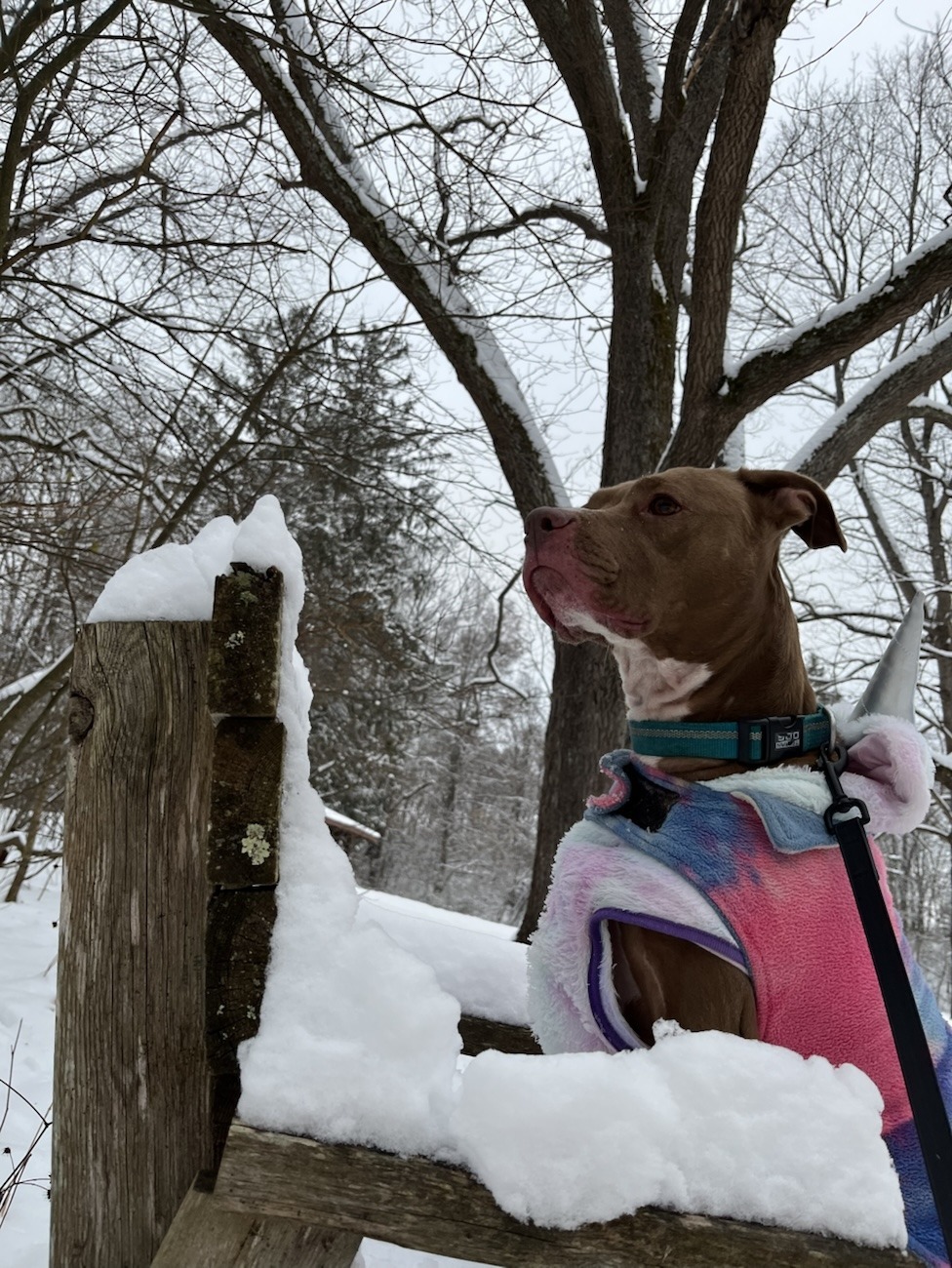
Luna and I slipped into Granville just after sunrise. The cold air would have been biting at my cheeks. However, I had a ski mask. 3-5 inches of snow dusting everything around us. The ridge-and-valley trail, rated moderate on All Trails was short enough to feel manageable even under slick, icy underfoot. This trail wound us into a hush only a heavy winter snow brings. We stepped carefully, Lunas dog boots crunching against snow and hidden ice. Yet, the forest around us hushed, still, listening.
This was too good to pass up! I didn’t make it but i definitely laughed!
The old tennis courts near the trailhead are gone now. Where once we walked around the edges of morning tennis matches, now sat silence, empty ground, and memory. That absence felt right, emptied for the woods to reclaim.
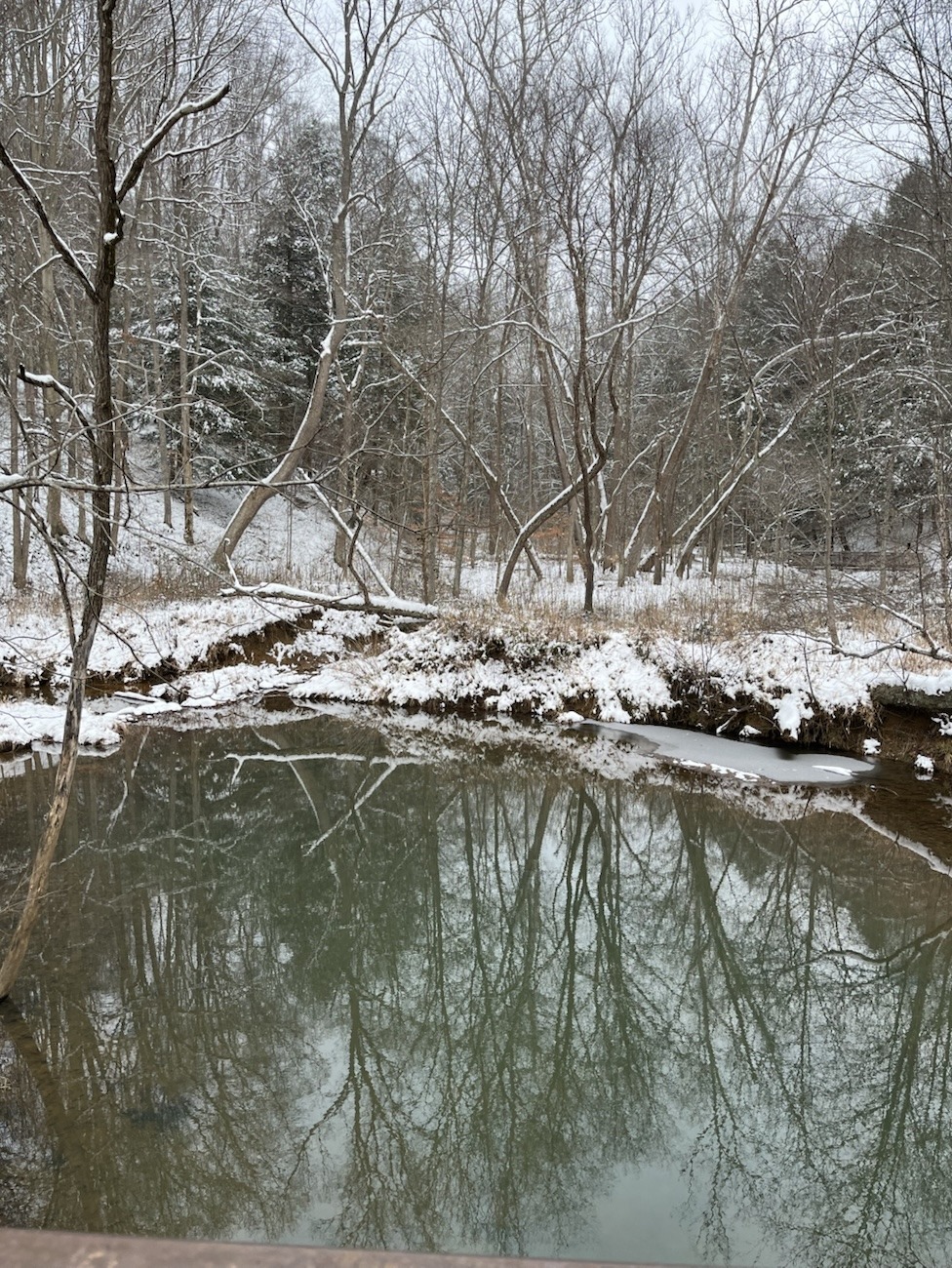
A snow covered bridge
Ice underfoot made each step deliberate, thoughtful. That crisp quiet … that grey-blue dawn light pooling between tree trunks … felt sacred. We moved slow, careful, but alive nonetheless. The valley hollows, frozen underbrush, skeletal trees leaning like old bones over snow, all whispered winter’s poetry.
I just love looking at snow
What this trail gives, and what snow shows
The loop of Robert’s Ridge and Valley Trail sits close, compact, modest in distance, but in winter it feels larger. Snow shifts perspective, makes what’s familiar uncanny. In warmer months this trail echoes with birdsong, rustling leaves, soft earth underfoot. It also boasts tons of wildflowers! Snow hush replaced that, turning the woods into a slow, listening world. The winter transform pushes you into presence. Now every breath, every crunch, every cautious step feels sharper. It becomes meditation with boots instead of a casual walk.
The cold can’t keep me down
Luna and I kept quiet much of the way. The world was stripped down, clean. Cold air in our lungs, slow steady pace. Felt like winter was whispering a poem we can’t quite write yet.
Other nearby woods and quiet places worth your next wander
If you like to explore, here are a few other Granville-area spots that hold magic. No pretension, just land and history and timing.
Denison University Biological Reserve
350-acre reserve on the north end of Granville, open to the public dawn to dusk. Offers a well-marked trail system through varied habitats… woodland, wetlands, springs. This place is perfect for longer walks or quiet afternoons. It is a local favorite when I want more than a quick. This is a deeper walk, richer in flora, maybe a bird or deer sighting if you’re quiet, and loads of fungi!
Fanchion Lewis Park (aka Ty Tawel Farm woods and pond)
43-acre pocket of woods with a pond, forest trails, easy loops. This is a favorite of ours as well ,and is good for quick resets or a short afternoon wander. Think simple, friendly trails, nothing demanding. A great choice for when you want calm without commitment.
A note under your boots, ancient shapes in the hills
If you wander east in town you’ll find Alligator Effigy Mound, a prehistoric earthen sculpture carved by early Indigenous people long ago.
This area of central and south central Ohio is historically rich with Native American artifacts. I have frequently visited the Earthworks in Health, Ohio as I lived on the same block for a year. I’ve visited Cross mound near Lancaster, Ohio. As well as the Serpent mound in Peebles, Ohio. A mound in Cedarville, Ohio. Infirmary Mound in Granville, Glenford Preserve in Somerset and others. When visiting these ancient sacred places please be respectful and kind.
Trans‑Masculine Pioneers Through History: Power, Purpose, and Legacy
Trans and trans‑masculine people have long shaped the world in ways that go beyond survival. These figures have made significant contributions in medicine and public health. They have also excelled in military service, sports, arts, and community building. Their lives and achievements are worth celebrating. Their stories remind us that trans masculinity is not a modern invention, but woven deeply into global history.
James Barry — Surgeon & Medical Innovator (British Empire)
Dr. James Barry (c. 1795–1865) was a remarkable military surgeon in the British Army, born in Ireland. Barry performed one of the first known Caesarean sections. In this operation, both mother and child survived. It was a huge medical feat for the time. He was deeply committed to improving hygiene and sanitation in military hospitals. Barry pushed for better medical care for soldiers and local populations. Barry lived publicly as a man, signed as “Dr. James Barry,” and challenged early-19th-century gender norms while saving lives.
Why he matters: Barry’s identity didn’t limit his contributions. Instead, he used his position to heal, reform, and innovate in colonial-era medicine.
Alan L. Hart — Radiologist, Tuberculosis Pioneer & Writer (United States)
Alan L. Hart (1890–1962) was a pioneering radiologist who helped revolutionize early detection of tuberculosis. He introduced the use of X-ray imaging for TB, greatly improving public health efforts. Beyond medicine, Hart was also a writer, weaving themes of identity, science, and healing into his fiction. He lived as a man for decades, and his lifelong work saved lives and pushed medical boundaries.
Why he matters: Hart’s transmasculine identity is inseparable from his legacy. He was both a healer and a storyteller. His commitment to public health left a measurable impact.
Karl M. Baer — Writer, Reformer & Gender Pioneer (Germany / Israel)
Karl M. Baer (1885–1956) authored Memoirs of a Man’s Maiden Years, reflecting on his childhood, identity, and transition. In the early 1900s, Karl underwent what is widely recognized as one of the first gender-affirming surgeries. He gained legal recognition as male. Baer also worked with Magnus Hirschfeld, influencing early sexology and social reform. His life bridged personal narrative with political and social change—he was a social worker, suffragist, and advocate for marginalized people.
Why he matters: Baer’s work helped lay the foundations for gender-affirming care and gender rights. His story is both deeply personal and socially transformative.
Michael Dillon — Physician, Ethicist & Medical Trailblazer (United Kingdom)
Michael Dillon (1915–1962) was a British physician. He became one of the first trans men to medically transition using testosterone. He wrote Self: A Study in Endocrinology and Ethics, exploring gender identity, medical decision-making, and ethics. Dillon’s work helped shape early frameworks for trans healthcare and medical ethics.
Why he matters: He merged professional rigor with personal courage. His life and writings helped build compassionate, evidence-based approaches to gender-affirming care.
Amelio Robles Ávila (1889–1984) was a Colonel in the Mexican Revolution. He lived openly as a man from his mid-20s, and his military leadership was recognized by the Mexican government. Robles earned a Revolutionary Merit Award and is celebrated in Mexico for bravery and service while living authentically.
Why he matters: Robles demonstrated the intersection of trans identity and revolutionary activism. He fought for justice and recognition. He left a lasting legacy in Mexican history.
Lou Sullivan — Activist, Community Builder & Writer (United States)
Lou Sullivan (1951–1991) was openly gay and trans at a time when that was revolutionary. He created resources for FTM people. He built peer support networks. Lou clarified that gender identity and sexual orientation are distinct but overlapping. His diaries and posthumously published writings reflect hope, insight, and advocacy.
Why he matters: Sullivan built community structures. He fought for medical recognition. He articulated trans masculinity in ways that continue to guide activism today.
Reed Erickson — Philanthropist & Trans Movement Fundraiser (United States)
Reed Erickson (1917–1992) founded the Erickson Educational Foundation (EEF), which funded early transgender medical research, community outreach, and publications. His work expanded medical care and education opportunities for trans people in the 1960s–80s.
Why he matters: Erickson’s philanthropy helped create infrastructure for trans communities and ensured early access to gender-affirming care.
Albert D. J. Cashier — Soldier & Union Veteran (United States)
Albert Cashier (1843–1915), born Jennie Irene Hodgers, served in the 95th Illinois Infantry during the U.S. Civil War. Cashier fought bravely, lived as a man for decades, and was respected by his community. He exemplified heroism, integrity, and authenticity.
Why he matters: Cashier’s dedication to country and self demonstrates courage in both service and identity.
Zdeněk Koubek — Athlete & Gender Trailblazer (Czechoslovakia)
Zdeněk Koubek (1913–1986), born Zdena Koubková, was a world-class runner in the 1930s, setting records and winning medals. In 1935, he publicly announced he would live as a man and continued to pursue life openly in Prague. His story expanded conversations around gender in sports.
Why he matters: Koubek’s athletic excellence and public transition challenged norms and left a legacy of courage and change.
Why These Histories Matter
Trans identity is not new: These men and transmasculine figures span centuries and continents. Their impact was positive and varied: Medicine, activism, war, arts, sports—their lives left tangible contributions. Visibility strengthens communities: Recognizing these stories empowers transmasculine people today. Global and intersectional representation: Figures from Mexico, Czechoslovakia, the U.S., and Australia illustrate the diversity of trans histories.
I’ve got something soft and bright to share today… my poem “Sunlight In Honey” has been published by Magique Publishing in their collection Furrily Lovable. This collection isn’t just poems. Instead it’s full of pictures, art, and heartfelt pieces about the ones we love most: our fur babies.
Writing “Sunlight In Honey” felt like tracing pawprints across a mountain trail, capturing the warmth of golden light on fur, the quiet bond between dog and human after a long hike. I pictured my dog tail wagging, tongue lolling, ears perked soaking in the forest’s hush. I wanted to hold that moment in words, to honor the loyalty, the joy, the wild love.
When Magique Publishing posted about the submission call bing open, I felt like this was made for me. Their collection brings together art and soul, dog lovers and dreamers, human and animal kin. Holding the physical copy, seeing my poem next to paintings, photos, other poems, felt like standing among many storytellers all speaking the same language: love for the creatures we share our lives with.
If you want to grab a physical copy, it’s available on Amazon now. Look for Furrily Lovable flip the pages, feel the brush of whiskers, the softness of paws, the pulse of life we sometimes rush past.
For those who know me you know this kind of publishing is the reason I started Poeaxtry_ and The Prism. It’s about collecting the whispers, the small wild moments, the love that often goes unseen. It’s for the underdogs, the moon-lit hikes, the pages stained with dirt and hope.
If you grab a copy, I’d love to hear which poem or art piece hits you hardest. And maybe someday I’ll share behind-the-scenes of writing “Sunlight In Honey” from trail dust to printer ink.