
Tag: sacred space

  • How to Set Up a Witch’s Altar with the Five Elements | Beginner Altar Guide

    How to Set Up a Witch’s Altar with the Five Elements | Beginner Altar Guide


    Build your altar with purpose 🌿 This layout aligns your sacred space with the five classical elements. These elements are earth, air, fire, water, and spirit. Each spot holds its own energy and meaning, so you can bring balance and intention to your practice.

    Use simple, natural tools you already have at home. Swap them out seasonally or whenever you feel called. Remember, your intention is the magic powering the whole thing.

    🕯️ Center -Spirit:

    This is the heart of your altar where your connection to spirit or higher power is focused. Place a candle here for illumination and presence. You can also place a deity symbol or statue. This will honor the divine force guiding your practice. You can also use a crystal cluster, sacred object, or meaningful talisman that helps you feel spiritually rooted. This spot grounds your intention and centers your energy, making it the spiritual anchor of your sacred space.

    💧 Left -Water:

    Water represents emotion, intuition, and cleansing energy. Use a small bowl filled with water, a cup, a shell, or even a vial of rain or spring water. This element invites flow and adaptability. It reminds you to listen to your inner feelings. Wash away what no longer serves you. You can add fresh flowers to highlight flow. Include sea glass and blue crystals like aquamarine to emphasize depth. Use a small fountain to accentuate water’s movement.

    🔥 Right -Fire:

    Fire fuels transformation, passion, and courage. Place a candle, wand, incense burner, or even dried herbs like cinnamon or rosemary that burn easily. Fire brings light and energy, helping you ignite your inner spark and bring boldness to your magic. Symbols of the sun, red or orange stones, or matches and lanterns can also amplify this energy. This is where your drive lives, the motivation, and power behind your spell work.

    🌬️ Top – Air:

    Air represents communication, clarity, and mental energy. Use feathers, incense, dried herbs like lavender or sage, bells, or even a smudge fan here. Air helps you connect with thought, breath, and inspiration. You might also add a quill pen, scroll, or even paper for affirmations or spells. This space invites new ideas, clears the mental fog, and opens the way for honest self-expression.

    🌍 Bottom – Earth:

    Earth offers stability, grounding, and growth. Place salt, crystals, herbs, soil, stones, or even a tiny potted plant. Earth holds the energy of protection and abundance, helping you root your practice in something real and lasting. You can also use pinecones, green or brown cloth, or seasonal produce. This spot connects you to your foundation and reminds you of your place in nature’s rhythm.

    Seasonal swaps

    Keep your altar fresh and in tune with the world around you:

    In spring, add flowers, pastel stones, or seed packets.

    In summer, try shells, bright candles, or sun symbols.

    For autumn, dried leaves, mini pumpkins, or warm-toned cloth.

    In winter, use evergreens, pine cones, white or dark candles, and cinnamon sticks.

    Use what you have, follow your intuition, and let your altar grow with you. It doesn’t need to be perfect. It just needs to feel right.
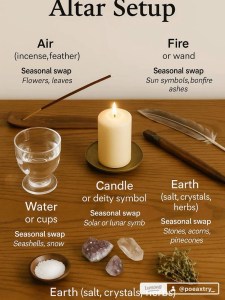
    Beginner & Advanced Usable Altar set-up with Seasonal changes

    Gumrode Free PDF Payhip Free PDF

    🖤 Find all my work across platforms — zines, ebooks, spellwork, and more:

    🔗 Links

  • Witchy 101: Altars, Divinity, and the Five-Fold Path Explained

    Witchy 101: Altars, Divinity, and the Five-Fold Path Explained

    Witchy 101: Altars, Divinity, and the Five-Fold Path
    This is for those who wander between flame and shadow. Their hands are outstretched to the unseen.

    Setting up altar

    typical components:


    Center:
    A cloth, plate, or board to work on

    Candles:
    Often one black (banishing) and one white (inviting)

    Representation of the elements:

    Earth:
    salt, crystal, soil

    Air:
    incense, feather

    Fire:
    candle, match


    Water:
    small bowl, shell

    Tools:
    Athame, wand, chalice, pentacle—optional and customizable

    Offerings:
    Food, herbs, water, flowers, written words


    Divine symbols:
    If you work with deities, include items that honor them

    Refresh the altar often.

    Dust, change it seasonally, and remove anything no longer aligned with your path.

    Think of it as a reflection of your current inner world.

    Deity Work vs Secular Craft


    You don’t need to believe in or work with deities to be a witch.


    Secular witches use energy, intuition, and intention without involving gods or spirits. They often work with the elements, the moon, and their own power.


    Devotional witches may connect to deities, ancestors, or spirits. They may perform rituals, offer devotions, or allow the divine to guide their spell work.
    Neither path is more powerful. Neither is more “right.” What matters is your truth, your comfort, your belief.

    If you do feel called to deity work:

    Study myths, signs, symbols.
    Watch for recurring dreams or synchronicities.
    Start small light a candle, offer a glass of water, write a prayer
    Consent matters.
    You can always say no, even to a God.


    Popular Deities in Witchcraft & Pagan Practice:

    Hecate (Greek):
    Goddess of witchcraft, crossroads, ghosts, and moonlight.

    Brigid (Celtic):
    Goddess of healing, poetry, and the forge.

    The Morrigan (Celtic):
    Goddess of war, fate, sovereignty, and prophecy.

    Freya (Norse):
    Goddess of love, beauty, war, and seidr magic.

    Lilith (varied):
    Symbol of independence and shadow work.

    Cernunnos (Celtic):
    Horned God of the wild and balance.

    Isis (Egyptian):
    Goddess of magic, healing, and sacred knowledge.

    Pan (Greek):
    God of nature, instinct, and chaos.

    Diana/Artemis (Roman/Greek):
    Moon goddess and protector of the wild.

    Bastet (Egyptian):
    Guardian of the home, joy, and cats.

    Choose a deity (or pantheon) that aligns with your values and needs. You don’t have to rush. Some deities find you. Others grow on you slowly, like ivy around a stone wall.

    Elemental Magic: Earth, Air, Fire, Water, Spirit


    The five elements form the bones of many magical systems:

    Earth: stability, growth, grounding. Use stones, herbs, salt.


    Air: clarity, thought, communication. Use feathers, incense, wind.


    Fire: passion, change, action. Use candles, ash, sunlight.


    Water: emotion, healing, intuition. Use bowls, moon water, rain.


    Spirit (Aether): the soul, the thread between all things. Represented by breath, the self, or a fifth point on a pentacle.

    To work with them:

    Call them in during ritual. Leave them offerings. Meditate on their qualities. Use their correspondences in spell work. When you build relationships with the elements, they’ll appear more frequently in your dreams. You’ll notice them in the weather and even in your gut instincts.
    Offer them things. Reflect on their qualities. Incorporate their correspondences into your spell work. Build relationships with the elements gradually. As you do, you’ll see them more. They will appear in dreams, in weather, and even in your gut instinct.


    Links Portfolio