Tag: minorities

  • When History Repeats: The New Attack on Rights and Justice in America

    When History Repeats: The New Attack on Rights and Justice in America

    What historical event fascinates you the most?

    History as Mirror

    We often think of major historical tragedies… such as the transatlantic slave trade, the treatment of people of color during and after the civil-rights movement in the United States, or the Holocaust, as distant. Important. Horrific. But past. What is less comfortable: the patterns they formed still echo today. And we may be witnessing a new chapter of systemic threat. But this time, not abroad or in previous years , but in our own country right fucking now.

    From Slavery to Civil Rights

    The oppression of not white Americans through slavery and the trail of tears (and many other horrible historical events) created generational trauma, economic disparity, and social exclusion. The civil-rights era sought to dismantle legalized segregation and voter disenfranchisement. These struggles were about identity, dignity, belonging, equality of rights. Americans rightly look back and say: “Never again.”

    But “never again” only works if we recognise the signs when they return. Never again only works if we are not continually doing the same damn shit just in other ways.

    The New Frontline: Rights Under Fire

    Transgender Passports & Identity Documentation

    In early 2025, the Donald Trump administration issued Executive Order 14168 titled Defending Women From Gender Ideology Extremism and Restoring Biological Truth to the Federal Government. The order declared that federal documents must align with “biological sex at birth.” 

    As a result, the U.S. Department of State suspended changes to gender markers on passports and revoked the “X” gender designation option for many applicants. Which affects many people who aren’t trans but are intersex and left to figure it out.

    Legal action followed. A federal judge blocked parts of the policy that prevented transgender and non-binary Americans from obtaining accurate passports, recognising the policy was likely unconstitutional. 

    But the damage is real. People have been forced to use documents that mis-mark their gender, creating risk and exposing identity. In other words: state-sanctioned mis-identity.

    SNAP Cuts and Food Insecurity

    Around 42 million Americans rely on the Supplemental Nutrition Assistance Program (SNAP) for basic food security.  The government shutdown and refusal to allocate contingency funds means SNAP payments risk being withheld starting November 1, 2025. 

    When we compare this to historical deprivation of rights and access, for example: poll taxes or economic exclusion of minorities, the parallel is stark. Denial of sustenance is denial of dignity. Most Snap recipients are your friends, the workers, the disabled, and the elderly. As well as the children the party that is causing this is so quick to claim they care about.

    Deployment of Troops and Erosion of Checks & Balances

    In 2025 the Trump administration has explicitly floated deploying the Army, Navy, Air Force and Marines into U.S. cities, bypassing traditional guard & civilian limitations. 

    Cities led by Democratic governments have seen National Guard troops deployed despite objections from local authorities. For example, Washington D.C., Los Angeles, Portland, and even West Virginia?

    Legally this raises questions of federal overreach, the Posse Comitatus Act, and state sovereignty. When the military becomes an instrument of domestic policy without proper checks, the separation of powers erodes.

    Moreover, framing transgender people, activists, or political opponents as domestic “threats” or “Antifa” emboldens the machinery of suppression, another echo from historical oppression.

    Why This Matters

    When identity is controlled (who you can say you are, what documents you carry), then belonging becomes conditional. When access to sustenance (food stamps) can be politically withheld, then the social contract falters. When the military is repurposed to internal enforcement without clear guardrails, then the rule of law and democratic accountability are at risk. When these issues disproportionately target minorities: trans people, racialised communities, the poor, it reflects the same structures that enabled slavery, Jim Crow, Nazi bureaucracy.

    Who’s Affected

    Transgender and non-binary people facing documentation that erases or mis-represents them, as well as intersex people. Low-income families reliant on SNAP who may lose assistance, elderly, working class Americans, and people with disabilities. Not to mention the cut local economy will face without snap being pumped back into it. Communities in states where federal troops may intervene despite local governance. Allies and minority voices who stand for change, inclusivity, and equity.

    What We Can Do

    Raise awareness: Highlight these issues in your networks, your blog, your community. Support legal advocacy organisations: American Civil Liberties Union (ACLU), Lambda Legal, etc. Document personal stories and amplify minority voices who are most impacted. Push for structural policies: Transparent oversight on troop deployments, secure funding for social programs, identity-affirming documentation rights. Build inclusive publishing forum to centre voices that are excluded, silenced, or under-represented.and most importantly create community and help one another when you can!

    Don’t Be Silent

    The historical parallels are evident. This is not hyperbole, it’s reality. And if we don’t write it, publish it, challenge it, then we risk letting history’s darkest chapters repeat. Use your voice. Raise the spark. Let every word matter. What side of history will you look back and be able to say you were on.

    Because when the lines blur between democracy and dictatorship, when troops march where civilians should walk… we have to ask… where is fucking NATO?

    Links. Portfolio. Poem.

  • Poeaxtry Expands Online: New Twitch Channel & Revolt server

    Poeaxtry Expands Online: New Twitch Channel & Revolt server

    Join Us Live on Twitch

    Big news: Poeaxtry is now streaming live! Tune into our Twitch channel for poetry readings, creative collabs, and behind-the-scenes looks at our indie publishing and witchy projects. Maybe some rock slicing jam sessions? Who knows I Just set it up last night… FINALLY! So come check it out: twitch!

    Expect live Q&As, community spotlights, and surprises along the way.

    Poeaxtry Revolt – Your Creative Community Hub

    REVOLT:

    If you haven’t heard Poeaxtry’s Poetry Prism discord got a twin server. Where you ask? We joined the Revolt app, now felt like the perfect time. Our creative community is growing with discussion spaces for poets, artists, and writers of all kinds. Join here.

    Whether you’re here for poetry, art, or just to meet like-minded creators, there’s a spot for you.

    Connect and EngageFollow, join, or just watch! Let’s bringing all corners of Poeaxtry together online. Stay tuned for streams, events, and community-driven projects highlighting voices that need to be heard.

    Poeaxtry’s Links

    Poem nature

  • Joyful Actions That Promote Change

    Joyful Actions That Promote Change

    Creating meaningful change can feel overwhelming if you’re not sure where to start, but it doesn’t have to be. Change is built through consistent, joyful actions. These are small steps that add up to a bigger impact over time. In this guide, you’ll learn ways to make a difference weekly, monthly, and bimonthly. Each action is explained with practical examples, so no matter your experience or resources, you can start contributing immediately. At the end, you can download 3 full checklists and a bonus checklist for easy reference.

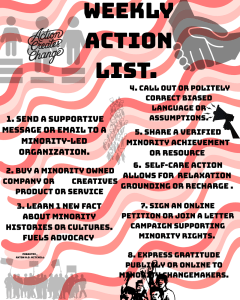
    One of the easiest ways to begin creating an impact is by taking small, weekly actions that are actionable and meaningful. We also added joy to the mix to give a reward to ourselves for becoming the change. For instance, sending a supportive message or email to a minority-led organization might seem simple, but it can make a real difference. Even a brief note like “Hi, I just wanted to thank you for your work; it inspires me…” can boost morale and let these organizations know that their efforts are seen and appreciated.

    Using or purchasing from minority-owned businesses is another small but powerful action. By intentionally supporting products or services from these businesses, you’re directly contributing to economic empowerment. You can find minority-owned businesses through directories like Buy Black, Official Black Wall Street, or even local listings. Even one small purchase counts.

    Learning one new fact about minority histories or cultures each week expands your understanding and counters misinformation. Things like reading an article, watching a short video, or listening to a podcast, then sharing what you learned with a friend. Over time, these small learnings compound into a deeper awareness that influences your daily choices and conversations.

    Calling out or politely correcting biased language or assumptions is another way to take weekly action. It doesn’t need to be confrontational; calmly explaining why a comment is harmful helps educate those around you and encourages accountability. Similarly, sharing a verified minority achievement or resource with someone… like a news story, a blog post, or a social media feature can help amplify important voices and keep these accomplishments visible.

    Self-care also counts as an action. Taking time for yourself by going for a hike, cooking a favorite meal, doing a face mask, getting your nails done, reading a book, or listening to uplifting music can keep you grounded and energized for advocacy. You simply signing an online petition or joining a letter campaign are other ways to use your voice and influence policy. Finally, expressing gratitude publicly or privately to minority changemakers reinforces positive recognition and strengthens community bonds.

    Monthly actions give you a chance to take slightly bigger steps that still fit within a manageable schedule. Participating in a virtual or local minority-supporting event, like a webinar, a virtual or local open mic, a lecture, or a cultural celebration. These expose you to new perspectives and help you connect with the work being done. Things like trying one new minority cultural experience: cooking a traditional dish, exploring music, or viewing art, can be a joyful way to learn and share culture, either with friends or online communities.

    Self-paced online workshops on allyship or cultural understanding are perfect for deeper learning. You can take them on your own schedule, allowing you to reflect and use what you learn at your own pace. Volunteering remotely for advocacy or awareness tasks, such as moderating online discussions, sharing resources, or helping campaigns These let you contribute meaningfully without needing to attend in person.

    By documenting and celebrating a minority achievements by writing a short post, vlogging, or highlighting someone on social media. You spread positivity and recognition. Sending letters or emails to officials advocating for inclusive policies is another actionable step, giving your voice weight in shaping decisions. When you highlight a minority-owned business or creator in your network it increases visibility and supports economic empowerment. Lastly, reflecting on and sharing a story or resource related to minority rights, even in casual conversation or online posts, expands understanding and encourages others to engage.

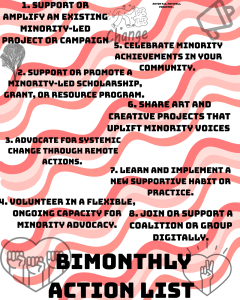
    Bi-monthly actions involve taking on larger, more flexible commitments that can still be done by anyone. Supporting or amplifying existing minority-led projects or campaigns is one way to have a broader impact. This could mean sharing updates online, signing up for notifications, or contributing in small ways. Promoting scholarship, grant, or resource programs created by minority leaders, expands opportunities for others and can be done digitally.

    When you advocate for systemic change through remote actions, like policy emails or participating in online, you allow anyone a voice in shaping outcomes. Volunteering flexibly for advocacy by things like resource sharing, digital organization, or communications allows you to make an impact when you can. Celebrating minority achievements in your community, either publicly or online, reinforces visibility and encouragement.

    If you can create optional joyful projects to amplify minority voices you have another avenue. You can contribute creatively, write, draw, record, or otherwise produce something meaningful. Implementing a new supportive habit, like sharing resources, mentoring via email, or spotlighting stories, builds consistent impact. Finally, joining or supporting digital coalitions or advocacy groups allows participation in campaigns, discussions, and advocacy initiatives. This connects you to larger networks.

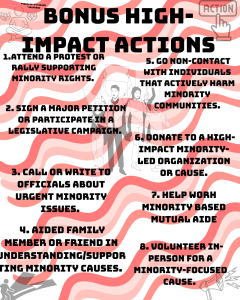
    Occasionally, you might want to take on high-impact actions. This could be going to a protest or rally, signing major petitions, or participating in legislative campaigns. These give your voice significant weight. You may want to call or write officials about urgent minority issues which directly engages policy influence. You may help a family member or friend understand and support minority causes or spread awareness in your immediate community. You may decide to go no-contact with harmful individuals or companies, donate to high-impact minority-led organizations, organize awareness events, or volunteer in person. These all can be transformative actions, and are optional but powerful ways to amplify your impact.

    Change is built through consistent, joyful actions that anyone can take. By following this guide, incorporating weekly, monthly, and bi-monthly steps, and exploring the Bonus Round opportunities, you can make a meaningful difference in supporting minority communities. Start small, celebrate progress, and remember that your actions whether big or small all add up.

    Below are the checklist images to view you can download them for free from my gumroad and Payhip as well.

    Links

    Weekly action list
    Weekly action list
    Monthly action list
    Monthly action list
    Bi monthly action list
    Bimonthly action list
    Bonus actions list
    Bonus actions
  • Daily writing prompt: My Legacy 🖊️

    Daily writing prompt: My Legacy 🖊️

    What is the legacy you want to leave behind?

    When I think about legacy, I don’t picture wealth or status, I envision of a shelf. A tall, dusty shelf sits in some quiet room, decades from now. It is lined with books that echo voices. These are the voices that were once silenced. I want my poetry to outlive me. This is not just for the sake of art. It is for the sake of those who have felt or will feel invisible. My legacy will be one of poetic excellence, but also one of resistance, resilience, and raw truth.

    Words like Lanterns

    I want to be remembered as someone who used his words like lanterns. I aim to light paths for trans and queer youth. They need to see themselves clearly in a world that often erases them. I want to leave behind a body of work that makes people feel braver, more seen, and more whole. My legacy will focus on collaboration in publishing.

    I aim to publish not only my own books. I also lift others’ voices in shared collections. These collections challenge injustice and document our collective truths. I will also start a publishing company. Its primary focus will be on publishing the work of those who are most vulnerable. These individuals are often most likely to be ignored.

    Restless Care

    Above all, I want my legacy to be one of relentless care. I care for the underdog, for the misrepresented, and for those living in the margins. I want my words and projects to remind future generations that their stories matter. Once upon a time, someone fought like hell to make sure they’d be heard.

    Axton is the Change!

    Just in case this was a thing you didn’t pick up on. I don’t want to be remembered as someone who simply talked about the need for change. I want to be remembered as someone who was the change. Someone whose voice didn’t just echo in empty halls. It moved through communities, laws, and generations. This helped to carve out a freer world for minorities. A world where they are no longer just fighting to be heard, but living loudly, boldly, and without shame.


    links portfolio
    Poetizer